Archive for the ‘Art’ Category
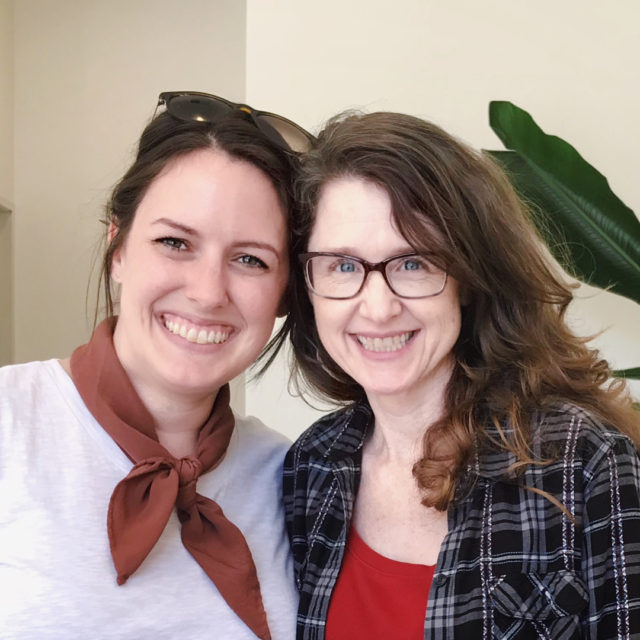
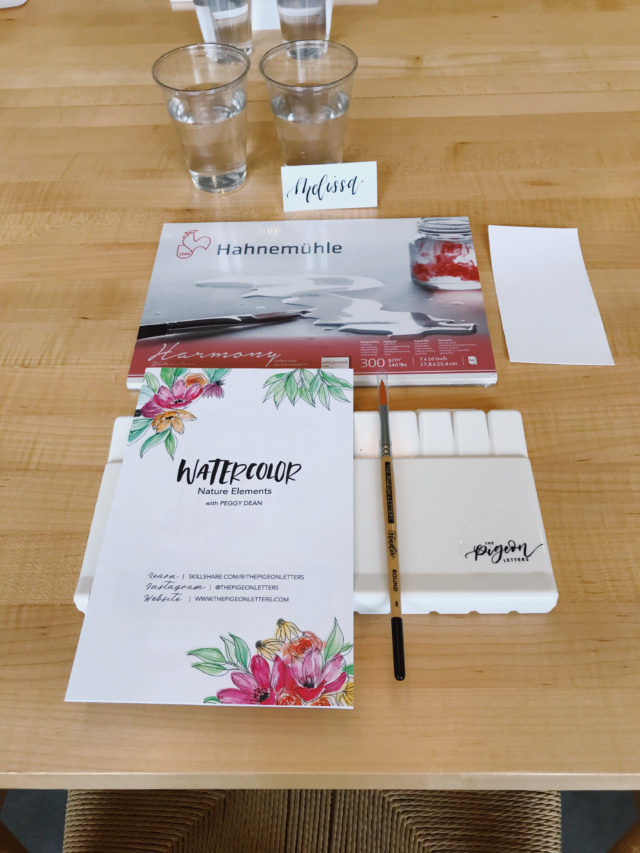
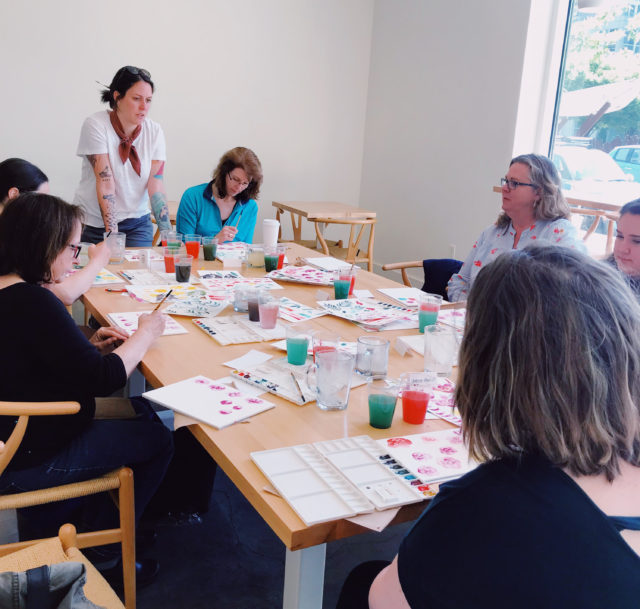
So here’s a fun thing: I got to take a watercolor class last Saturday. If Peggy Dean offers a workshop in your town, jump at the chance to take it! Three hours passed in a flash as we learned watercolor techniques for leaves and loose florals. Such a blast. And the paints she sent us home with—more swoon. Plus one of her cruelty-free, eco-conscious brushes. We laughed and painted and learned cool stuff (with a brief, blissful interruption to take turns petting the ADORABLE King Charles spaniel puppy who appeared in the tea shop with his very accommodating owner). Peggy’s teaching style is A+++ and I had a wonderful time sharing everything I learned with Rilla at our Saturday Night Art Date afterward.
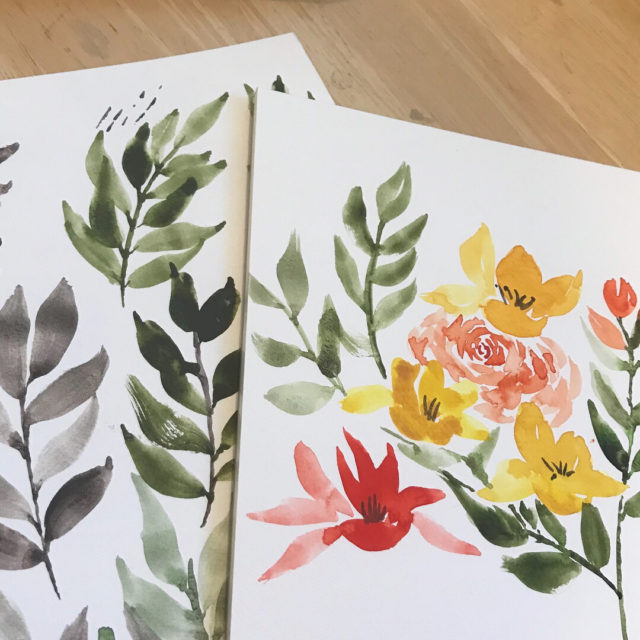
If you can’t get to a workshop, Peggy’s Skillshare classes are also excellent (Rilla and I have taken several) and you’ve heard me praise her Botanical Line Drawing book many times before. I’m glad I’m a homeschooler because I can decree next week to be take-all-the-rest-of-Peggy’s-classes week if I feel like it. If you’re new to Skillshare, you can get two free months of unlimited classes. (Also highly recommended: Stephanie Kilgast’s Sculpey classes.)
Thank you Peggy for a fabulous workshop! I’m still swooning over that hematite violet. 😍
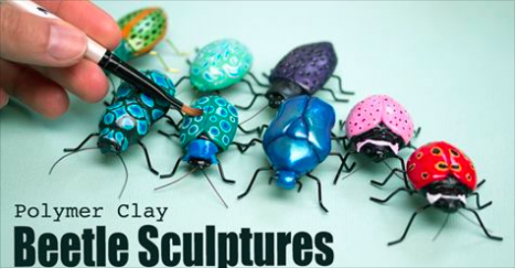
Image via Skillshare
Rilla’s pick for our Saturday night art date: “How to Sculpt Beetles, Bugs and Scarabs Realistically” class at Skillshare. Delightful course. Really enjoyed the instructor, Stephanie Kilgast—her lessons are clear, simple, and inspiring. Rilla’s take was: “OH GOOD, this is exactly what I’ve been needing to learn.” (Her two chief interests in life are bugs and art. She wants to become an entomologist-slash-artist.)
My house is about to be overrun with Sculpey beetles, I can tell.
(Referral code for two months’ free trial: http://skl.sh/2GogjAi )
December 16, 2016 @ 5:15 pm | Filed under:
Art 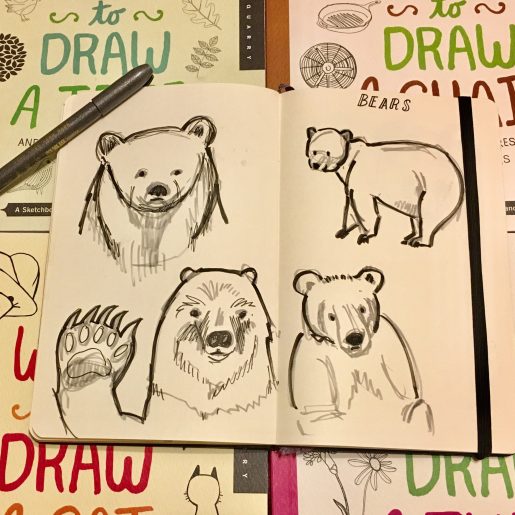
In a comment on yesterday’s “inside my pen case” post, Hanni wrote:
I have loved watching your journey of learning to sketch and draw. I want to start myself but I’m nervous. Have you always been a person who doodled etc? Or did it start when you made it a goal to sketch everyday? Seeing if there is hope for a person like me who has never done it naturally but has always been inspired by others.
I answered with a long reply, which I’ve decided to pull into its own post here. Tl:dr version: If I can do it, anyone can.
Hanni, start, start!!! I wasn’t a doodler before…I used to try to draw as a kid and was always so frustrated by my inability to make anything look the way I wanted it to. In college I took a costume design course that included a brief unit on Drawing on the Right Side of the Brain. That book blew me away. And in doing those exercises in class, I was astonished at how much better I got, and how rapidly. But then I dropped it again…for over 20 years.
I started this daily practice with Lisa Congdon’s line drawing class at Creativebug in fall 2014. From there I jumped to Sketchbook Skool and was really inspired and energized by those classes. Or—I guess actually I started with a Creativebug class on art journaling with Dawn DeVries Sokol* before the Congdon line drawing class, and I liked that one but found that what I really wanted was to learn to draw (vs art journaling which I always admire when I see other people’s but don’t seem drawn to in my own practice).
Since then, Creativebug has added SO MANY great drawing classes (all for your $5/mo subscription). I especially like the ones that are Daily Drawing Challenges because they walk you through how to draw specific things. (I’m currently obsessed with spatulas. Don’t ask me why. Just something really satisfying about that shape, LOL.)
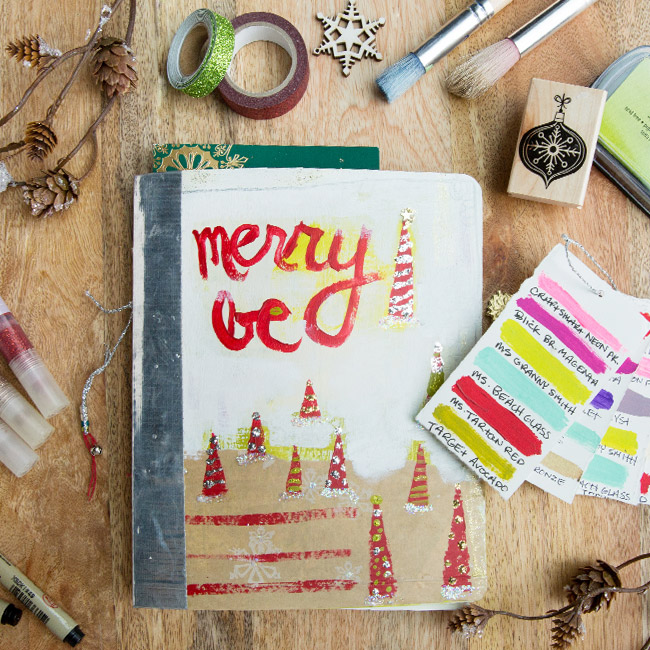
*Dawn Sokol has a new Holiday Art Journaling class at Creativebug that Rilla and I will be checking out on our next art date, because art journals are absolutely my daughter’s cup of tea. (Affiliate link.)
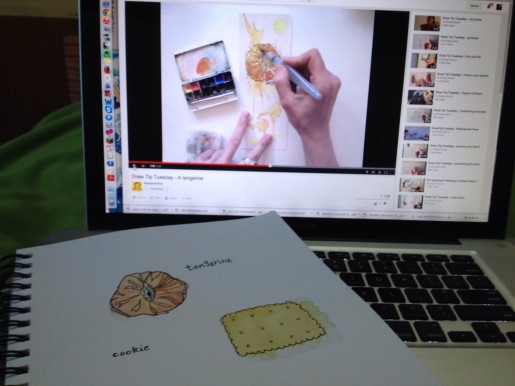
For dipping your toes in without spending money, I would recommend trying out some of Koosje Koene’s free “Draw Tip Tuesday” videos on Youtube. So good and totally doable. Search YT for them and then maybe scroll back to some earlier ones and work forward. You’ll see that a lot of the stuff in my sketchbook comes from Koosje’s lessons.
Other good online instructors are:
Jane LaFazio, Liz Steel, and Roz Stendahl. I encountered them all via Sketchbook Skool first. Then Jane came to San Diego for a one-day workshop version of the nature journaling/watercoloring class she offers online, so I signed up for that. And oh my! So awesome. Here’s a post with some photos of the work I did in that class.
Liz and Roz are both gifted instructors. Their online classes are video-based and include extremely detailed PDF handouts to download.
Backing up to your question: Honestly, I don’t have natural drawing talent. I think in words, not pictures, and I can’t just sit down and draw something out of my head and have the angles and shapes look right. I’m frustrated a LOT of the time by my shortcomings. But natural drawing talent isn’t required to be able to *learn* to draw. If you can sign your name, you can already make all the basic shapes that every single drawing is composed of. That was one of the Drawing on the Right Side of the Brain revelations that floored me, way back when. Anyone can learn.
Danny Gregory (the other co-founder of Sketchbook Skool along with Koosje) makes a distinction between small-a art (which we can all make) and capital-A Art (you know, museum stuff). 😉 I’m not striving for Art, just art. My sketchbook journey has made me really happy. About every ten pages I draw something I actually like. 🙂 And you know what, for now that’s plenty. I usually mess up the page with something else, but sketching is something I do that truly is about process, not product. The pens and paints feel so good in my hand. Mark-making, color-swirling—it’s incredibly satisfying.
And I like having this thing I do that is purely about personal satisfaction. Writing is the Thing I have always done, the Thing that defines me—and because I’m good at it, it’s the Thing I do for a living. Which…puts you in a different relationship with the Thing. If that makes sense. Sketching owes me nothing, and I owe it nothing. No demands beyond the easy five-minutes-a-day minimum I impose upon myself. Most days, it’s much more than that, because once I get sucked in, I never want to start.
I often yearn for a better eye, a stronger and more original sense of artistic vision in my work (like the brilliant creative vision I see manifested in the work of the sketchbook artists I admire on Instagram), and as I said I get plenty frustrated with my fumbling, my un-originality. But that’s all before and after the fact. DURING, when the pen is in my hand, all of that drops away and I experience the pure, absorbed joy of mark-making. That’s what keeps me at it, not a sense of progress (although when I look back, I can see that I have improved).
I hope you’ll dive in! Let me know if you wind up taking any classes…
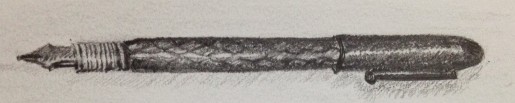
A last thought. When I began taking online classes, I found that many instructors speak very strongly against sketching in pencil, on the grounds that it makes beginners too fussy, too prone to erase. I will say that while I understand that thinking (and do a fair amount of sketching directly in ink myself, because I’m addicted to pens), for me that advice was a misdirect. I spent about eighteen months obediently eschewing pencil before I had a light bulb moment of: oh wait, I love how pencil feels going on the page. And boom, just like that, things opened wide. I love pencil sketching and then putting ink over it. That suits me really well. Diminished a lot of my frustration over ‘ruining’ things because it takes me a few tries to get the shape right. And I just plain like the texture! It’s funny that with everything else in life (homeschooling, ahem) my entire approach is: take what works and do my own thing with it, but with drawing I was quite cowed by authority at first.
I’ll close with some books Rilla and I have enjoyed working from, these past two years. When I’m stumped for material, I pull out one of them and tackle a page.
20 Ways to Draw a Tulip and 44 Other Fabulous Flowers
20 Ways to Draw a Cat and 44 Other Awesome Animals
20 Ways to Draw a Tree and 44 Other Nifty Things from Nature
20 Ways to Draw a Chair and 44 Other Interesting Everyday Things
Illustration School: Let’s Draw Cute Animals
Illustration School: Let’s Draw Happy People
Illustration School: Let’s Draw Plants and Small Creatures


Practical inspiration from Danny Gregory:
Art Before Breakfast: A Zillion Ways to be More Creative No Matter How Busy You Are
The Creative License: Giving Yourself Permission to Be the Artist You Truly Are


Rilla and I are looking forward to working through this book together: Draw Every Day, Draw Every Way (Guided Sketchbook): Sketch, Paint, and Doodle Through One Creative Year by Jennifer Orkin Lewis (AugustWren on Instagram—my fave!). This is one of those books you’re meant to and paint directly in, and I’m excited to think we’ll be creating a little archive for ourselves of our shared sketchbook journey. She’s been my staunch companion every step of the way, so far. Danny and Koosje and Roz are the superstars of Rilla’s world.


(Jennifer Lewis also offers a wonderful course on painting with gouache at Creativebug, as well as a Daily Painting Challenge. I’m making slow progress through both, because gouache takes a bit more planning for me than just reaching for my watercolor palette, but these are marvelous classes.)
Related posts:
• Daily Creativebug Challenge
• Drawing It Out (2005 post that, like this one, reminisces about that costume design class and the Edwards book, but then focuses on the how-to-draw books my older kids loved in those days. It’s funny to reread it now and see that despite its “anyone can learn to draw” message, I wasn’t striving in that direction at all myself. I talk about being able to draw a tree, a cartoon giraffe, and an alligator. That was the full extent of my doodling repertoire at the time and in this post, I don’t seem to express any intention to move beyond that. I’m sure it’s no coincidence that at the time it was written, I’d had four babies in ten years and was expecting a fifth.)
• Notebooks and sketchbooks and planners, oh my!
• 2015, Year of Paper
• Planner Love
• Notebookery
• Unearthed: the Notebooks
• Ten Ways to Cultivate a Family Art Habit
• My interview with Danny Gregory about raising creative kids
• Learning in Public
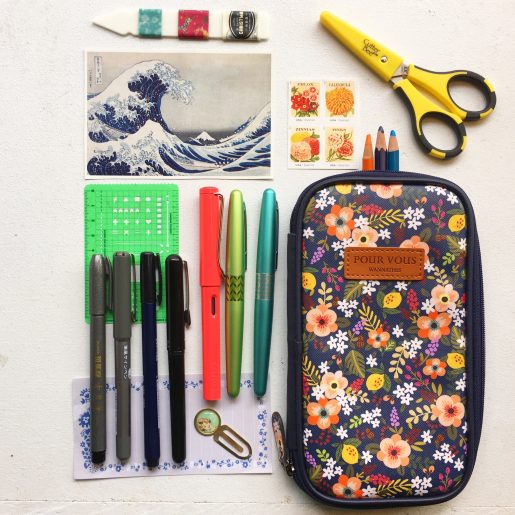
I put this on Instagram and decided to carry it over here in case anyone needs stocking stuffer ideas. 😉 The Amazon links are affiliate but not the JetPens links and the rest.
Everyday pen carry, deconstructed. Washi samples, a beloved Hokusai print I cut out of an old desk calendar, postage stamps, scissors. Hobonichi stencil, Galison notepad (last sheet, wah!), and a Reset Girl “planner honey” clip. I think the washi samples were a freebie included with an order from Etsy seller Cute Things From Japan.
Favorite drawing pens, left to right: Zebra brush pen, Kuretake brush pen in gray ink (my new love), Tombow blue body brush pen, hard tip (which I find myself reaching for more and more often—I like it better than the UniPin or Micron), Pentel Pocket Brush Pen (this one has been a total game-changer for me).
Favorite writing pens: Lamy Safari (pink), medium nib, blue-black ink. Pilot Metropolitan fountain pens, both medium nibs, one gray ink (I forget which, from a Goulet gray sampler), one my dream ink, Pilot Iroshizuku Shin-Kai, a deep navy blue.
I always carry a few Prismacolor pencils with me. Turquoise is essential to my well-being and then I always pack an orange, green, or ruby red/fuschia shade for contrast. I use these for sketching and fancy headers as well as for calling out key events in my planner, or coloring in my to-do boxes. And then I like to pack one or two Faber Castell watercolor pencils for easy planner/journal decoration. Deep blue is my favorite. (That link goes to a set of 36, with a price tag way beyond my art supply budget. I have exactly three colors of these pencils—blue, cranberry, and grape. They layer wonderfully.)
All of these inks and pigments are dreamy in my Hobonichi Cousin and Weeks planners, my Midori Travelers Notebook (I favor their 002 grid inserts), and on the flecked, recycled papers of the impossibly lovely Wild Simplicity Daybook inserts.
Floral pen case from MochiThings (I recommend watching for their sales because otherwise they’re pricey). I carry my tiny watercolor palette and waterbrushes in a separate pouch, but they fit in this case too if I leave a few pens home.
For the papery side of things—see these posts:
Planner Love
Notebooks and Sketchbooks and Planners, Oh My
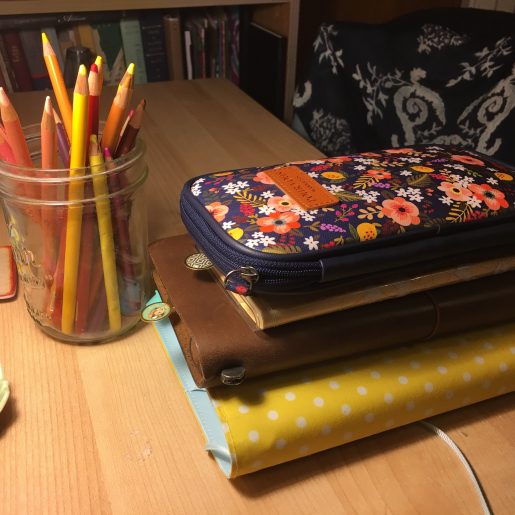
Full disclosure: in this post, I’m going to rave about Creativebug. The links are affiliate links, which means if you use them to sign up for a subscription, I’ll get a small commission. This is not, however, a sponsored post—I have not been paid to write it. I’m speaking out of my personal experience with the excellent classes offered by Creativebug. At the bottom, I’ll put an affiliate banner ad that will give you a month’s free trial of the service.
I’ve posted about Creativebug many times before. Of all the online arts-and-crafts learning sites, Creativebug is the one I use most regularly. (But if you have questions about Skillshare, Big Picture Classes, Craftsy, or my beloved Sketchbook Skool, please feel free to ask. What I really need to do is post notes on all the classes I—or we, because Rilla and I spend a lot of time on these sites together—have taken. Okay. There’s another project to add to my list.) At $4.95/month, I consider Creativebug the best deal around: your subscription buys you unlimited access to the library of over 700 classes in knitting, crocheting, baking, cake decorating, sewing, paper crafts, decorating, painting, drawing, quilting, and jewelrymaking.
The Creativebug classes I enjoy the most are the Daily [drawing/painting/art journaling] Challenges. There’s a new challenge almost every month—but if the current month’s medium doesn’t speak to you, your subscription gives you access to all previous challenges and other classes. This month’s Daily Creativity Challenge is unique in that the 31 short lessons are taught by the behind-the-scenes members of the Creativebug staff, rather than a single artist. Unique, too, is the broader topic: instead of daily drawing or painting challenges, this topic list is an eclectic mix of activities such as: mail art, stenciled t-shirts, scarf tying, paper beads, hand turkeys (LOL), and even “iPhone app re-org,” which is tomorrow’s topic.
How I approach these daily challenge classes:
Do I keep up with every single day’s assignment? Oh heavens no. I’m a fits-and-starts kind of person. A creative binge-er. One might even describe my tendencies as, dare I say, tidal. Ahem. But for this very reason—the way my interest and commitment ebbs and flows—I appreciate the daily-challenge framework. The recurring ping of a new lesson helps bring me back to a creative practice when my attention has wandered. Sure, I might wind up doing a whole week’s worth of drawing challenges in one go—that’s quite all right. In fact, that’s a pretty common way for Rilla and me to spend our Saturday night art dates. The daily videos are short, just a few minutes each. We can work through several in an hour, filling a page or two in our sketchbooks.
To share or not to share:
A lot of participants post each day’s work on social media, especially on Instagram, where there is a lively, supportive community of artsy folks. I share my own work…not very often. I’m pretty shy about it, to be honest. And it’s much better for me to work under the assumption that no one will see my artwork except me (and Rilla)—or else I’ll feel inhibited and perfectionist. But when I draw something I actually like, I sometimes post it.
 Creativebug daily challenge classes I have taken and thoroughly enjoyed:
30 Things to Paint with August Wren ***SUCH A GREAT CLASS! Jennifer Orkin Lewis, aka August Wren, is wonderful.
31 Art Journal Prompts with Dawn DeVries Sokol
31 Things to Draw with Pam Garrison
29 Things to Draw with Molly Hatch and Heather Ross
31 Things to Draw with Lisa Congdon
I’ve (we’ve) taken a lot of other Creativebug classes besides the daily drawing challenges, but I’m tired of pasting in links. 🙂 However, I will say that the watercolor classes taught by Yao Cheng are entirely splendid. Rilla and I have spent many a Saturday night absorbed in Yao’s assignments. Oh, and I quite enjoyed Flora Bowley’s “Intuitive Painting” class, which focused on acrylic paints.
This new Daily Creativity Challenge promises to veer into some territory I’m not spending much time in these days (textiles, for example), but I’ll enjoy watching the videos nonetheless, and I look forward to the sparking of new ideas as we go. It’s all fodder.


• Earworms German (Rilla and Huck)
• U.S. Presidents song
• 7 times table practice
• Visited a neighbor (Rilla and Huck)
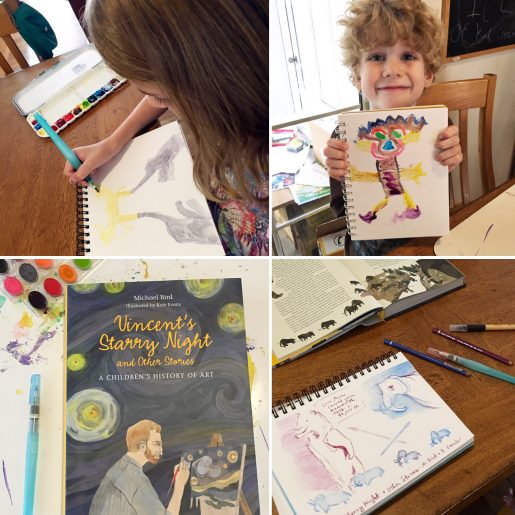
• Read “The Lion Man” chapter in Vincent’s Starry Night and Other Stories: A Children’s History of Art (Rilla and me)
• Scooter and walk (Huck and Rose)
• Did art journal pages inspired by the Lion Man chapter (Rilla, Huck, me)
• Listened to Mozart’s 40th symphony while painting
• Read Frederick by Lio Lionni because it tied in so nicely to the Lion Man text (Rilla, Huck, me)
• Beanie did a lot of her usual Beanie stuff—German, geometry, working on a paper for British lit, reading cool books, taking a Photoshop class, piano practice
• Falconry test prep: studied five questions (Rose, Beanie, me)
• Looked up taxonomy mnemonic (King Philip Came Over For Good Soup)(Rose, Beanie, me)
• Boisterous game involving all Mom and Dad’s pillows (Huck and Rilla)
• Read-aloud: two chapters of A Lion to Guard Us (Rilla, Huck, me)
And then it was time for lunch. 🙂

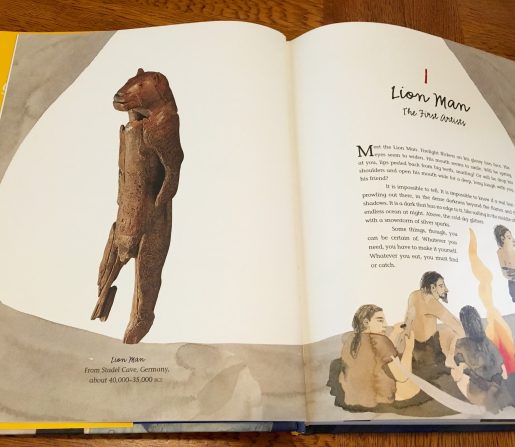
 The art history book landed on our doorstep as an unexpected review copy from Laurence King Publishing—and in a flash Rilla and I had a new history plan for the year. This book was love at first sight for both of us. Of course, it’s early days yet; as you can see above, so far we’ve only read the first chapter. So consider this a first impression, not a review. But I’m loving the format. The art prints and photos are augmented by gorgeous handpainted illustrations, and the text is engaging and fresh. We learned about the Lion Man carving (c. 40,000 BC!) in the context of the daily lives of Paleolithic hunter-gatherers. The depiction of the unknown artist laboring for hundreds of hours on the mammoth-tusk carving reminded me of Lio Lionni’s Frederick the Mouse soaking up sunrays, colors, and words while the other mice bustled to collect food, so of course we had to pull out Frederick afterward.
We decided to make pages in our sketchbooks inspired by the Lion Man. I copied the illustrations in the book; Rilla invented her own mammoth-and-lion scene. Huck painted a happy guy. 🙂 Rilla and I are hoping to fill our art journals with drawings based on our Vincent’s Starry Night readings through the year. I’ll try to post updates here if we stick with the plan.
Our current read-aloud is Clyde Robert Bulla’s chapter book A Lion to Guard Us, the adventures of three English children who travel to Jamestown after their mother’s death to reunite with their father there. Huck expresses less enthusiasm for this book than our last few readalouds—he expresses it, and yet every time I start reading (“You don’t have to listen, buddy, you can go play”) he gets sucked right in and has lots of commentary to add. We were amused to note the book’s similarity to our last readaloud (The Family Under the Bridge, which was a rousing success)—down-on-their-luck kids, big sister, middle brother, little sister.
Scott and I took Jane back to college over the weekend (sniffle), so summer is officially over in Chez Peterson. I’m more than a little freaked out by how deep into the month we are already. Too fast, y’all.
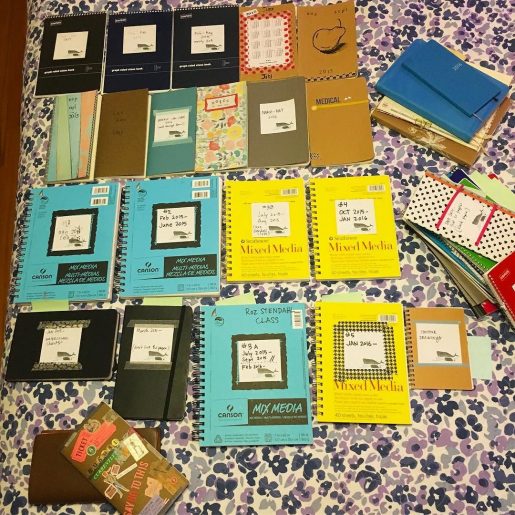
So this is not a great photo but the sight of all these books spread out on the bed delighted me. And also caused me not a small amount of chagrin—mainly that toppled stack of half-filled notebooks on the far right. This is the past two years in paper: August 2014-2016. I hadn’t realized how many sketchbooks I have filled since I started my daily drawing project two years ago this month!
The top two rows are my notebooks, about which I’ve written much in the past. They contain a hodgepodge of notes, task lists, doodles, and sketches. I used to always use small, lined spirals like the red one leaning against the stack on the right, but a couple of years ago I shifted to the black steno books up top because I like gridded paper better. Then I switched to Moleskine’s Cahier size with the kraft covers—and those are perfect little everyday scribble books, in my opinion. There are three completely filled ones in this photo (one has a gray cover, second row) plus the one I use for all our family medical notes. There’s another gray one in the only-partially-filled stack—I used about a third of it on sketches and notes at the Brave Writer Retreat last month.
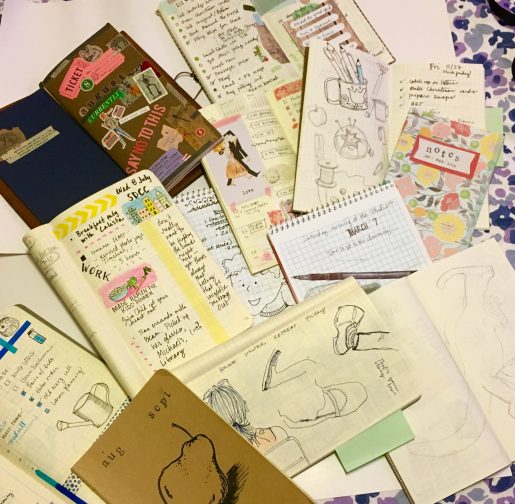
The four skinny books in row two are Midori Travelers Notebook inserts. When my pal Kristen gave me a Midori last fall, I abandoned the Moleskines (for the most part—I do grab them occasionally, as with the Bravewriter one). On the bottom left is my current Midori insert. I remain as fervently in love with my TN as ever, although I have scaled down the number and type of inserts I tote around in it. Right now I just have the gridded catch-all (collaged cover, pulled out of the cover for this photo) and a zipper pouch containing washi samples, stamps, and ephemera.
The lower two rows are my sketchbooks—although as I said, the notebooks are also crammed with drawings. In fact, I find I often prefer sketching on gridded notebook paper—I feel freer, less fussy, less concerned with getting things right. The stakes are somehow lower.
But I do love working on good sketchbook paper. The blue Canson Mixed Media books are probably my favorite type—I have learned that I prefer spiral bound sketchbooks, and I like paper with a little bit of tooth. The smaller yellow Strathmore books are also great. In fact, their paper quality is probably better and the smaller size is good for carrying around. I have completely filled two of each, and I’m working simultaneously in the ones on the bottom row. Not really any rhyme or reason to which one I pick up on a given day. Whatever’s closest to hand, usually.
The black Moleskine sketchbooks on the bottom left see a lot less use. The horizontal one contains watercolor paper and is quite lovely, but I mostly only use it for color charts. (A semi-obsession.) The vertical one is Moleskine’s standard sketchbook and it took me about twenty pages to realize I kind of hate the paper. Too smooth. I like texture and skritch. I was excited to discover I have a preference! It’s too bad, because I love the compactness of that book. It would be much easier to carry around than the Canson or Strathmore spirals.
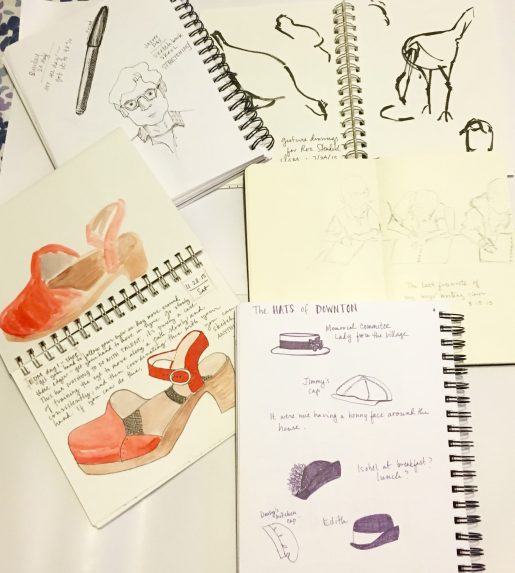
I’ve realized, though, that I don’t—at this stage, at least—do a lot of sketching or painting out in the world. When I do, it’s in one of my grid notebooks. I like the real sketchbooks for working at my desk, on my bed, or on the kitchen table. I have another big one with watercolor paper that isn’t in this photo. It doesn’t have much inside it just yet—mainly just the paintings I did at Jane LaFazio’s watercolor workshop last spring.
Middle right of the photo: my little stack of planners. Wild Simplicity Daybook, Hobonichi Cousin, Hobo Weeks. The Daybook is for homeschooling notes; the Cousin is my current bullet journal/daily calendar/scrapbook; the slender Weeks is my go-everywhere appointment book. I’ve done plenty of chattering about them before so I won’t elaborate here.
And then there’s the pile of Incompletes. I thrive on change, what can I say? Some of those books were begun for specific projects—many have to do with grants I worked on this past year. I’ll fill up the extra pages with sketches and doodles. Eventually.
Related:
2015, Year of Paper
Planner Love
Notebookery
Unearthed: the Notebooks
August 5, 2016 @ 4:00 pm | Filed under:
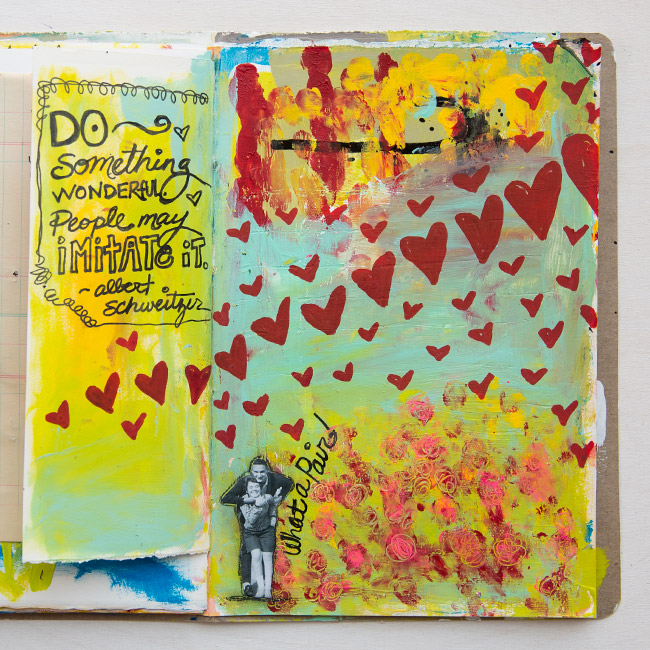
Art August Daily Drawing Challenge: 31 Art Journal Prompts with Dawn Sokol at CreativeBug. Dawn’s Art Journaling class was what kickstarted my daily sketching habit two years ago this month. (!) This “31 Prompts” is a new class that looks like a good time. A CreativeBug subscription is $4.95/month, which I think is a pretty great deal for the huge array of courses that gives you access to. Rilla, Beanie, and I manage to wring every penny and then some out of our subscription.
(Affiliate link, but I’m also a happy subscriber. I recently took and quite enjoyed Intuitive Painting with Flora Bowley. Other favorites are Creative Doodling with Pam Garrison, Daily Painting Challenge with Augustwren who happens to be one of my favorite Instagrammers, and anything taught by Lisa Congdon.)
***
Creative Lettering with Andrea Joseph at Sketchbook Skool. Andrea’s week in Sketchbook Skool’s Seeing “kourse” is one of my three favorite sets of lessons in the entire SBS lineup. I love, love, love her art and her mellow approach to teaching. And the way her sketchbook pages are an interplay of words and images is tremendously appealing to me. I also really resonated with a comment she made in one of her zines about how she has always had several “handwritings”—me too! Me too! I never could commit to a single style of R or F. So the idea of a whole course devoted to this subject has me pretty giddy, I must say.
(Not an affiliate—just a huge fan of Andrea Joseph and Sketchbook Skool!)
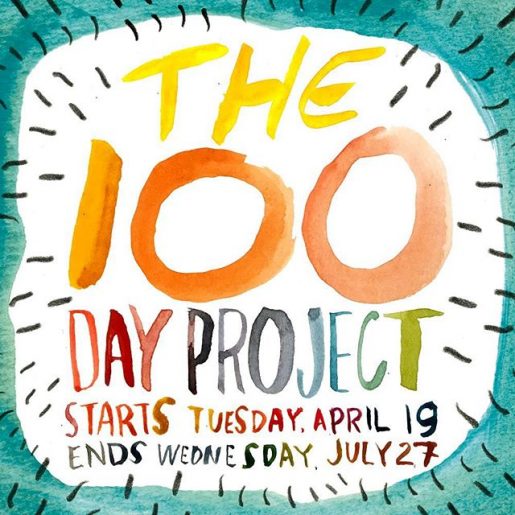
The 100 Day Project begins today. I’m wary of committing (even in a vague personal challenge kind of way) to any non-work or -family task that lasts a hundred days, but I love following this project on Instagram and found a way I can make it work for myself. As a way to help keep my daily sketchbook practice going strong, my ‘project’ will be to put color down on paper every day for a hundred days. Paint, colored pencil, fountain pen ink, collage…whatever medium I feel like on a given day will count.
To participate in the project, you share your daily efforts on Instagram with the hashtag (#the100dayproject). Now, will I manage to keep up with that part for a hundred days in a row? Not likely. I generally only feel like sharing a tiny fraction of what goes into my sketchbook. But that’s okay. The rules are malleable in voluntary internet challenges, right?
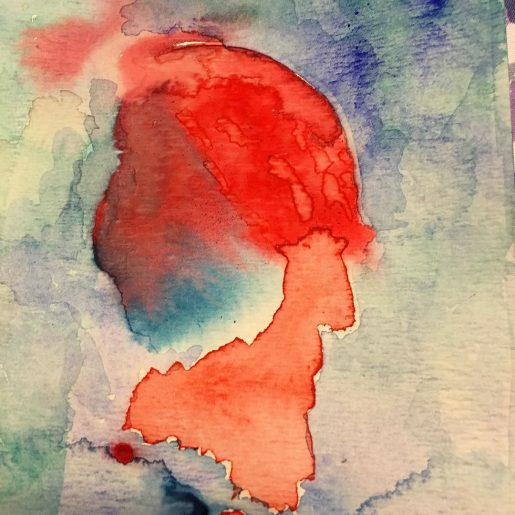
So today is Day 1. This morning I was showing Huck the delights of wet-on-wet watercolors and this little fish turned up of its own accord. At least, I see a fish. My IG friends see a man’s profile.
Don’t worry about diving into this late, if you’re of a mind to participate. Follow elleluna on Instagram for more info, or visit this post for particulars.