Archive for the ‘Nature Study’ Category
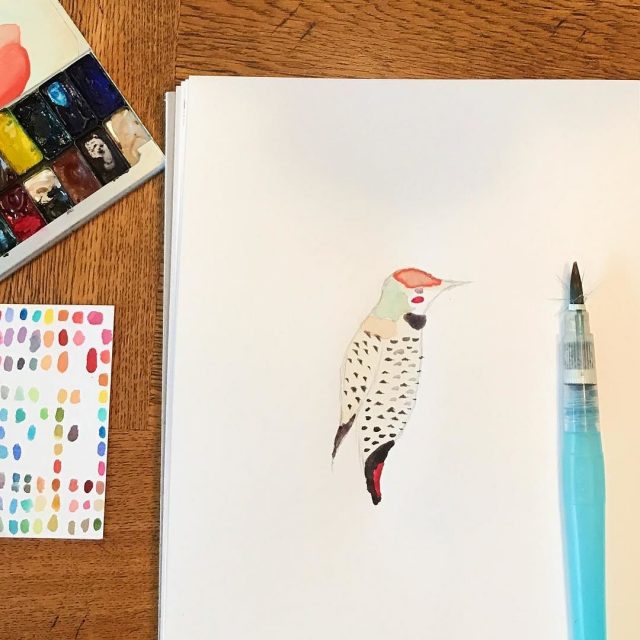
Northern flicker by Rilla, 2017
Would you like to hear this post read aloud? Allears has invited me to try their new voice recording studio for bloggers. I’d love to know what you think! (If the embedded audio player isn’t visible below this note, try this link.)

 Most mornings I’m still sipping my first cup of caffeine when Huck rolls in for a snuggle in my writing chair. He’s markedly up-tempo at that time of day, and I’m still dragging. One way I manage the discrepancy in our states of alertness is to reach for a book of poems, which he’ll dive into eagerly and read aloud while my brain catches up to his speed. The Everyman’s Library Pocket Poets Haiku volume is a favorite and usually sparks some sweet discussion about the trees, the sky, the rain.
Misty rain;
Today is a happy day,
Although Mt. Fuji is unseen.
—Basho
That’s a pretty good one for a January day in Portland. For us it’s Mt. Hood and Mt. St. Helens, the latter of which we can glimpse in parts of our neighborhood on very clear days. When we catch sight of Mt. Hood, we’re usually in the car. “The mountain is out today!” someone will exclaim. Or: a delighted gasp and a cry of “Super Death Mountain!” which is what Scott and the kids call our local volcanoes. Third winter here and volcanoes are still a novelty for my gang.
Once a week Huck and Rilla attend classes at a co-op near the science center. Rilla has a free hour that we’ve been spending at the museum, a pretty giddy experience for both of us. We want every single thing in the gift shop. We spend long, absorbed minutes trying to solve brainteasers in one of the exhibits. We look out at the gray river in the rain and make plans for walks along its bank in the spring.
After Rilla heads to her classes, I have a chunk of time on my own—still as much of a novelty for me as those glimpses of volcanoes! Often I’ll have a work date at a café with my friend Shannon. On days she can’t make it, I walk to a nearby ramen shop for lunch and then take my laptop to the riverside cafe at the science center. I could eat there, but I really love ramen. I love the unavoidable single-tasking of eating it. You have your chopsticks in one hand for the noodles and the big spoon in the other hand for the broth, and that’s it, that’s all you can do—just eat this meal. No screens, no books even—you’d splash drops of broth all over the page if you tried. I sit where I can look out at the winter streets and watch people hurry or mosey past, and I imagine what David Sedaris would write about them in his diary. What Ross Gay would notice. What Joan Didion would see. Later, if I remember, I write down what I saw.
Not often, though—by the time co-op is over and I’ve driven back home, my mind has rushed on to the next thing, the next thing. This week we stopped at the bird shop for suet cakes. A flock of bush tits, tiny gray-brown things, swoops to our feeder every day for a feast. A female Northern flicker visits daily, and sometimes the male. Or maybe he comes every day too and I just haven’t caught the moment. We get downy woodpeckers and three chickadees and an occasional nuthatch, and of course lots of goldfinches and house finches. A pair of pine siskins. One sweet little Bewick’s wren. And sometimes a hermit thrush or two strides under the bare bushes, flinging leaf litter left and right in search of insects.
Withered branch
where a crow has settled
autumn nightfall
Another haiku from Basho, who wrote of being “astonished at the voices of mountain streams and wild birds.” Astonishment, yes. Every day, the world astonishes me.
I’ve found it suits me better not to announce or necessarily even plan my occasional breaks from social media, but rather to let them happen organically and reflect on them afterward. This one wasn’t a total break, since I did post snippets to IG Stories almost daily, and I spent a little more time on Twitter than usual. (Which still isn’t much. I have to take Twitter in carefully timed microdoses these days.) But for two weeks, no Instagram grid posts, no captions, no FB, no Bonny Glen, and I put my Patreon on pause for the month of August.
None of this (except the Patreon pause) was planned; I was just busy elsewhere. WB had surgery at the end of July (went well, good recovery); Jane moved home from California around the same time. This weekend we celebrated Rose’s 21st birthday. (!) In between: work, long walks, a book or two, lots of embroidery. A small party where I found ‘my’ karaoke song (i.e. one I can nail). Or maybe that was before the surgery; late July and early August melted into each other.
I took Holly Wren Spaulding’s free mini poetry challenge this past week and welcomed her infusion of gentle insight into my morning creative practice, a practice which continues to be the most satisfying and nourishing gift I can give myself: this quiet, screen-free dawn hour, alone with a few good poems, a notebook, a fresh pen. I spent a lot of time with Kimiko Hahn this summer—Mosquito and Ant; Toxic Flora; Narrow Road to the Interior. Also a lot of Japanese haiku in translation. Huck wakes during the end of my writing time and staggers sleepily into my studio to snuggle into the gray armchair with me, tucked under our poppy blanket. We read poems and watch the sky change. Even when I’m tired, it’s delicious.
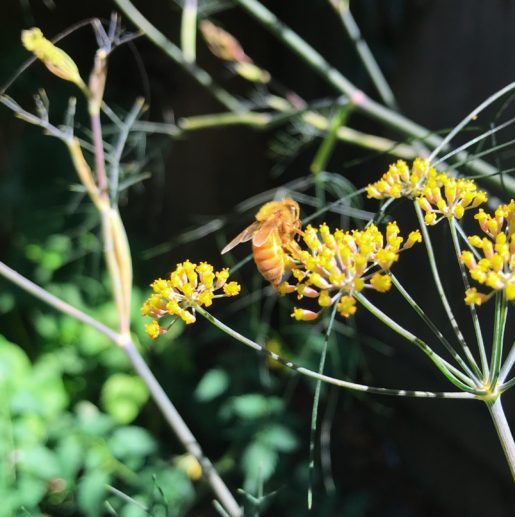
I also spent a lot of time in the garden, enjoying the late-summer lushness! Hummingbirds in the hyssop; bees industrious in the fennel and coneflower. A few tiny strawberries, a handful of cherry tomatoes. Asters spangling the porch wall with blue stars. A strange crow with a coppery head raiding the suet feeder each morning. My neighbor’s asparagus bed now a forest: airy green treetops festooned with apple-red berries. An abundance of small noticings. A necessary quiet.
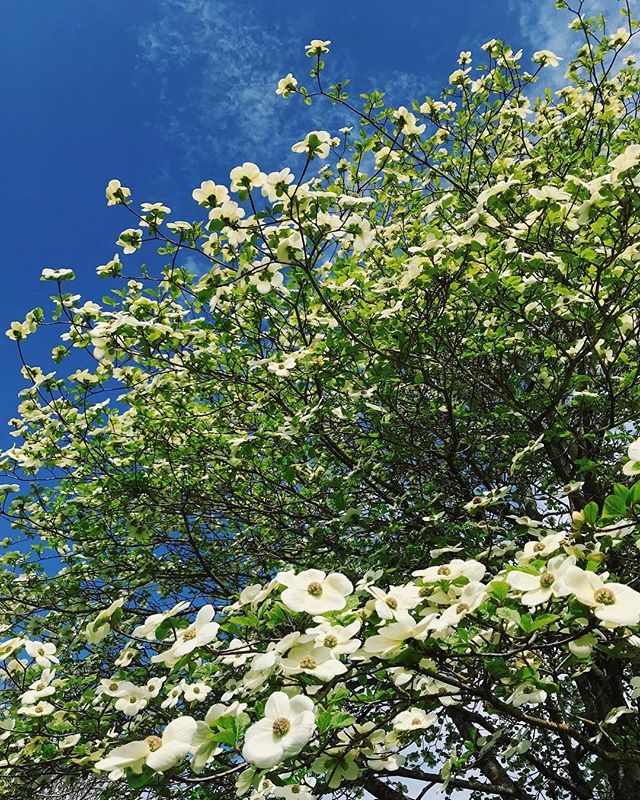
It’s Saturday morning and I’m lazing in bed, drinking cocoa and dipping lightly into social media, which I mostly ignored this week. Saturdays are the only mornings my alarm isn’t set for 5:45. I could sleep later on weekdays but my two boys get up around 6:45 and I really love having that quiet hour to read and write. I’m committed to the practice of poetry before screens, even if some days it’s a bit of a wrench to drag myself out of bed that early. This week was extra challenging because I take allergy medicine at bedtime, and its soporific effects last into the morning. Portland’s spring is spectacularly lovely but it also wants to kill me a little.
I could take the meds earlier but I’m equally time-greedy about my evenings. I try to use 7-9pm as another block for creative work, with a break in the middle to go tuck in my Huckleberry, for whom this is still an important ritual. (My last little kid, y’all…Rilla became a teenager this month. Can you believe it?) Then Scott and I watch an hour of TV, and then I read in bed for a while, where “read” means “hold my Kindle in front of unseeing eyes until Scott gently removes it from my hand.” Often I turn on the Kindle next morning to discover I highlighted random phrases as I dozed off, like:
tics. The simple action of sweeping
Or:
Norman was unaffected by her because
Uh, super helpful there, sleepy Lissa.
I learned last summer that as our Pacific Northwest evenings lengthen, I won’t be able to resist that magical golden-hour light, so the 7-9pm time block for creative work will give way to long walks, and I’ll have to find other ways to create room for playing with color and words. Of course in a way my whole day revolves around those activities: reading to and chatting with the kids, doing art projects together, working on various writing projects in the afternoons. But I’ve learned I need to give myself chunks of time for creative play that has no end-purpose—no deadlines, no expectations to meet. Lately I’ve been enjoying drawing houseplants—on index cards, mostly, because that’s the ultimate low-pressure canvas—or doing Procreate tutorials on the iPad. (I’m trying to catch up to Rilla and Beanie. Their Procreate skills far surpass mine.)
Not that I have any wish to hurry spring along! I could linger here for another three or four months. My bitterroot is just beginning to bloom, and the dogwoods are in full glory. I remember last May as a month full of swoons—the light, mostly, that miraculous glow illuminating the clouds every evening, turning the air blue and gold.
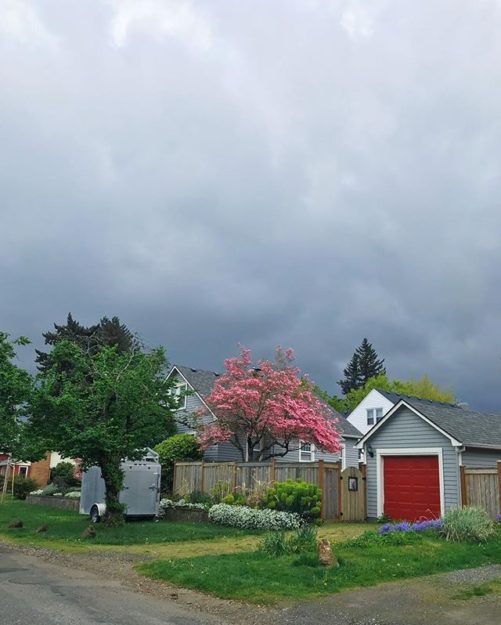
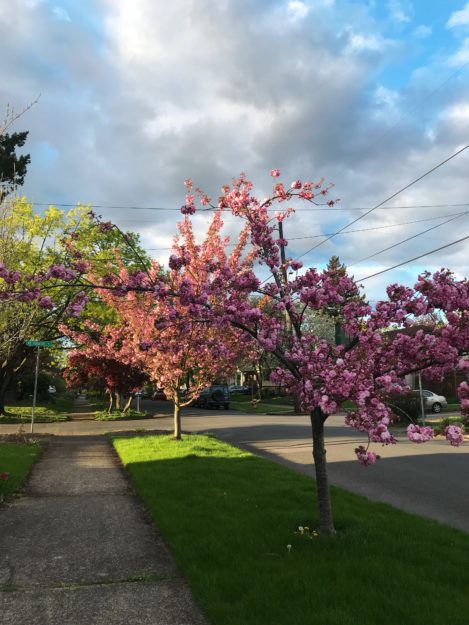
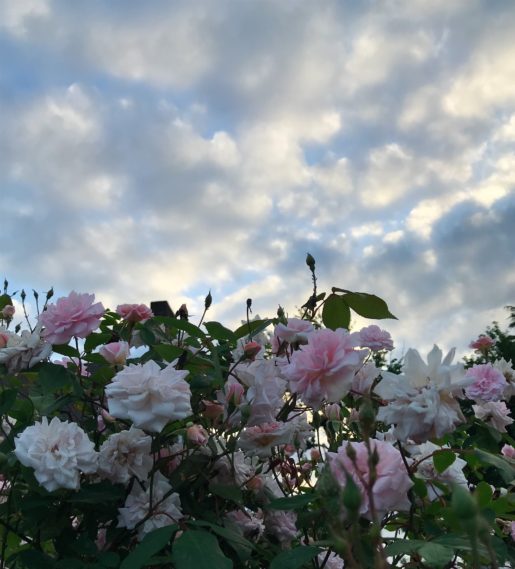
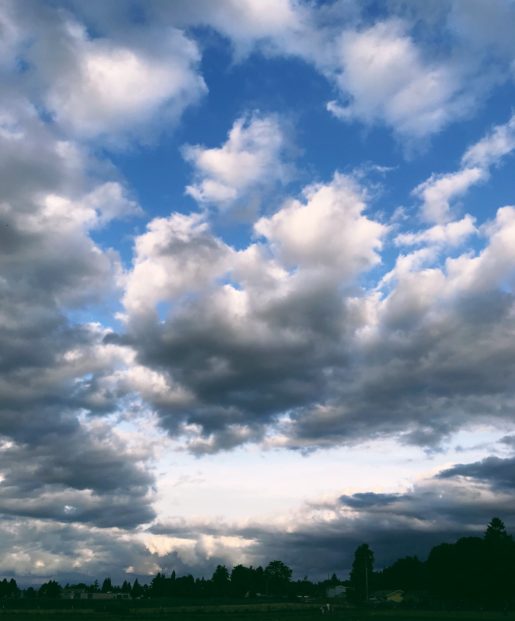
I may be getting carried away with photos—I have hundreds like this from last spring.

Some quick notes on things we read this past week:

 —Began a readaloud of Where the Mountain Meets the Moon, a lovely novel by Grace Lin. I wrote a BraveWriter Arrow guide for this book last year; it was one of my favorites from the year’s lineup. I’ve been looking forward all year to enjoying it with Huck and Rilla.
—Continued our nostalgia-read of Brambly Hedge. It’s slow going because Rilla and I have to spend long minutes cooing over every tiny detail in the art.
—Rilla (my resident green thumb) and I have also spend loads of time poring over my treasured-since-college copy of Crockett’s Indoor Garden. Rilla has taken charge of the houseplant-watering schedule, which is marvelous since I’ve been…unreliable on that front these past two years. My goldfish plant is getting ready to bloom, we repotted the aeschynanthus, Rilla’s jade cutting, and a few other overcrowded treasures. Rilla has a small succulent collection that began with cuttings given to her by a neighbor whose cat she looked after for a week last summer, augmented by plants harvested from a beautiful succulent wreath my sister gave me for Christmas. And this week we inherited a large fennel volunteer that was taking over my friend Ron’s vegetable bed. Trying to decide whether to plant it in a pot or in the small raised garden bed out back. The latter was probably sundrenched when it was built, but now the neighbor’s magnolia is leaning over it, casting heavy shade over the bed for much of the day. Our fennel will probably prefer a spot on the sunny front steps.
My parents gave Rilla a big box of flower bulbs for her birthday (thirteen! did I mention?!)—dahlias, daylilies, glads, and I forget what else. So those will be going into pots this weekend. Luckily we inherited a dozen large clay pots from yet another neighbor who was clearing out her garage before a move. And a big bag of potting soil! Such riches!
My rosemary, thyme, sage, mint, and chives survived the winter. The basil, not so much. (Its demise was expected.) The potted blueberry has buds and there’s a nice fat poppy coming up where I planned to repot the dahlia tuber Ron gave me when we moved in. My yarrow is looking lush and the foxglove has gone bananas! No flower stalks yet but the leaves are huge and abundant. And my tulips, oh! I can’t get enough of them.

 But I’m supposed to be writing booknotes here! Apart from things I enjoyed with the kids, I didn’t get much reading done this week—I had an unusual number of out-of-the-house events in the evenings. I’m enjoying Austin Kleon’s latest, though—Keep Going. Come to think of it, I read that one with the kids as well—they love his artwork.
I’m about halfway through Mike Monteiro’s Ruined By Design, which is thought-provoking and somewhat chilling.
The world is working exactly as designed.
The combustion engine which is destroying our planet’s atmosphere and rapidly making it inhospitable is working exactly as we designed it. Guns, which lead to so much death, work exactly as they’re designed to work. And every time we “improve” their design, they get better at killing….
Design is also a craft with a lot of blood on its hands. Every cigarette ad is on us. Every gun is on us. Every ballot that a voter cannot understand is on us. Every time social network’s interface allows a stalker to find their victim, that’s on us. The monsters we unleash into the world will carry your name.
This book will make you see that design is a political act. What we choose to design is a political act. Who we choose to work for is a political act. Who we choose to work with is a political act. And, most importantly, the people we’ve excluded from these decisions is the biggest (and stupidest) political act we’ve made as a society.
Fascinating and unsettling, and it feels like an important conversation for this moment in time.
Today I’m in the mood for some entertaining fiction—maybe another Terry Pratchett since I so enjoyed The Wee Free Men. My only highlight in the Kindle edition: “an egg’s worth of education.” I read it aloud to the kids so that fragment can’t have been the thunk of a sleeping hand on the screen. I guess I just liked the notion! (Tiffany barters eggs for knowledge when the scholars come to town.)
(Affiliate links.)
This week on Medium I shared a peek at how I used a Trello board to help with my novel revision. And squee—the most exciting moment of my week—my editor sent me the cover sketch for my new book and it’s fabulous! I can’t wait to share it. The artist is brilliant and the sketch just crackles with energy. I’m so happy. I think we’ll have final art for it quite soon. Of course the book doesn’t pub until summer 2020, but seeing the title in print makes it feel very real!
Happy last-weekend-in-April, my dears. I’d love to hear what you’re reading and planting!
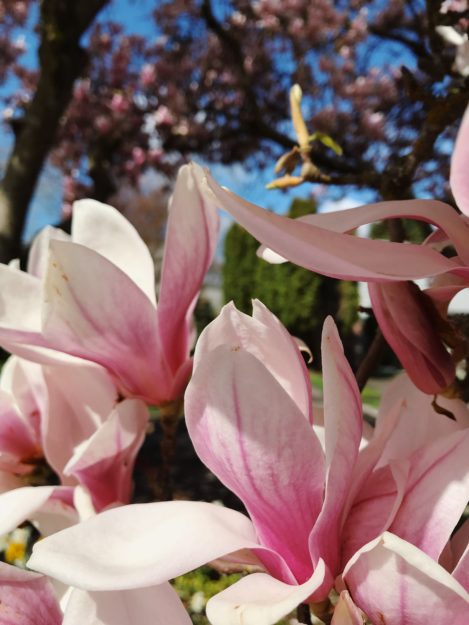
My parents were here for Wonderboy’s spring break, and Portland greeted them with an explosion of bloom. Their visit overlapped with the Association of Writing Programs Conference (AWP), which meant I had friends in town and poets I love, and though I didn’t attend the conference proper I found time to slip away to a few offsite events and spent most of Saturday at the book fair, aka heaven. Cherry blossoms, daffodils, good company, blue skies, and poetry at every turn.
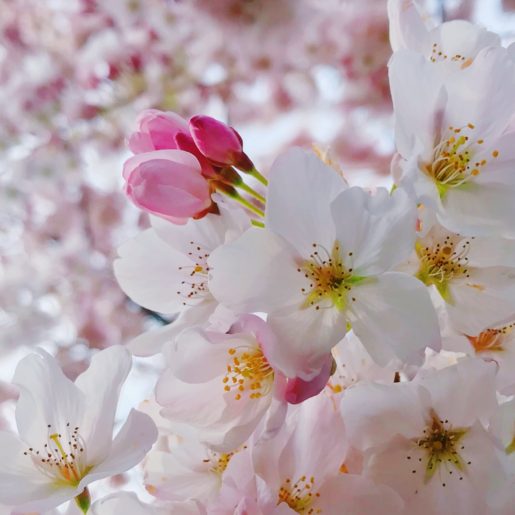
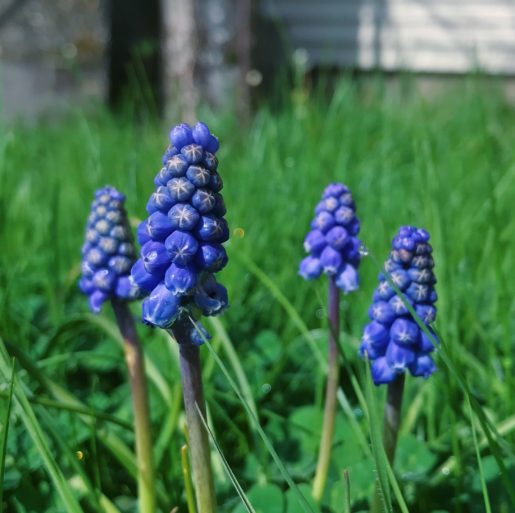
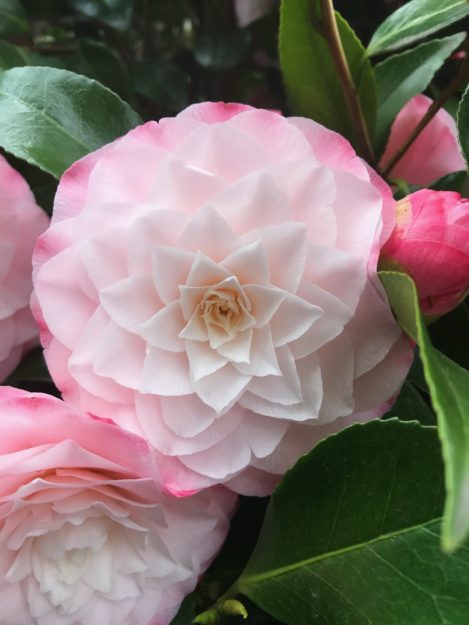
Now I’m collecting my thoughts for the final push on my novel revision (two more weeks!) and plugging away at other work. It’s challenging at this time of year. When I’m inside, I want to be outside. The grape hyacinths and euphorbia are in bloom, and camellia and hellebore, and tulips are beginning to open! And tulip magnolias in their glory. Focus, Lissa. Focus.
On Patreon this weekend, I wrote about my weekly meandering through various books of poems and artists’ journals in my morning poetry hour. It’s a while since I’ve explained my Patreon here, so a quick refresher: you can subscribe for as little as $1/month, which grants access to a weekly post about my reading and writing life (including sneak peeks at the book in progress, as it begins to move through the various stages of publishing). At the $3+ tier, you’re invited to join my weekly coffee hour, a casual, chatty, unrecorded Google Hangout where you can pop in and pick my brain about anything you like.
Tomorrow I’m off to Salem for a monthly meeting of folks in the intellectual and developmental disabilities supports community. And then on Wednesday: it’s back to high tide for Huck, Rilla, and me. Another milestone today: it was Beanie’s first day of school—and college! Bean and Rose are taking an oceanography class together. We have a few more months before Beanie officially graduates from our homeschool, and then—gulp—I’ll be down to just two students here in Bonny Glen Academy. Talk about the tides!
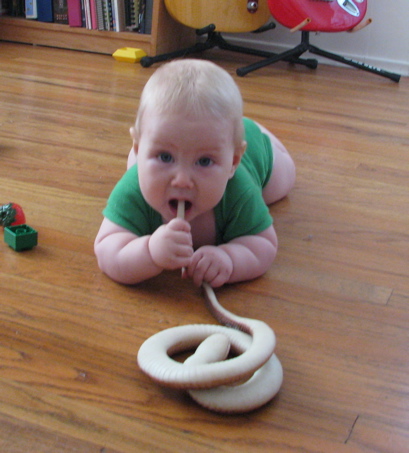
note: not a real snake
A WordPress update caused some hiccups for me yesterday and I broke my whopping two-day posting streak. The noive!
Ah well, here I am on a Thursday afternoon, finishing up my last BraveWriter Arrow of the year. I think that makes a total of 17 Arrows I’ve written in the past two years. Wow, it’s a lot when I add them all up! This one’s on By the Great Horn Spoon, a most beloved novel in the Wiley-Peterson household. I just revisited the old post in that link—written FOURTEEN years ago, can you believe it?—and am sitting here cracking up at poor little four-year-old Beanie:
It’s been a rough morning. Our wagon tipped over while fording a river, and we lost fifty pounds of salt pork and our only shotgun. Then Rose took sick—cholera, we think—and died before we could do anything about it.
My girls are undaunted by this stunning double tragedy. They push on across the prairie, estimating the number of miles to the next fort. Maybe we can trade our mule for a new gun.
“At least we still have the fishing pole,” says Rose. She seems to have accepted her own death gracefully.
“I don’t like wattlesnakes,” announces Beanie.
Jane cracks up. “Who does? Remember when I got bit, back before we crossed the Platte?”
Of course now I’m remembering our actual in-real-life wattlesnake (or racklenake, depending which of my toddlers you asked) encounters. We’ve had more than our share!
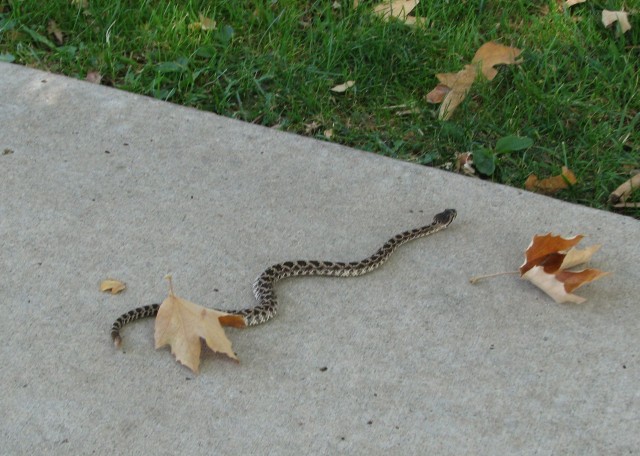
this one was all too real
February, 2012:
Then something will happen to remind me why I don’t go hiking more often, like OH SAY A RATTLESNAKE WILL APPEAR ON THE TRAIL THREE FEET FROM MY CHILDREN.
Rose and Beanie spotted him at the same time—they were in the lead, fortunately; they’re sharp-eyed lasses and I was distracted by a hot, red-faced, cranky Huck. If this had been the part of the trail where Huck suddenly charged ahead and we larger folk had to scramble to catch up, he’d have been on that snake before any of us saw it. It was lying quite still at first, stretched out across our path. Rose had just enough time to ask “Is it real?” before it twitched, and I took in the triangular head and the rattle and hollered EVERYONE BACK UP IT’S A RATTLER GRAB THE LITTLE ONES!! (I used more exclamation points.)
We edged back a yard and stood watching it. Huck, who’d been begging me to carry him, now clamored to be put down. Not a chance, pal. The rest of us were still and silent. After a long moment, the snake began to move; it slid across the trail into the underbrush.
“This is the best thing that EVER HAPPENED TO ME,” Rose declared.
August, 2012 (you’ll note Beanie’s shift to a more wattlesnake-inclusive position):
“I adore rattlers,” said Beanie.
The firemen raised their eyebrows. “Well, maybe don’t adore them,” one said.
“From a distance,” said another.
“Me don’t like racklenakes,” announced Huck.
“ME EITHER,” declared his big brother in the firmest of tones.
ME EITHER, reiterates their poor mother, all these years later. Neither the wattlers nor the racklers. Nor, for that matter, the rubber kind, which have given me no less than seventy minor heart attacks over the years.
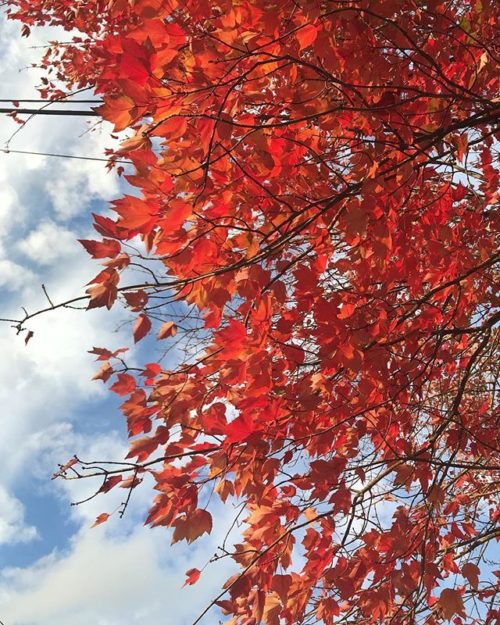
I took this photo a couple of weeks ago; most of those glorious leaves have fallen now and the sky is hung upon the bare arms of the trees. Light glows from behind the clouds. I hadn’t realized how much I missed clouds, all those years under the clear blue Southern California sky. Here in the Pacific Northwest, the sky is painted by Maxfield Parrish, shot through with light. Even when it’s overcast and gray, there’s a glow behind the veil.
I made a list yesterday of things to write about. I’ve tucked so many stories in drafts this past year! But everything on my list feels like work. And I’m trying really hard not to work today.
So I’ll talk about Project Feederwatch instead. 🙂 Are any of you participating this year? We missed it last year. And our San Diego feeder attracted rats, so we abandoned it. But here, the birds are putting on quite a show. Our count days are Monday and Tuesday. Last week we counted 25 goldfinches, a flock of bush tits (we lost count at 25 but I think there were more), a handful of house finches and juncos, a female Northern Flicker who visits the suet feeder every morning, a downy woodpecker, two chickadees, two scrub jays, and some starlings. A highly satisfying count. The best view of the feeders is from my studio window, and it amuses me no end to come in here and find the chairs pulled out for better viewing. Huck and Rilla spend a lot of time in here, watching the show.
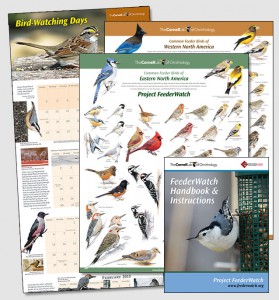 If you’re interested in taking part in the project, it’s not to late to join for this season. It takes a few weeks for the packet to arrive, but you can download a data sheet to tide you over. Once you get your registration packet in the mail, you begin entering your bird counts online. The Cornell Lab of Ornithology uses this data to “track long-term trends in bird distribution and abundance.” I think it’s open to U.S. residents only (and costs $18 to participate), but there’s a Canadian version linked on the site.
I fill our two tube feeders with sunflower seeds. One suet feeder holds a peanutty cake, and the other is a suet-and-insect cake that the woodpeckers seem crazy about. We scatter a bit of millet on the ground for the juncos, and they clean up any sunflower seeds spilled by the squabbling goldfinches. We also have a mesh sock full of nyjer thistle for the finches. But my favorite is when they descend upon the big pot of cosmos and pick out the seeds from the flower centers.
I keep watching for the varied thrushes who began visiting our yard last winter. No luck yet but I’m hopeful!
I would love to hear about the birds that visit your yard, feeders or no!
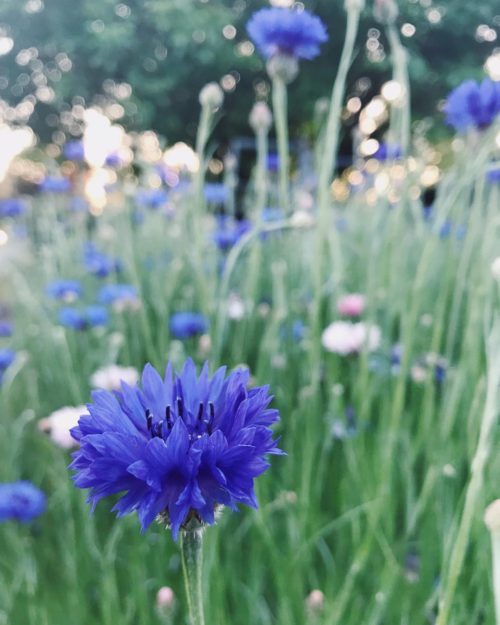
Sick kids this week, and lots of IEP stuff going on. But golden hour doesn’t begin until 8pm these days, so I’ve managed plenty of long, rhapsodic evening walks. The light is glorious. I’m completely enchanted.
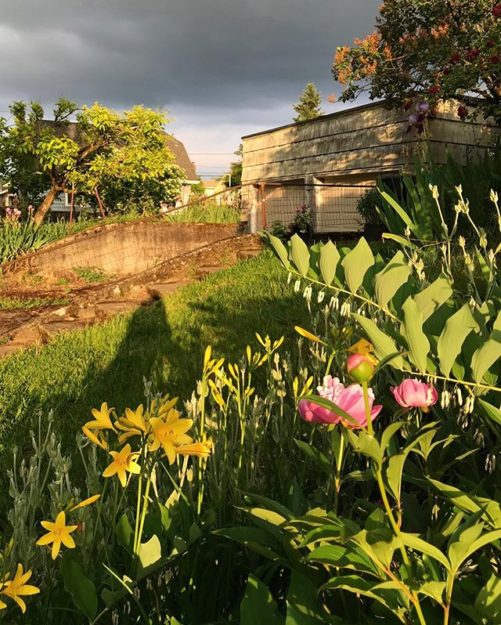
Huck, Rilla, and I are still reading The Penderwicks and lots of poetry. They finished learning the Willow Cabin speech from Twelfth Night and have begun If music be the food of love. play on. We spent a few weeks immersing in the history of Ancient India, and next week we’re starting an exploration of ancient numbering systems. Rilla helped me prep for it and we’re both pretty excited to dive in. And we’re doing watercolors almost every day, because I’m addicted. Strawberry number two was ripe today. We’re anxiously awaiting the arrival of this lovely book: Gathering Moss: A Natural and Cultural History of Mosses. (Amazon influencer link.) I’m in no hurry at all for the tide to go out.
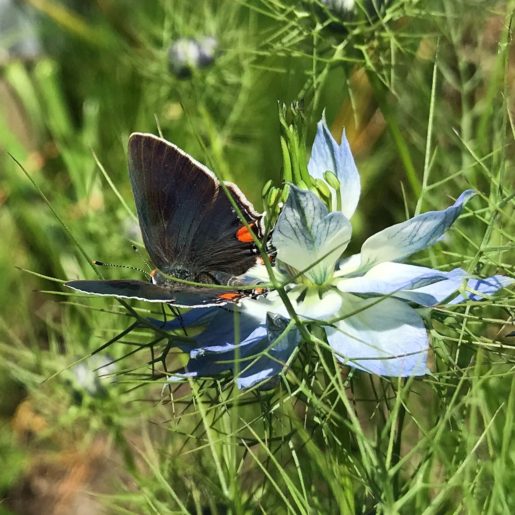
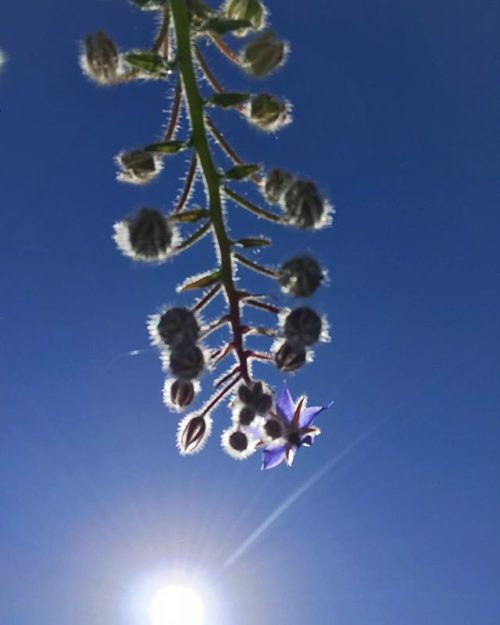

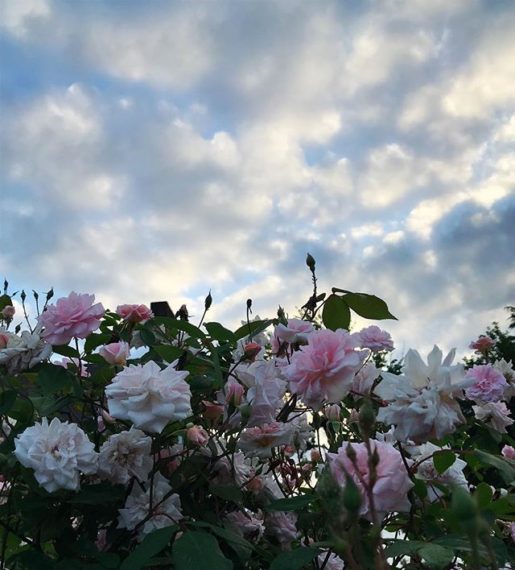
Hello hello hello hello!
Today is my 24th wedding anniversary. You know I gotta post that pic I always post. 🙂
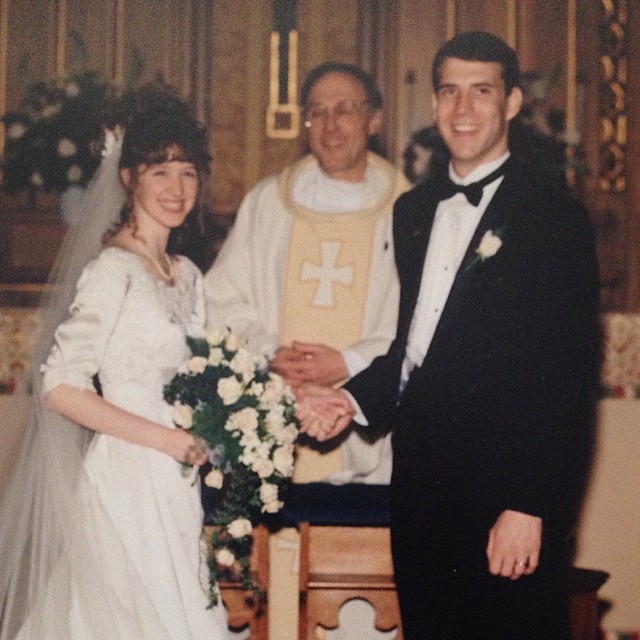
Still crazy about this guy. (Understatement.)
We celebrated Mother’s Day by…cleaning the garage and basement. Yes, I am THAT woman: the one who saves the grungiest jobs for the day her family lives to do her beck and call. 😉
My gift was a really lovely surprise: a couple of weeks ago I posted a pic on Instagram of some perfectly GORGEOUS flowers (Hayley Mills voice there, obvs) I spotted in a neighbor’s yard on one of my walks. I learned that they are called Lewisia (after Lewis of Lewis & Clark) or, commonly, bitterroot. I adore them.
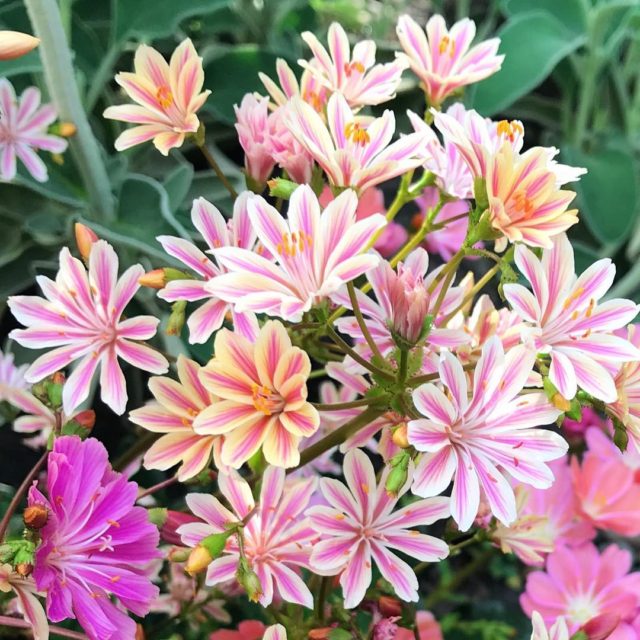
I swooned hard again when I saw them at a nursery the week after—but I was there for garden starts and I Firmly Resisted the Temptation to Indulge. And then the other day after my first post-treatment mammogram (all clear, hurrah!) Scott surprised me with a detour to the garden center. Unbeknownst to me, he showed my Insta photo to an employee…and now I have my ownty-downty little bitterroot plant. Bliss.
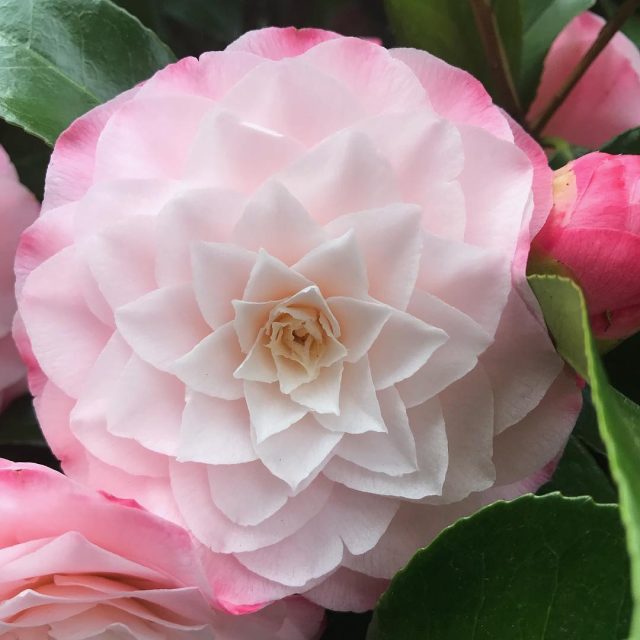
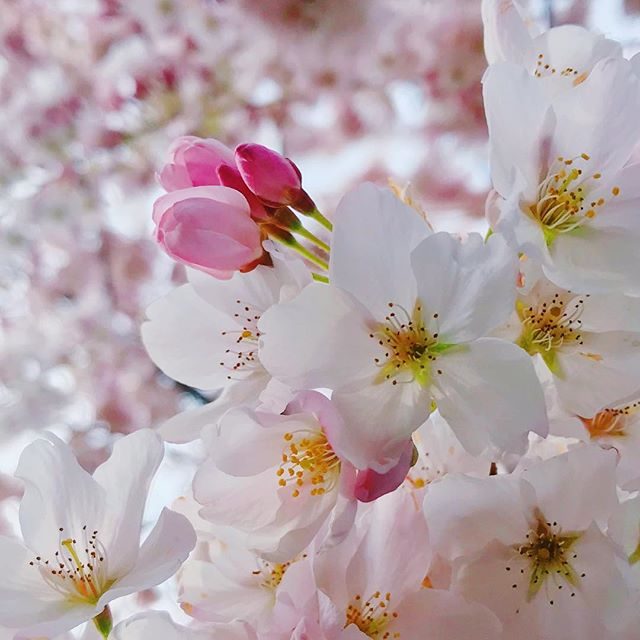
Flew home from Virginia on Tuesday and have spent the week catching up on Everything. Catching up—and taking as many nature walks as humanly possible. Rilla and I have been casually tracking the waves of blossom here in Portland—first came the crocuses and hellebores; then the flowering plum and pear trees, with quince close behind; and now everywhere is a sea of daffodils and grape hyacinths, and the bees are tumbling in the cherry blossoms, and the first tulips are filling their cups with sky. When I left for my trip last week, Klickitat Street was a froth of pink and white, giving way now to a veil of soft green.
Why am I inside right now? Goodbye, I have to go for a walk. 🙂