Archive for the ‘Wonderboy’ Category
After watching Rilla, Monica asked:
I was wondering what the research says about how hearing kids learning sign affects (if it does at all) their verbal speech acquisition. I assume it is like my 4yo learning romanian and english. his english is miles ahead of romanian, but learning romanian hasnt affected his english at all. just wondering if you had read anything about this.
That’s a very good question! As a matter of fact, teaching babies to sign does seem to have an affect on their verbal language development—a good one. I’ve read about at least two separate studies whose results demonstrated that children who used sign language as babies tend to score higher on IQ tests than non-signers. There was a study at the University of Alaska and another one at Davis, I believe. One of them tracked kids through age 8 and found that the baby-signers wound up reading at earlier ages and showed higher cognitive and verbal skills.
But honestly, even if that weren’t the case I’d be on board with baby sign just for the way it smooths the toddler years. You get to bypass that stage where the little one knows exactly what she wants to tell you but doesn’t have the words for it yet, leading to the intense frustration that often winds up in a meltdown.
We’ve used baby sign with all our babies, even before Wonderboy came along. When Jane was about a year old, Scott’s boss’s wife very thoughtfully sent me an article on the subject, and I thought it was a brilliant concept. I taught Jane a few signs but we didn’t really take off with it until Rose came along. By then, Jane was three and had spent a lot of time in the hospital where she saw an ASL interpreter working with another patient. She was very interested and I was a young would-be homeschooling mommy eager to start strewing. 😉 I ordered this set of videos from the Timberdoodle catalog and we dove in.
The videos didn’t appeal to Jane—they are intended as tutorials for the parents of deaf babies and toddlers (and yes, how goosebumpy is that, considering what was in store for us a few babies later? God’s providence, anyone?) and the format is rather dry. But the vocabulary was perfect for daily use with my little ones. By the time Rose was 18 months, she was using about two dozen signs on a regular basis. I remember my relatives being impressed by her “please” and “thank you” at a family funeral. It is awfully nice to have “please” be a habit even before verbal speech begins.
When Beanie was a year old, Jane was six, and she and her friend Summer were both interested in learning ASL, so we watched the Sign With Me videos again. The little girls hung in there with the videos despite their dry format, and since they both had one-year-old sisters they really enjoyed being able to sign words like “yucky” and “silly.” We started checking children’s sign DVDs out of the library, and Summer’s family came across Signing Time. That was the beginning of a beeyootiful friendship…
But we had no idea, then, how important the Signing Time series—or, indeed, ASL itself—would become to us. When Wonderboy was born I launched right into baby sign, same as always, having no clue that he had hearing loss. He was six months old before we started to seriously worry about his hearing, and it was another three months (after a set of tubes proved fluid buildup wasn’t the problem) before we got a firm diagnosis.
I’ve already written about what happened next: how our family threw ourselves into the study of ASL for Wonderboy’s sake—and our own intense enjoyment. ASL is a beautiful, beautiful language. I wish I were more fluent—we are still plugging away on our own, but one of these days we’d like to study with a fluent signer. Jane hopes to become certified as an interpreter one day.
One piece of advice I have about teaching babies to sign is that it’s better to use real ASL (American Sign Language—if you’re American, that is) rather than one of the made-up “baby sign” programs. It seems to me that as long as you’re teaching signs, why not give the child a head start on a real second language? That’s one of the reasons I come out so strong for Signing Time (and no, I don’t get a commission from those folks)—it uses ASL.
We recently received the three latest installments of Signing Time, and once again I’m blown away by how fun and engaging they are, how practically useful the vocabulary is, and how effective the instruction is. Both Wonderboy and Rilla are doing a lot of counting these days, because there is a new “Counting Time” section of the show. The “ABC Time” segment has also been a big hit. The new editions are:
Move and Groove
Happy Birthday to You
Nice to Meet You
I really like the manners signs taught in that last one. I admit I still think the songs in Volumes 4, 5, and 6 are the best of the whole series, but once again the music is catchy and fun, and I honestly can’t say enough good things about these DVDs. Rachel Coleman and crew have hit upon a perfect format. In fact, I also think Signing Time gives reading skills a boost, since the English word for each sign is displayed next to the person demonstrating it.
Once Wonderboy’s hearing loss was diagnosed, we knew ASL would be an important second language for him—both as a bridge to verbal speech and as a backup for times when he isn’t wearing his hearing aids (or in case his hearing degenerates further as he gets older). There are different theories about signing with hard-of-hearing kids, and the “Total Communication” approach is what made most sense to us. His expressive and receptive language skills have consistently tested as at-or-above-age-level despite his “speech delay”—that delay is only with pronunciation. I am so grateful that we were already primed to jump into the use of ASL with him because of the “baby sign” trend. Some trends are sound and sensible. This is one!
Related posts:
• Signing Time DVDs
• More about Signing Time
• Rilla Signs
• Unsolicited Signing Time Commercial
Wonderboy ran up to me and said, "Mommy, I need kiss you!"
Smooch. Now that’s what I call speech therapy.
"Need kiss" is more like "nee kih" but he is starting to use ending consonants on words like up, cup, and big.
"I need to kiss you" has to be one of the sweetest sentences a mother can hear.
In the meeting last week there was a really funny (and for me, triumphant) moment when he said something to the audiologist. Earlier in the meeting, his speech therapist and I had been talking about how much she "gets out of him" during a session. His tendency is to watch her, either solemnly or with a big grin (if you know him in person you know what I mean about the grin—I was telling this story to a friend and she said, "Yup, that’s Wonderboy all right"), but not repeat back the words the therapist is trying to get him to say. Then, after an activity is finished, he’ll say the sound or word clear as a bell. He just—like most kids his age—doesn’t like to be put on the spot.
So in the meeting, I was describing this as a typical behavior for his age and developmental stage. (Developmentally, he is more like a young three than a going-on-four three.) The speech therapist was looking at it from a different angle: she was seeing his silence as an inability to perform on cue rather than a choice not to perform. Well, this is one of those things that a mother just knows. When you spend all day with a child, you get a pretty good sense of when he can’t do something and when he won’t.
About twenty minutes after this conversation, the audiologist burst out laughing. She explained that she had been trying to get Wonderboy to talk to her. She was sitting next to me, and he often wandered over from the toy area to stand at my elbow and give me a kiss on the arm. (He is so sweet with his kisses!) The audi had been holding out a plastic ice cream cone and telling him, "Say ice cream. Say ice cream." And he had just grinned at her.
So what made her burst out laughing was that several minutes after she stopped playing with him and set the toy cone down on the table, he ran up and grabbed the cone and said to her, with the most impish glint in his eye, "I got my ice cream cone."
"It’s exactly like you said!" the audiologist crowed.
This reminds me so much of when Jane was two years old, in the hospital for chemotherapy. One day she pitched a big huge fit right in the middle of the hall on the cancer ward. This was unusual behavior for her, and medical personnel came running from all directions.
"Is she seizing?" called a nurse, racing to my side. A doctor elbowed me out of the way, dropping to his knees beside my shrieking, writhing child.
"No, it’s not a seizure," I said. "It’s a tantrum. I wouldn’t let her run in the hall."
She had a central line in her chest, which was connected by tubing to an i/v pole from which hung a bag of medicine so toxic I was under orders to wear protective gloves when changing her diaper. So, no, I wouldn’t let her run away from me down the hall, pulling the i/v behind her. And she was two years old, and this made her mad.
You wouldn’t believe what a hard time I had convincing the assembled docs and nurses that this wasn’t a medical emergency.
Sometimes special needs kids are just kids.
So much I want to respond to in your comments! Good thing there’s a weekend coming up…
One important point I didn’t get to yesterday is this piece of information regarding homeschooling with an IEP in California: as soon as the child reaches legal kindergarten age, more options open up. Wonderboy will be four in December. Part of the system’s inflexibility has to do with his age. He falls in a murky space between the Early Intervention cut-off age of three years, and legal kindergarten age. No, murky is the wrong word: the law is very clear. It’s a rigid space; that’s a better way to describe it.
As soon as Wonderboy reaches legal kindergarten age, I have the option of ditching his IEP. That’s because I am homeschooling under California’s private school provision, one of several options open to home educators in this state. According to the state of California, my three older children are enrolled in a private school called Bonny Glen Academy. The "headmaster" is my husband, and I am the other member of the faculty.
When Wonderboy reaches legal kindergarten age, I can enroll him in our private school and turn down his IEP in lieu of an ISP, an Individualized service plan. This is how students in actual private schools can receive special education services like speech, physical therapy, and occupational therapy from the public school system. I’m still wading through the regulations, but there seems to be more flexibility with an ISP than with an IEP.
But Wonderboy won’t be legal kindergarten age until the beginning of the 2009-2010 school year. He misses next year’s cutoff by one week. I find it hilarious that I am suddenly going, Shoot, I can’t believe we miss the cutoff—in all other circumstances, I would be thrilled not to have to fuss with enrollment paperwork for him for an extra year. (Especially since kindergarten is not mandatory in California. Yet.)
For now, we’re solidly in IEP territory. And despite how complicated it has become, I don’t (yet?) regret pursuing speech and audiology services through the school system. I love the district audiologist. She is very good at her job, she’s flexible about scheduling, and her services do not cost us anything. If I’d foregone the whole IEP adventure, we’d be getting audiology services via the medical establishment, which means a significant expense of time and money.
As for speech, well, I’m on the fence. But that too is fodder for another post. It’s a big topic, so I’ll save it. This one is going to be long enough, I fear.
~~~
Amy commented:
IMHO the school systems just don’t *get* the homeschooling mother’s
mentality of "I *can* and *will* do this at home because it is part of
my job as homeschooling parent" – we saw so many parents (good parents,
mind you) who just "left it all up to us" as "professionals" and never
really worked with their kids at home. Not that there was much TIME
with the kids coming home late from school, two income families and
many activities! I know I’m generalizing here, so I hope no public
school families are offended. There were some great parents, but many,
many hands-off parents, therapy wise.
Yup,
and that is indeed what informs the school personnel’s decisions—that
and the related issue of parents filing suit against school districts
for failing to do enough. And knowing how hard some of my
public-school-parent friends have had to work to GET necessary services
for their children, I am well aware that this is a complicated problem,
a swinging door that smacks faces in both directions.
Sitting in that room, debating with the team, I knew I was talking
to people who think well of me, and the ones who have worked with Wonderboy do truly care about my son. Pam, I am quite sure, was enduring a
form of anguish in "having" to recommended against what she knew I
wanted.
Not that her anguish excuses her for failing to tell me in advance
what she was going to do—if she wasn’t going to recommend cutting back
to one session, there was really no point in having the meeting. No
need to assemble the panel if you aren’t going to change the paperwork.
Really, what it means is that she didn’t have the courage to tell me
herself—she let the district rep, a stranger, do the dirty work for
her—and in quite intimidating circumstances.
It’s HARD to argue back in the face of authority. It does not come
naturally to me, let me tell you. The reason I can do it is because
underneath my oh-gosh-they’ll-get-mad-if-I-buck-’em insecurities, I
know that in truth *I* am the authority. I learned this during our long
ordeal with Jane’s cancer. It took me months of hospital living to get
to a point where I could be "frank, firm, and persistent" with doctors.
I had to assimilate the knowledge that although they knew more about
fighting cancer than I did, I knew more about my child. I am the
authority on that subject.
Back to Amy’s point. I know that my decision not to avail myself of
the very good deaf/hard-of-hearing preschool program our district offers is utterly
mystifying to several of the members of the team. You can practically
hear them thinking, "But…you could have him off your hands for hours
every day!! Whyyyy wouldn’t you want to take advantage of that break?
As you say, you’re juggling a ton already…"
"She homeschools her children," I heard one team member whisper to
another. "OHHH," the other, who was meeting me for the first time,
responded, as if that explained so much. Heck, maybe it does.
In the interests of fairness, I want to clarify that the person who
whispered "She homeschools" was my biggest advocate in the meeting. I
think she really was offering that information to her colleague as a
relevant fact: this is a mom who is very involved with her children’s education. It was the colleague’s response that was so telling. "Ohhh," in a tone that conveyed: "So that’s why she’s being difficult."
(More fairness! By the end of the meeting, the Ohhh woman seemed to
have completely revised whatever negative impression she had of me at
the beginning. She told me I should write a book. Hee.)
I want to reiterate that although I was in opposition to the team’s
initial decision, this wasn’t an overtly hostile environment. These are really
nice people, dedicated to their jobs, working from their best
understanding of how kids learn, how families work, what the law says,
and how the system works. Almost by definition, a homeschooling family
is going to run counter to that understanding. What we believe about
how kids (people) learn and how families work tends to be dramatically
different from the views of mainstream educators. (For one thing, I
don’t think I know any homeschoolers who would commit to a definition
of "how families work"—the "how" is different for every family!)
~~~
There was a point in our meeting when it really looked as though the
team was not going to budge on the reduction of service. The
conversation had become about scheduling: since our current schedule
doesn’t work, what other options were there. As you may recall from last year, when I first came
seeking speech therapy, the district’s strong recommendation was for me
to enroll Wonderboy in that five-day-a-week deaf/HOH preschool program. I declined, for a
number of reasons.
One thing I was interested in for this year, though, was having him
receive speech therapy from one of the two therapists involved with
the preschool. Since they work with deaf/HOH kids, they are specially
skilled in meeting the kind of speech needs my son has. (Our current
therapist’s specialty is preschoolers, but he is her first HOH child,
and she is learning as she goes. She makes some classic mistakes, such
as forgetting that he can’t hear her when she whispers. But again, that’s for another post.)
We discussed a number of options. He could get his one-on-one speech therapy at the preschool. Pam and I both wondered whether that would be too distracting, to have a bunch of other kids around doing other things during the session. The preschool teacher said that no, it was a play-based program, so Wonderboy could do whatever he liked, and the speech therapist would simply follow him around the room, working speech into Wonderboy’s activities.
"Um, how is that any different from what I do all day at home?" I asked. I reminded them that his IEP doesn’t say anything about developing expressive and receptive language. He has no delay in that area—in fact, he’s ahead for his age, since (speaking English and ASL) he is bilingual.
His IEP goals for speech—there are only two goals, by the way—involve the production of five new sounds. That’s all the district is supposed to concern itself with: helping him gain a finite number of consonants. He has already gained three of the five sounds specified in the goals.
Back to the drawing board. If he were enrolled in the preschool program even part-time, they told me, he could get speech during the small-group session that would be more in line with the goals we’re working toward. Would I consider a two-hour time slot, once or twice a week?
I gave this idea serious consideration. Once a week, for speech and audiology? It might possibly work…he’d be working with the deaf/HOH-trained speech pathologist, for one thing, and having seen her at work (she attended one of our sessions to give Pam some pointers), I was very open to the idea of finding a way to work with her.
But then it hit me, and I asked the question. "What happens if I
agree to this, but in a few months’ time I have determined it not to be
in his best interests? What if I wanted to go back to what we have now,
the 30-minute private sessions?"
There was a pause, and the district rep exchanged glances with the others.
"Well," she said slowly, "we would have to have another meeting like
this one, and the team would have to agree that he would be best served
by pulling him out."
"In that case," I said, "we can stop talking about this option right
now. And it’s too bad, because I do think there are some strong
arguments in its favor. But I can’t take the risk of running into
another situation like this one. If there is any possibility of my
having to walk back into this room and be told by a panel of people
that I can’t do what I know to be in the best interests of my own
child, then forget it."
I worded it strongly because I needed to make sure they understood
the point. I will not cede my parental authority to a panel of school
district personnel. End of story.
This statement seemed to hit home. From that point on, the tone of
the meeting was different. I think several of the people in the room
had assumed I was completely closed to the idea of any participation in
the preschool program because of some anti-school prejudice.
In fact, there had been a funny moment earlier in the meeting when I
teased the audiologist for making exactly that assumption. She
mentioned that she knew my older girls go to "enrichment activities"
(her words) like music and dance. "Maybe," she suggested, "you could
think of the preschool program as an enrichment activity for Wonderboy."
I grinned. "You don’t have to come up with other names for it," I said. "I’m not going to break out in hives at the word school."
There was a ripple of laughter, and it was clear that a few people at the table had assumed I would categorically refuse anything with a schooly label.
"Listen," I said, still smiling but also serious, "what I’m about—the reason I homeschool—is because I’m about individualized education, the freedom to do what’s best for each individual child."
We all had a nice chuckle over it, and someone else joshed the audi
for trying to slip something past me, and she said she wasn’t slipping
anything past me, she didn’t think I missed much. Which was nice of
her, but thinking back over the meeting, I see that there were some nuances I nearly missed. (And probably some I did miss, but I wouldn’t know, would I?)
I almost missed the fact that opting for a two-hour dropoff at the preschool would have meant increasing the level of service—when here I was fighting to decrease it in the first place.
I almost missed the fact that dropoff therapy would negate the most important aspect of our therapy experience: I wouldn’t be there to learn techniques and activities to use at home.
It rather amazes me, now, looking back at the meeting, that I came
close to making such a colossal mistake. I’m sharing that part of the
story here, embarrassing as it is, because I think it speaks to
something very important for parents to know as they head into meetings
like this. When you’re under that much pressure, and facing disapproval
from figures who speak with authority, it is very, very easy to lose
track of what you want and what you know to be true.
You are trying to be reasonable, and you begin to think in terms of
compromise, because to do anything else is to make yourself a royal
pain in the tuckus. But there are certain things you should never have
to compromise, and your child’s best interests ranks mighty high on that list.
~~~
So the way it turned out is that I said, "Listen. This is intensely frustrating. What you are saying—what several of you have articulated very clearly—is that you agree that because we do so much work with Wonderboy at home, and because his life is filled with so many other appointments eating up our time, and because he is making such terrific progress, it makes sense to cut back to one speech therapy session a week. But you say you can’t agree to that change because it doesn’t look good on paper. Pam, what you said was, ‘On paper it’s hard to justify a reduction of services for a child with that level of need.’ So what I’m hearing is that you are going to stick to a decision we all agree is not in the best interests of this specific child, because of a fear of how it looks on paper."
Some of them were nodding. The itinerant teacher, the one whose curriculum I had declined last year but who came to our house a week ago for the annual 30-minute consult I did consent to (and that in itself is another whole post topic), spoke up on my behalf. She said that having seen Wonderboy in his home environment, having heard him chatter, having watched how I interact with him, she had to admit that there wasn’t one single thing she would recommend to a parent that I wasn’t already doing on my own.
She was very complimentary. I was grateful, and yet it was strange—it felt like having a great defense witness testify for me when I shouldn’t have been on trial in the first place. It bothers me, still, that part of what eventually won me the result I was after was that I had allowed a district employee into my home, had been observed and passed muster.
~~~
Believe it or not, long as this post is, there’s a lot I haven’t told yet. Maybe I’ll get to it later. Maybe I really will have to write that book.
You know the end of the story already—the end of this chapter, at least. After a whole lot more discussion, the team agreed. We signed the papers. Wonderboy will attend speech therapy once a week. His IEP expires in January and we’ll have to reconvene the panel at that time, to revise, update, tweak.
That means this isn’t over. But I’m learning more about the system all the time.
As some of you guessed in the comments, the meeting I alluded to the other day was a doozie. It will probably take me several posts to sort through everything. But let me spare you the suspense and say this: It ended well. I got what I wanted. But it took two hours of intense discussion to get there.
:::::deep breath:::::
Remember last winter when I wrote about getting Wonderboy’s IEP in place? Remember how I said:
Which leads me to a very interesting and important thing I learned at
the end of the meeting. I need to look into whether this applies to
California only or the entire nation. As my pen was poised to sign the
final paperwork, the psychologist notified me (as she is legally bound
to do) that once the parent signs the IEP, the child is officially "in
the system," and the parent can’t just decide later to pull him out of
services without a big to-do. From that point on, the appropriate district personnel (in this case, speech therapist) must agree that the child no longer needs these services in order to cancel them.
You know, I worked pretty hard to make sure my son’s IEP was worded exactly as I wished it to be, lest this section of the law come back to bite us later. But you can never, never be too careful. I should have been, it turns out, even more careful than I was.
The IEP says Wonderboy will receive 60 minutes of speech therapy a week. That’s what we did last year, in two 30 minute private sessions. He did very well, and because I was present during the sessions I was able to repeat the activities at home, daily. He made great progress and gained several consonant sounds. It was very exciting.
But the two-day-a-week schedule was difficult to juggle. He sees a number of other doctors, and that adds up to a lot of appointments. Add in the girls’ activities, and it makes for a great deal of running around. The speech therapist and I agreed that Wonderboy was making fabulous progress. When we started back up after the summer break, I said I wanted to cut back to once a week.
She was hesitant, worrying that if he only saw her once a week, she wouldn’t get as much out of him in the sessions. That wasn’t a concern for me: I don’t really care how much she "gets out of him" (meaning, how much he speaks for her in session); I care about whether he is learning to make new sounds. At home, and out in the world, he is quite a chatterbox—and that includes using the consonants we’re working on in therapy. When the speech therapist puts him on the spot, he clams up, grinning his funny grin. Often he’ll be quiet for 29 minutes of therapy and then burst into conversation on our way out the door. The speech therapist and I have often laughed about this.
So we talked about my reasons for wanting to cut back, and we threw around some other ideas for scheduling—the current schedule doesn’t work at all for us anymore, not with a new year’s lineup of activities for the older girls—and she suggested that we could look at switching to another time with another speech therapist, if her availability didn’t work out for us. We talked about all of that, and none of the options seemed to fit, and so we came back to my preference to cut back to one session a week.
To do that, she said we’d have to set up a meeting with the "whole team" to revise the IEP. The "whole team" means all the school district personnel legally required to sign off on this document. It’s a big slate, in Wonderboy’s case: our speech therapist, the speech pathologist connected with the district’s deaf/hard of hearing preschool program, the preschool teacher, a district rep, an early childhood education rep, the district psychologist, the deaf/HOH itinerant teacher, the district audiologist, oh, and me.
I’m only being a teeny bit snarky in listing myself as an afterthought there. You see, and this is the most significant thing I have to say on the subject of the IEP, the parent is considered "a member of the team." Not the coach, not the person in charge. A member, a single vote.
It is for this reason that a parent must exercise extreme caution in signing an IEP. As I said before, don’t make a mark on that dotted line until you are 100% satisfied with the language in the document.
But I’m jumping ahead of my story. As far as I knew when I walked into that meeting on Tuesday, I was there simply to sign paperwork: the team was assembled to sign off on my request to cut back from two weekly speech therapy sessions to one.
And then, after the introductions around the table—a little low table in the deaf/HOH preschool room, with all ten of us squinched into those tiny little kindergarten chairs—they sandbagged me.
The district rep was leading the meeting. We were there, she explained to the room, because I had requested a reduction in services and the speech therapist had declined the request.
I looked at our speech therapist. (I should give her a name. Let’s call her Pam.) I was shocked. She hadn’t indicated in any way that she was going to recommend against granting my request.
(Do you know how disturbing I find it even to use the words "grant my request"? The very idea of having to ask permission to do what I know to be best for my own child—it’s repugnant.)
Pam looked like she wanted to sink under the table. "I’m so sorry," she said miserably. "I just—I mean, going by Wonderboy specifically, knowing you and how much you work with him, I know he’d be fine, but it’s just—well, a child with his level of need—legally, you understand—I just can’t see how I could justify it on paper, that a child with his level of need could have a reduction in services."
"A child with his level of need"—that’s a key phrase, one which would be used often during the next two hours. It quickly became clear to me that the district personnel were making a distinction between my son and his actual, specific circumstances, and a generic "child with his level of need." Over and over, I was told—not just by the therapist, but by several of the other people on the "team"—that it was clear Wonderboy’s situation is unusual (hearing loss is but one of his many issues; we juggle a boatload of medical appointments; his parents and siblings work with him constantly at home; and so on) and they all had confidence that he "would do fine" with one session a week, but "legally, a child with his level of need…"
Et cetera.
I could make this a very long story. I will probably examine specific points of the discussion in future posts. I think this is an important issue, not only in regard to my family, but in regard to all American homeschoolers—and, indeed, parents in general. We are, as a country, quietly ceding our parental rights to the state.
But I will not cede mine without a fight. In this case, I did eventually bring the "team" round to my point of view. It took two hours of intense discussion. Not heated discussion; no voices were raised. But I had to be frank, and firm, and persistent.
In the beginning, when the district personnel were holding fast to their position, I was told that if I could not agree to stick at the 2 sessions per week, the next step would be to go to mediation, and after that (if we refused to comply with the decision), arbitration. This is California law. As I said in my first IEP post quoted above, in this state, once you sign the IEP, you can’t withdraw your child from services without the consent of the team. I should add "or reduce the level of service" to that sentence.
This post is to be continued. There is lots more to tell (I haven’t gotten to the most outrageous part), and lots to talk about. For now, it’s enough to be able to say that I convinced the team to look at my specific child, not "a child with this level of need." We’ve cut back to one session a week. I’ll continue to work with him every day at home. That’s my job. I’m not a team member. I’m his mother.
Wonderboy had an appointment with a genetics specialist yesterday. This was an appointment his neurosurgeon had urged me to set up, even though I explained that the genetics department at our former hospital had done extensive testing and ruled out chromosomal reasons for my boy’s many "abnormalities." Their best guess was that Wonderboy’s issues are the result of a developmental glitch early on in utero, some influential cells marching to the beat of their own peculiar drum. Much as everyone would like a name to attach to Wonderboy’s collection of atypical physical characteristics, a name with a nice clear road map to show us the best route to take in nurturing this odd little man, the consensus was that no such name, no predefined syndrome, exists.
Wonderboy, I’ve been told by many a specialist, is a one of a kind.
But this neurosurgeon was insistent, and the geneticist he wanted us to see is, he declared, one of the most esteemed in the world. I set up the appointment, and I’m glad I did.
I loved her, loved her warm and easy manner, the instant camaraderie she struck up with my son. I loved the gleam of understanding in her eyes, and the shrewdness of her questions.
During the course of the appointment, I realized something about genetics specialists, something that was as true of our experience with that department back in Virginia as it was in Dr. J.’s office yesterday. All the other specialists we see—and don’t get me wrong, I am a very big fan of your specialty doctors, your surgeons, neurosurgeons, cardiologists, otolaryngologists, developmental pediatricians and the rest of the lot—though honesty compels me to admit I have yet to meet a neurologist who didn’t treat me like a pest, and my child like an interruption to his research—all those other specialists, I was saying, focus by definition on one little piece of the puzzle.
The genetics doctors are looking at how all the pieces fit together. What I realized during yesterday’s appointment is that Dr. J. was not just taking a history, she was eliciting a narration about my son. She wants his story, two or three generations back, if you please.
A doctor whose passion is story is a doctor I can relate to. A great deal of my life revolves around interpreting the cryptic, adorable, worrisome text that is my son. I study the pages of his life like a scholar, with a scholar’s passion for his subject. Dr. J. took a look at this book and found it every bit as compelling as I do.
And she surprised me. I raised the question I’d discussed with the neurologist: hadn’t Genetics already ruled out genetics as the explanation for Wonderboy’s alphabet soup of issues?
Not necessarily, says Dr. Jones. I told her what tests had been done in three years ago, and she nodded and said that yes, that sounds about right in regard to what processes were available in 2004.
"The thing is," she explained, "we’re good at reading chromosomes. But we’re not so good at reading genes."
But there’s a new test that decodes a bit more of the genetic cipher, and it’s possible—not likely, but possible—that cracking that code could tell us more about Wonderboy.
Something else about Dr. J.: delightful sense of humor. She didn’t even mind when I said, begging her pardon, that we see so many specialists it sometimes feels like trying to walk a bunch of dogs all pulling in different directions. "Forgive the analogy," I hastened to add, but she laughed and said that oh, no, it’s the perfect description.
I walked out of her office feeling like I’d found someone who could lend a hand with all those leashes.
August 28, 2007 @ 2:19 pm | Filed under:
Wonderboy A few people wrote that they were unable to view the video at the bottom of the last post, so here it is in a different format. Let me know if this one works for you!
But I did.
I took the kids to the San Diego Museum of Art today, for Free Tuesday. Admission to the various museums and gardens in Balboa Park is free one Tuesday a month on a rotating basis. We plan to hit them all, eventually.
To our delight, we arrived to discover the museum is hosting an exhibit called Giverny, featuring canvases by several well-known Impressionists who came together to form a little artists’ colony in the rural French village of that name. We met Monet in person for the first time today. I had goose bumps. I’ll write more later about the paintings we saw today. I have lots and lots to say about our outing, but for now I’ll just tell this one story.
We stopped by the museum gift shop on our way out. It’s long and narrow, and the free-Tuesday crowd was clogging the aisles. I parked Wonderboy’s stroller in a nook by the door where no one would trip over him, and I left Jane to keep watch over him while I bought a few art postcards. The register was in the middle of the store where I could keep an eye on the kids while I stood in line.
On the whole, they were being pretty patient, I thought, and well-behaved. But Beanie reached out to touch something on a shelf and Wonderboy let out a screech. He can be quite strict with his sisters. He had seen me issue instructions not to touch anything while I was in line. Thus the screech.
Two women happened to be passing behind me at that moment, and one of them rolled her eyes at the other.
“Why do people let their kids scream like animals?” she muttered.
I couldn’t help it. I had to say something.
I turned to her with a big bright smile. “That animal,” I said, “is DEAF. He’s doing the best he can.”
Her face blanched, and she choked out an apology as she hastened past, hurrying far, far away from the poisonously sweet mother of the screeching animal. I’m pretty sure she hid in the back of the store until I left. Poor thing; she had a long wait, for the line was long.
Heh.
Okay, so maybe it was a cheap shot. In truth, his shriekiness probably has more to do with his being a high-strung three-year-old than his being hearing impaired. And yes, he’s only partly deaf. Medium deaf, if you will. Not all the way deaf.
I just get tired, sometimes, of how intolerant our culture seems to be of little children. I feel like I’m always shushing my brood, reining in their high spirits. I love to take them places, love piling in the car for another adventure in nature or art or history, but there can be so much tension in the role of the mom who is on don’t-annoy-anyone alert.
They are obedient and pleasant children. We get plenty of smiles and compliments when we’re out and about. We also get lots of stares, and sometimes frowns. If you’re walking behind us on a narrow path, we’ll try to get out of your way because I know we can be painfully slow to be trapped behind, but I can’t always pull it off. My stroller wheels stick, and I’m preoccupied with keeping Beanie from walking every wall like a tightrope and Rilla from picking my pocket from her perch in the sling. And whoops, there goes Wonderboy’s sippy cup under the stroller. And Jane wants me to look at a new species of butterfly she just spotted. And Rose requires a detailed explanation of exactly why we couldn’t buy the $60 framed print we fell in love with in the store.
Bright, happy, eager, reasonably polite. Doesn’t that balance sometimes inconvenient and occasionally noisy?
Of course I know it does. I’m not really angry about what that woman said. “Like animals” stung a bit, perhaps, but I know words like that cannot have been uttered by anyone who has walked ten steps in my shoes. And I don’t know what her own shoes feel like. Perhaps she has bunions.
She certainly does not have my screeching, high-strung, hard-of-hearing animal, who sees me taking off his baby sister’s clothes at bedtime and trots off down the hall to fetch her pajamas, unasked, chuckling with the joy of the task, and delivers them with a kiss for the baby and another for me. She does not have those skinny arms around her neck, that gaptoothed grin, those busy little fingers flashing and twisting to shape words in accompaniment to that funny, nasal, charming, tuneless singing.
One woman’s animal, another woman’s heart.
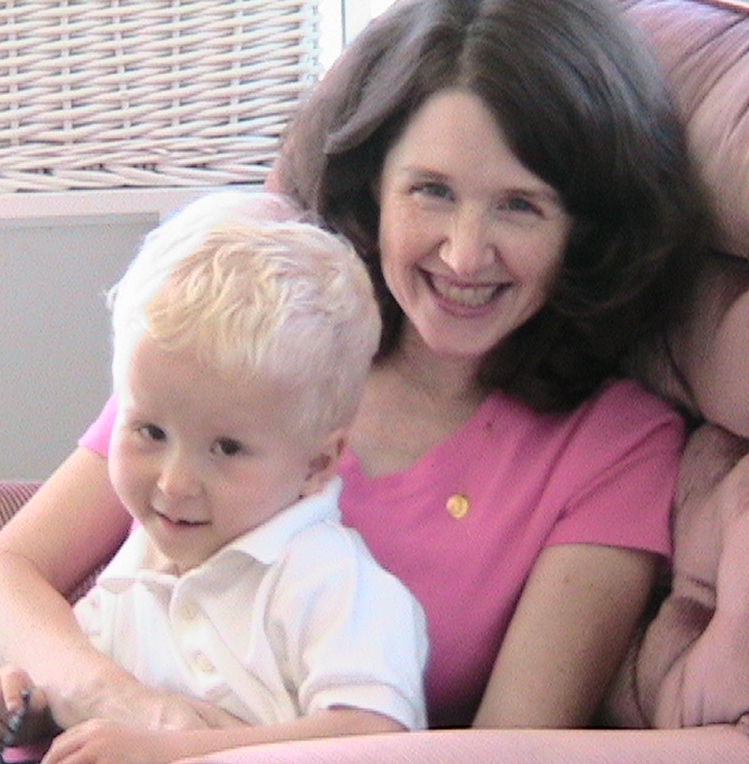
I will repeat what I just wrote in an email to a fellow ClubMom blogger whose toddler son, the delicious Noah (over whom I have drooled in person), is going through the same Early Intervention evaluation process Wonderboy went through a couple of years ago. Noah has been diagnosed with speech delay, and I feel a bizarre and probably obnoxious urge to welcome Amy to the club. She mentioned on her blog that although they think hearing loss is not likely in his case, Noah will be undergoing a diagnostic hearing screen soon, to be safe.
And that prompted me to spout forth a great deal of unsolicited advice about how to get most out of a toddler hearing screen. Then it occurred to me that that’s what ClubMom is paying me for, to spout forth unsolicited advice on this here blog. So spout I shall.
When Wonderboy was an infant, his hearing tests were the auditory brainstem kind I wrote about here. But once he was a year old and had his hearing aids, his periodic testing shifted to a sound booth. Kids with aids need testing on a regular basis, to make sure the settings are right. As the child gets older and more responsive in the booth, the audiologist can better fine-tune the settings.
For a child under four, the big challenge of the sound booth hearing test is understanding what the audiologist wants him to do. Typically, the child will be in the booth with a parent or the audiologist’s assistant. The audi is behind a window, pushing buttons on her fancy machine. The child (or his helper) holds a toy or block up to his ear, and he’s
wearing little earplugs that pipe in sound, and when he hears a sound
he’s supposed to put the block in a basket or something. Then a little
monkey* in the corner bangs a toy drum and FREAKS HIM OUT. At
least that’s how it goes with Wonderboy. The drum-banging is supposed to be the payoff
for responding to the sound but Wonderboy suspects the monkey wants to eat
him.
*(Sometimes the monkey is a rabbit.)
I don’t know why they never tell you in advance, but you can help this test go
much better by doing some prep work. You can play the
hold-the-block-to-your-ear-and-slam-dunk-it-when- I-go-beep game at home to get
him used to how the whole thing works. It’s good to hold a card or
something in front of your
mouth so he has to listen for the beep instead of watching you open
your mouth. Also try it with shhhh and ssss sounds, and clicks, and whispering of all sorts.
The first time we did this kind of hearing screen, it was a
big waste of time because Wonderboy didn’t know what to do. The audiologist
told me no worries, the first time is mainly to train the child to do
the test and we should come back next week. I wanted to scream because Scott had lost half a day of work to take care of the other kids so I could go to this appointment, and now
we were going to have to repeat the whole process. I would have had Wonderboy practice, had I but known. (Had I but known Google Reader.)

Say! I don’t think I ever showed you my snazzy blue ear molds. And after my nutty mother made you look at all those How Ear Molds Are Made pictures and everything!
June 6, 2007 @ 7:16 am | Filed under:
Wonderboy Oh, the irony. Today is Wonderboy’s final speech therapy session before the summer break, and I have completely and totally lost my voice.
Not that I’m normally the one who does the talking during his sessions—but today there would have been a fair amount of summing-up chitchat between me and the speech therapist.
I guess she’ll get to be the one who sums up.
As for my boy, all I can say is thank goodness for sign language. The girls can hear my hoarse whispers but as far as Wonderboy’s hearing-aided ears are concerned, I’m just mouthing in silence. This is frustrating for him, because he is in the middle of a huge language explosion and wants to practice verbal speech all—the—time.
You know how it is with toddlers—practicing speech means they say something, and you repeat it back, and your part of the game is vastly important to them because it shows you know what they mean.
I was thinking about that, how important it is to human beings, from our earliest days, to be understood.
There’s a reason "you know?" and "know what I mean?" are common tags in our conversation.
There’s a reason St. Francis included "grant that I may never seek to be understood so much as to understand" in his famous prayer.
Even the baby has this desire. She is beginning to use sign language herself. When she signs something, and you understand and sign it back or say the word in English, her eyes light up; she beams. Your comprehension of her meaning delights her utterly.
It’s the same look on my boy’s face these days when I know that what he said was, "Daddy puts his phone in his pocket."
We are now going to be LATE for speech therapy because I’ve been sitting here overlong, writing. But I can’t tell the speech therapist today (because she doesn’t speak ASL) how excited I am that Wonderboy is so excited about saying sentences like the above.
And I am excited. It’s awesome, in the old sense of the word, to see him making these leaps of expression. And I had to share it with someone, you know?