The maple has dropped perhaps seventy percent of its leaves now. All the upper branches on its south-facing side are bare and the morning light glows through into my studio. The north-facing side is holding its secrets a while longer.
I love that I can see—in the wide gap between the Norway maple and a different neighbor’s Douglas fir—a distant blue smudge of mountains in Washington State.
In a middle-school art class in my hometown of Aurora, Colorado, I once painted a picture of blue mountains beyond a wide green valley speckled with wildflowers. Blue-green foothills, and mountains in deepening shades of blue and violet. We saw the Rockies every time we walked outside, and I painted those mountains the way I saw them in my mind’s eye. But then another student made fun of them. Mountains aren’t blue, he scoffed. And I remember the sudden flood of doubt. Of course he was right. Mountains are brown and green and gray and snow-white. What was I thinking? Mortified, I cut the entire mountain range off the page and threw it away. I tried pasting the meadow to a new sheet of paper and painting properly tinted mountains, but the glue wrinkled the paper and anyway, the new range was hideous. I trashed the entire thing.
And went outside and saw that I’d been right. There was blue in the hills. I’ve been watching for blue mountains all my life. For a few years I lived at the feet of the Blue Ridge and drank in those blues and violets all day long, feeling like I’d found my own personal Innisfree.
There midnight’s all a glimmer, and noon a purple glow,
And evening full of the linnet’s wings.
I’ve thought often of that boy in class with a kind of wry gratitude and ruefulness. Of course I had no idea at the time, but that encounter helped shape me: it taught me to trust my own artistic vision. I knew what I knew. My mountains were blue, and they were beautiful. Everywhere I’ve gone, “standing on the roadway, or on the pavements grey,” I’ve seen them in the deep heart’s core.
I saw the first snowdrops yesterday. Crocuses seem a bit late this year—usually there are many in the yards of our neighborhood by this point. The photo above was taken at a local park the last week of January, the year we moved to Oregon.
I took photos like mad that year—that first incredible Pacific Northwest spring. Funnily, I’ve hardly taken any pictures at all in the past few months. I think that without noticing it, I’ve hit a point where I’ll look at something beautiful and think: I’ve already got a photo of that somewhere. It’s nice, quite peaceful really, feeling like the seeing alone is enough.
I’m now wondering if this shift is related to my increasing immersion in needle-painting. The time-scale is so different: you can snap umpteen pics a minute, or you can spend months laying stitches with single strands of floss. Both art forms spark great joy. But I think right now I’m more nourished by the slower one. Now I only seem to take a photo if I think I might want to stitch it at some point.
Even now I’m staring at those petals and stamens and imagining what colors of thread I might choose. Those delicious lines of dark purple against the lighter shades. The deeper orange-yellow of the stamens that are farther from the lens. The way you could drop in just a stitch or two of the gold in the center of the more distant crocuses. The question of focus: would you try to recreate the mist of flowers at the top edge of the photo? Or zoom in close to the few up front?
In one of Eric Maisel’s wonderful books—I think this was A Writer’s Space, but it might have been Fearless Creating—he suggested an exercise to help give clarity about what you really truly want to do. He said to dream big, just imagine the grandest vision possible involving the art you wanted to create. Like, say, giving an acceptance speech for a major award for your novel. And since this was when I was becoming really obsessed with embroidery, I started to imagine a gallery wall with my original pieces—but the thing is, the vision immediately shifted to a small mountain cabin, quiet, a tumble of floss skeins, a chair with good light. I understood in a flash that my embroidery ‘dream’ was simply time and space in which to work.
That was a good little epiphany. Apart from the mountain cabin, there was nothing in the vision that isn’t within my reach nearly every day, if only for a few minutes.
Creativebug remains my favorite place to dip into art and stitching classes. They’ve got a pretty incredible deal right now: a year’s subscription for $10! Membership gets you access to the entire library of classes, including the new lineup. I’ve got my eye on Joy Ting’s Color Play: A Daily Practice in Watercolor and Colored Pencil, and Courtney Cerruti’s Creative Correspondence class sounds fun too.
Although we had never met, I knew Rebecca lived in my corner of Portland. She left the sampler on my porch one day, but I wasn’t home. Remember not being home? That day seriously was one of the very last times I wasn’t at home for a year.
The second-to-last very last time was March 10th. Even though my nose was still recovering from a harrowing-if-fascinating surgery to remove skin cancer, I went to the Tuesday night singalong of my beloved Low Bar Chorale. On my way into Show Bar at Revolution Hall, I passed some women sitting at one of the patio tables—and did a double-take, because I recognized Rebecca!
I think I sort of shrieked at her? I’m excitable that way. I introduced myself and we had a good laugh about it. She thanked me for testing the sampler and I told her I was already having a fabulous time with it. Then we went inside and sang with the band: a roomful of joyful adults shoulder to shoulder, mouths wide open, masks undreamed of.
Rebecca started a group text with her four test stitchers, and we spent the rest of March and April adjusting to lockdown and finding ourselves with LOADS of time for embroidery. Our deadline was late April, because Rebecca was supposed to film in May, I think. I loved working on the sampler, especially the alphabets. When Rilla saw the palette of floss colors I’d chosen, she laughed—they’re the same hues of Prismacolor pencils I always wear to a nub.
Covid, of course, changed Rebecca’s plans to fly to Creativebug’s studios in 2020 and film the class. But this year she was able to go at long last, and her class—Schoolhouse Sampler: A Daily Embroidery Practice—will begin on Saturday, aka January 1, the best day of the year.
(I love love love me a fresh start.)
The Schoolhouse Sampler is available at Rebecca’s Etsy shop, and you can sign up for the class at Creativebug. I’m a Creativebug affiliate, but I’m also a longtime subscriber, as you probably know if you’ve been around Bonny Glen for any length of time. It’s where I learned how to draw!
Heads up on an incredible deal! A whole year of Creativebug for $5. (Affiliate link.) The kids and I have taken sooo many of their art & stitching classes over the years. I’ve taken all of Lisa Congdon’s drawing classes and Rebecca Ringquist’s embroidery classes, to name a few—especially fun since I’ve become friends with both Lisa and Rebecca since moving to Portland!
I’ve posted many times about what an invaluable resource Creativebug is for homeschoolers and anyone else looking for affordable, high-quality art classes. This post recaps a few of my favorites.
I’ve archived last week’s Creativebug post (since that special is over), but I wanted a more evergreen record of classes we’ve enjoyed there. So here’s that post, tweaked for posterity. 😉
***
I’ve shared a lot here over the years about how much the kids and I love taking classes at Creativebug. Their drawing and painting classes have long been a staple of my Saturday-night art date with Rilla. The modest monthly subscription fee grants access to hundreds of classes in all sorts of creative pursuits: watercolors, line drawing, embroidery, sewing, knitting, crochet, cake design, on and on!
This Lisa Congdonclass on Basic Line Drawing launched my personal sketchbook practice several years ago and changed my world. (I’ve since had the pleasure of getting to know Lisa in person, because she lives right here in Portland. She’s a gem! As is her new book, Find Your Artistic Voice.)
(Note: This is a screenshot, not an embedded video, in case any of you are trying to click on that arrow!)
The other day at a singing party, a poet friend mentioned that she feels like fall is the beginning of the new year, not January 1st. Because of ingrained back-to-school associations, we agreed, but also—the brisk air rising in your lungs, quickening your pace; the freshened world beckoning you back after the air-conditioned hibernation of summer. I feel it today, the sense of beginnings: the yellow buses bustling along the narrow streets, fifty-cent composition books at the drugstore, apples red and ready on my neighbor’s tree. When does an apple’s life begin? Seed, blossom, first sweet bite?
I spent August stitching, mostly—finishing embroidery projects begun earlier in the year, then feverishly needling a cross-stitch lion for Rose’s 21st birthday, and then this past week, at a pace both leisurely and obsessive, working my way through Rebecca Ringquist’s Stitch-a-Day Sampler class on Creativebug (affiliate link). I’d noticed on Instagram that she was having a seconds sale on some of her Dropcloth Samplers, so I snapped up a Drawing Stitches sampler for five dollars and commenced using up the shortish strands of floss left from other projects. And fell in love with filling stitches: battlement, cloud, brick and cross, trellis.
As I stitched, a project shaped itself in my mind: a series of small pieces on a particular theme—too new to say more about, and it’s going to stretch my drawing skills past their comfort zone, but (like Lottie in Enchanted April, which I watched for the umpteenth time one Saturday as I stitched) I see it. It’s strange and exhilarating to have a creative vision fall from the tree fully-formed like a ripe apple—that’s not at all how writing a book works, where I have to card and spin the thread before I can stitch a row of words together.
I had everything I needed for this project on hand, except the right fabric. I’ve borrowed Sarah Benning‘s trick of using old, raggedy bedsheets for embroidery pieces, but the green one in my scrap pile isn’t quite right for what I mean to do. I was planning to scour some thrift shops when an unexpected treasure fell into my lap from Nextdoor—a neighbor three streets over offering a giveaway bag of linen and cotton scraps left from sewing projects. “Most pieces around six by six inches,” her notice read, and I gasped. Astonishingly, the next ad down—same neighbor!—was for free river rock. She has a few beds of stones she wants to replace, and she encouraged neighbors to come by and fill a bucket or barrow. I say “astonishingly” because that very morning I’d collected two or three smooth stones from around our yard and given them to Huck in a pan of soapy water to be washed and then painted in bright colors for edging our flowerbeds. If you happen upon any more stones like this in the yard, I’d told him, grab them for me because I need lots.
Now, thanks to this generous neighbor, I do have lots, a pail full, so our winter garden will be as bright as our spring, summer, fall. And in my studio there’s a bag of linen, blue, brown, cream, white, in strips and squares and odd shapes left by sleeves or pant legs. Even a few pockets, stitched, cut away, discarded, rediscovered and bulging with possibility. Happy new year, indeed.
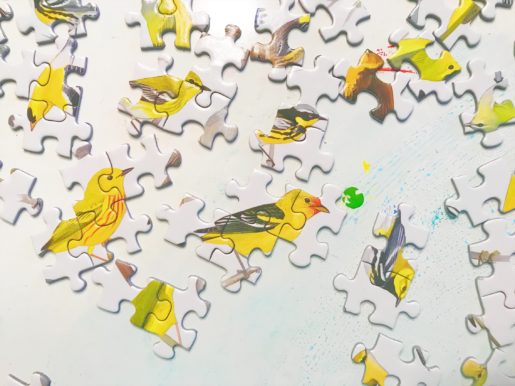
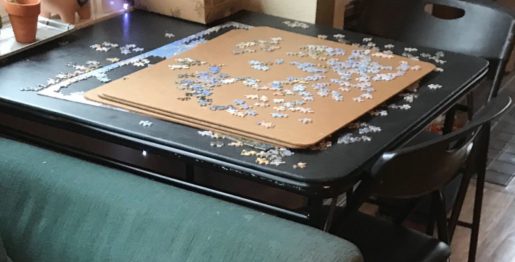
I’ve been getting lots of queries on Instagram about our puzzle boards as seen in the background of the pic, a few posts back, of Huck levitating off the sofa. Katharine asked about them, here, too, and I answered in the comments:
They’re whiteboards! I bought them a zillion years ago from a website called markerboardseconds.com or something like that. Discounted for scratch-and-dent, and man, what a great purchase that has turned out to be. What you’re seeing in the pic above is the backside, which we use constantly for puzzles–that little card table is right next to the big dinner table, so we need to be able to lay out our pieces and move them off the big table when it’s time to eat.
The other side is the whiteboard surface. We use some for homeschooly things, but mostly under watercolor paintings. Again, it’s nice to be able to move the wet paintings off the table to dry. They’re coated with years of spatter at this point.
That old markerboard seconds site seems to have disappeared, but you can find something similar (albeit considerably pricier) at Waldorf suppliers like Lyra, where they are sold as painting boards. And I’ve seen plain brown ones (no whiteboard side) at art supply shops. When I mentioned in yesterday’s post a topic idea about our best homeschooling purchases ever, these markerboards are what sparked the idea. We use them constantly, daily. The U.S. Presidents are listed on the back of one of them—probably permanent now since I think we wrote them out at least five years ago. And there’s a House of Stuart (or Tudor? both, probably) family tree stained into one of them. And then years and years of watercolor backsplash, as you can see in the top photo here. If you need to move a bunch of wet paintings off the dinner table, you can stack the boards up with Legos or blocks to create space between each tier.
In case you haven’t seen it: this battle of the museums is the most delightful thing I’ve read on Twitter in a long time. The Museum of English Country Life challenged the British Museum to “show us your best duck.” Museums around the world answered the call. Click through, unfurl all the responses, and settle in for some laughs.
We see your unique cosmetics container made around 1300 BC in ancient Egypt and raise you this nineteenth century plane with a weird looking duck head on ithttps://t.co/nYCKOgG5Q5pic.twitter.com/A3dGI1o9Yl
— The Museum of English Rural Life (@TheMERL) January 4, 2019