This is the dream we carry through the world
that something fantastic will happen
that it has to happen
that time will open by itself
that doors shall open by themselves
that the heart will find itself open
that mountain springs will jump up
that the dream will open by itself
that we one early morning
will slip into a harbor
that we have never known.
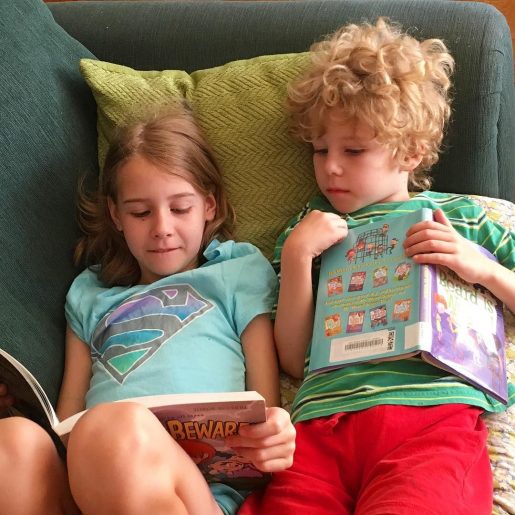
My copy of The Dream We Carry (named after a line from “This Is the Dream”) has the original Norwegian on the verso and the English translation on the recto. Rilla, curled up beside me, enjoyed comparing the two versions. She was struck by the lovely image of the mountain springs “jumping up” and reached for Google Translate’s snapshot feature to compare the literal (and much less poetic) translation. That led to a line-by-line unpacking of the language. The Hauge collection Luminous Spaces has an entirely different translation and we got really caught up in discussing the figurative and connotative differences between these variants:
…that we one early morning
will slip into a harbor
that we have never known
that I one early morning will glide
in on a wave I have never known
(Google Translate’s rendering of the original—interesting that it’s in first person singular, when both English translations use we)
Slip into a harbor, glide into a cove, glide in on a wave—such distinct and potent images, each in their own way.
There are buckets more I could say about our Hauge conversations, but the only one I’ll mention now is the Fillyjonk connection. We’re reading Tales From Moominvalley and today we finished the scene in which the anxious, constantly catastrophizing Fillyjonk tries to share her worries with her neighbor, Gaffsie, over tea in her gloomy seaside house:
“…This calm is unnatural. It means something terrible is going to happen. Dear Gaffsie, believe me, we are so very small and insignificant, and so are our tea cakes and carpets and all those things, you know, and still they’re so important, but always they’re threatened by mercilessness…By something one can’t ask anything of, or argue with, or understand, and that never tells one anything. Something that one can see drawing near, through a black windowpane, far away on the road, far away to sea, growing and growing but not really showing itself until too late. Mrs. Gaffsie, have you felt it? Tell me that you know what I’m talking about! Please!”
Gaffsie, a practical and restrained creature, doesn’t get it. She’s uncomfortable with the Fillyjonk’s demonstration of emotion, and she doesn’t have much use for a dramatic recitation of all the terrible things that could happen—because none of them have.
The poor Fillyjonk! Hauge’s dream is utterly closed to her—so far, at least.
Today this chapter sent me leaping (like a mountain spring) to read Hauge’s poem “We Don’t Sail the Same Sea”—
We don’t sail the same sea,
though it looks the same.
Rough timber and iron on deck,
sand and cement in the hold,
I ride low, plunge
headlong through breakers,
wail in fog.
You sail in a paper boat,
your dream fills its blue sail,
so soft is the wind, so gentle the wave.
Hauge struggled with depression and had to endure some very dark periods. Some of his poems acknowledge a sense of bleakness or of brooding menace—Fillyjonk feelings. I think the two of them do sail the same sea. But Hauge has the promise of that dream, the promise that some day the doors will open to a world where mountain springs jump up and and the wind fills a blue sail. I have hopes that the Fillyjonk, too, will encounter that dream—perhaps through an encounter with the Moomintroll family, or with Snufkin, later in the book. Right now she’s wailing in fog—with a kind of raw courage, the kind it takes to “plunge / headlong through the breakers.”
Well. At the end of lessons today I said we’d be moving on from Hauge next week, and such a clamor arose! Scott and the children think not. It seems I’ve been remiss in hoarding Hauge to myself all these years. I’m so happy they find him as compelling as I do.
This is the poem that carried me through this year, more than any other. “One Poem a Day” by Olav Hauge, from his lovely book The Dream We Carry. Those last lines especially—
I get up. It’s lighter. Have good intentions. And see the bullfinch rise from the cherry tree, stealing buds.
There have been so many days during the pandemic (and before) when I’ve walked around thinking: Have good intentions. Look for the bullfinch, the buds.
In her wonderful book Keep It Moving: Lessons for the Rest of Your Life, Twyla Tharp urges us to “make sharing delight into a daily occurrence,” or, as she puts it a few pages later, to find “the Daily Miracle. Find something that pleases you greatly first thing every morning when your mind is fresh.”
Mary Oliver puts it like this:
Every day I see or hear something that more or less
kills me with delight, that leaves me like a needle
What, for you, is the bullfinch rising from the cherry tree, stealing buds, today? Your ‘daily miracle’ for this last day of November? What little thing, ordinary or extraordinary, has more or less killed you with delight?
Would you like to hear this post read aloud? Allears has invited me to try their new voice recording studio for bloggers. I’d love to know what you think! (If the embedded audio player isn’t visible below this note, try this link.)
Most mornings I’m still sipping my first cup of caffeine when Huck rolls in for a snuggle in my writing chair. He’s markedly up-tempo at that time of day, and I’m still dragging. One way I manage the discrepancy in our states of alertness is to reach for a book of poems, which he’ll dive into eagerly and read aloud while my brain catches up to his speed. The Everyman’s Library Pocket Poets Haiku volume is a favorite and usually sparks some sweet discussion about the trees, the sky, the rain.
Misty rain; Today is a happy day, Although Mt. Fuji is unseen.
—Basho
That’s a pretty good one for a January day in Portland. For us it’s Mt. Hood and Mt. St. Helens, the latter of which we can glimpse in parts of our neighborhood on very clear days. When we catch sight of Mt. Hood, we’re usually in the car. “The mountain is out today!” someone will exclaim. Or: a delighted gasp and a cry of “Super Death Mountain!” which is what Scott and the kids call our local volcanoes. Third winter here and volcanoes are still a novelty for my gang.
Once a week Huck and Rilla attend classes at a co-op near the science center. Rilla has a free hour that we’ve been spending at the museum, a pretty giddy experience for both of us. We want every single thing in the gift shop. We spend long, absorbed minutes trying to solve brainteasers in one of the exhibits. We look out at the gray river in the rain and make plans for walks along its bank in the spring.
After Rilla heads to her classes, I have a chunk of time on my own—still as much of a novelty for me as those glimpses of volcanoes! Often I’ll have a work date at a café with my friend Shannon. On days she can’t make it, I walk to a nearby ramen shop for lunch and then take my laptop to the riverside cafe at the science center. I could eat there, but I really love ramen. I love the unavoidable single-tasking of eating it. You have your chopsticks in one hand for the noodles and the big spoon in the other hand for the broth, and that’s it, that’s all you can do—just eat this meal. No screens, no books even—you’d splash drops of broth all over the page if you tried. I sit where I can look out at the winter streets and watch people hurry or mosey past, and I imagine what David Sedaris would write about them in his diary. What Ross Gay would notice. What Joan Didion would see. Later, if I remember, I write down what I saw.
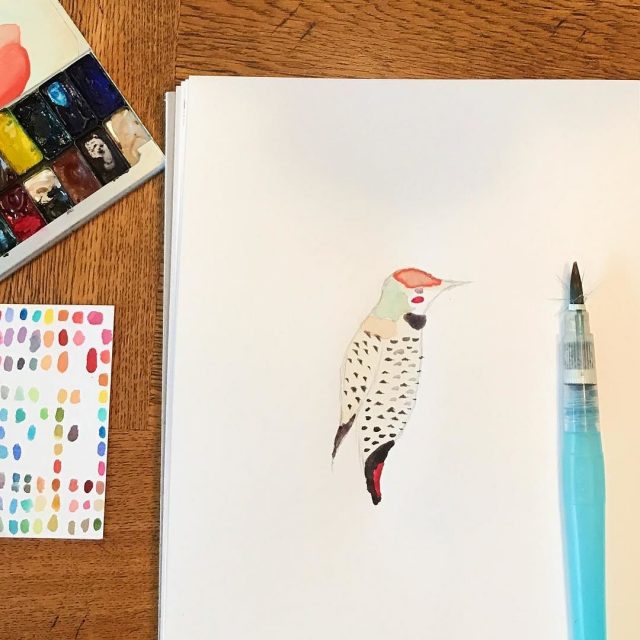
Not often, though—by the time co-op is over and I’ve driven back home, my mind has rushed on to the next thing, the next thing. This week we stopped at the bird shop for suet cakes. A flock of bush tits, tiny gray-brown things, swoops to our feeder every day for a feast. A female Northern flicker visits daily, and sometimes the male. Or maybe he comes every day too and I just haven’t caught the moment. We get downy woodpeckers and three chickadees and an occasional nuthatch, and of course lots of goldfinches and house finches. A pair of pine siskins. One sweet little Bewick’s wren. And sometimes a hermit thrush or two strides under the bare bushes, flinging leaf litter left and right in search of insects.
Withered branch where a crow has settled autumn nightfall
Another haiku from Basho, who wrote of being “astonished at the voices of mountain streams and wild birds.” Astonishment, yes. Every day, the world astonishes me.
Always leave thread in the needle and the sentence half-written.
The plunge into chill water is the hardest part, so leave the burner on, the hot tap running.
Don’t let ink sit in the pen for too long — it clogs the nib. You’ll lose time momentum interest scraping a dry point across your skin until the clot dissolves.
Always leave the iron on. You may return to find useful scorch marks, or with luck ashes you can read like tea leaves.
Fail to secure the lids of your garbage bins. While cleaning up the raccoon rummagings, you may happen upon lost notions or revelatory peelings. Sweep up the spilt verbs and reassemble them into cracked sentences. Smells are the best glue.
What times are these When to write a poem about love Is almost a crime Because it contains So many silences About so many horrors….
(His reworking of Bertolt Brecht’s “What times are these when to talk about trees is almost a crime because it implies silence about so many horrors?”)
***
Strive to change the world in such a way that there’s no further need to be a dissident.
***
Don’t let it be said of you that sluggish imagination drowned out the slush of your heart.
***
Don’t hew stones. Dip into the sea for poetry, every poem a live fish.
As often as not, this is what our Poetry Teatime looks like: circus animal cookies on a Dominoes napkin. Yesterday we didn’t even remember to bother with something to drink. Although it doesn’t take much to elevate the event (plates would be a good start) 😉 — there are days when you know you’ll miss your moment if you don’t jump right in. This was one of those days. We had just enough time left in our morning for a no-frills poetry teatime and a short nature walk, or a frillier tea and no walk at all. The vote was to squeeze in both.
Huck certainly doesn’t care, as long as poetry teatime contains the two essentials: cookies + Shel Silverstein. He had us all howling with “The Nap Taker” (“I did not take a nap— / The nap took me”). Beanie picked the Lewis Carroll collection (more howls) and Rilla chose a family favorite: Jack Prelutsky’s Imagine That! Poems of Never-Was. (When she read “The Multikertwigo” I had such déja vu. I will always hear that poem in wee Jane’s four-year-old voice.)
I, of course, read selections from Favorite Poems Old and New. There would be a mutiny if I reached for anything else.
(I sneak more contemporary poems into other parts of our day. These children mustn’t grow up without some Billy Collins in their lives.)
HMMM, I just realized my Diigo sidebar feed hasn’t been updating. If you like to check in on my Caught My Eye section, I’ve fixed the problem now. You especially shouldn’t miss Gabrielle Calvocoressi’s gorgeous and devastating poem, “The Sun Got All Over Everything.”
“…which seems like something I’d make up in a poem
except this time I actually did it.
I wrote: Grieve. Because we’re all so busy
aren’t we? And so broke.”
Lately it seems like poetry is the one constant in my day. (Well, and nail-biting.) We slid back into high tide about a week ago—albeit a choppy one, since I have to slip away for an hour in the middle of every morning to lie on a table that looks like something out of the set of 2001: A Space Odyssey—and what fits best into the allotted space are poems. Giddy over the thought of a Real Autumn, I turned to the “almanac” section of Favorite Poems Old and New and am working my way through all the seasonally appropriate verses. And then I’m reading “Rime of the Ancient Mariner” a section at a time—I can’t remember what prompted me to reach for it last week, but I’m glad I did because it’s been a big hit. You know it warms the cockles of this mama’s heart to hear her young children actually pleading for me to keep going, just a little more. I mean, of course they love it, it’s a good old-fashioned ghost story. Huck has joined the ranks of those tormented by the question of why the Old Mariner shot the Albatross. Why?
Side note: I had to chuckle over this stanza:
He holds him with his glittering eye—
The Wedding-Guest stood still,
And listens like a three years’ child:
The Mariner hath his will.
I know Coleridge had a pretty good handle on childhood—“Frost at Midnight” is in my top five favorite poems—but “listens like a three years’ child”? You mean the Wedding-Guest is wiggling and thumping his heels on the floor and interjecting questions into the tale every four seconds?
I remember reading to this three-year-old. It most certainly did not involve any ‘standing still.’
***
Thank so you much to all of you who have subscribed to my Patreon! I’m two people shy of 50 patrons, which is pretty darned exciting. I’m starting slowly with the special subscriber-only posts (trying to be sensible until radiation fatigue is over), but a new dispatch went out this afternoon. A monthly contribution of $1 or more gets you access to the private patron feed.
We interrupt this reading journal for a brief burst of mommyblogging. (But I promise you some Poetry Friday at the end.) The child whose blog name was decided before his real name was firmly settled upon…turns eight years old today.
Oh for boyhood’s painless play,
Sleep that wakes in laughing day,
Health that mocks the doctor’s rules,
Knowledge never learned of schools,
Of the wild bee’s morning chase,
Of the wild-flower’s time and place,
Flight of fowl and habitude
Of the tenants of the wood;
How the tortoise bears his shell,
How the woodchuck digs his cell,
And the ground-mole sinks his well;
How the robin feeds her young,
How the oriole’s nest is hung;
Where the whitest lilies blow,
Where the freshest berries grow,
Where the ground-nut trails its vine,
Where the wood-grape’s clusters shine;
Of the black wasp’s cunning way,
Mason of his walls of clay,
And the architectural plans
Of gray hornet artisans!
For, eschewing books and tasks,
Nature answers all he asks;
Hand in hand with her he walks,
Face to face with her he talks,
Part and parcel of her joy,—
Blessings on the barefoot boy!
The poem’s final stanza paints a somewhat grim vision of the boy’s likely future—”Made to tread the mills of toil,/Up and down in ceaseless moil”—but we’ll acknowledge that the weary adult may from time to time experience a pang of envy, looking at the carefree child with his life before him, “living and laughing as boyhood can.” Eat, drink, and be merry, the poet seems to be urging the child, for tomorrow you must get a job.
This bleak perspective sent me seeking to find out more about Whittier. I learned that he worked as editor of several weekly papers, including the New England Weekly Review, and was a passionate and active abolitionist. His anti-slavery publications and lobbying efforts earned him much enmity, including being stoned by angry mobs. He was politically active, pushing for legislation to end slavery, and was a founder of the Liberty Party which eventually morphed into the Free Soil Party. In addition to numerous abolitionist pamphlets, he published two volumes of antislavery poetry. In the late 1840s and ’50s, he served as editor of an influential abolitionist paper called The National Era. He was one of the founding contributors of the Atlantic Monthly. He was supportive of women writers, and in fact Sarah Orne Jewett, with whom he worked closely, dedicated one of her books to him. In short: Whittier was one of the good guys. And the wistfulness with which he urges the Barefoot Boy to celebrate his current joy and freedom makes sense in the context of Whittier’s grim awareness of the work that awaits him in the adult world. The more I learned about him, the more I saw that my initial take on the poem was a bit reductive.
I came to realize this was a particularly apt poem for me to ponder on my son’s birthday, here at the dawn of 2017. I understand why Whittier can’t extol the delights of a magical childhood—rooted in the small delights of the natural world, “rich in flowers and trees,/ Humming-birds and honey-bees…”—without his mind running to the toil that awaits the boy when he’s grown. We’re not finished yet. In the world of man, there remains a great deal to be done.
This week’s Poetry Friday roundup can be found at Keri Recommends.
America this is quite serious.
America this is the impression I get from looking in the television set.
America is this correct?
I’d better get right down to the job.
It’s true I don’t want to join the Army or turn lathes in precision parts factories, I’m nearsighted and psychopathic anyway.
America I’m putting my queer shoulder to the wheel.
And poetry keeps the intensity and the passion of a point of view, but in a forum where people aren’t hurting each other. It says, “Here’s what it’s like from my point of view.” All you have to do is listen to the poet.
And, in that, you don’t have to be anything other than what you are. The poem is a catalyst where you’re bringing two different kinds of people together. And at its best, when it works, there’s a kind of spark, and everyone comes away illuminated by what the spark has ignited.


 Most mornings I’m still sipping my first cup of caffeine when Huck rolls in for a snuggle in my writing chair. He’s markedly up-tempo at that time of day, and I’m still dragging. One way I manage the discrepancy in our states of alertness is to reach for a book of poems, which he’ll dive into eagerly and read aloud while my brain catches up to his speed. The