Archive for the ‘Television’ Category
WARNING: THIS POST IS NOTHING BUT SPOILERS.
Okay, I tried. Give it a chance, I told myself. There’s merit in the idea of putting Anne’s brutal backstory onstage and taking an honest look at the grim reality of the late 19th-century orphan’s plight. And some minor plot adjustments are to be expected with any book-to-screen adaptation.
So I hung in there when Marilla sends her back to the orphanage over the lost brooch (!!) and when Matthew gallops off to retrieve Anne, incurring a head injury along the way. I hung in when Anne rejects him in the train station, until he refers to her as his daughter. (!!!) I hung in there when Matthew and Marilla decide to show Anne they really do want to keep her by changing her name to Cuthbert. (!!!!)
Major plot alteration after major plot alteration, I hung in there. Ruby Gillis’s house catches fire and Anne rushes in to shut doors and windows, retarding the blaze but nearly dying of smoke inhalation–what?? Marilla gets invited and subsequently disinvited to join an organization of Avonlea mothers interested in progressive education for girls…okayyyy. Montgomery addressed that topic quite deftly with Miss Stacy (who hasn’t appeared in Anne With an E yet), but I can roll with it, even if it’s significantly ahistorical for these Avonlea mums. Anne is outright snotty to Jerry the hired boy (who has an interestingly large role in this adapation). Anne and Diana see Mr. Phillips touching Prissy Andrews’s hand and Anne informs the girls this means they are making a baby. Um what?
I even rolled with Anne smashing the slate in Gilbert’s face—a seemingly minor change but one that indicates a major shift in the direction the series has gone with her character. Amybeth McNulty has gotten high marks for her portrayal of Anne, and I agree she’s spot on in some respects—the delight she takes in delivering her grandiloquent speeches; the raw emotion on her face when she’s feeling rejected, which is about 80% of the time—but she tends to take Anne’s passionate outbursts into vicious, tantrumy territory. And the show keeps a tight focus on the drama, failing to present the small, funny moments that show us why the Cuthberts fall in love with Anne so quickly–even Marilla.
And here I am halfway through episode five and I’ve had just about all I can take. Anne has spent most of this episode snarling and sniping at Marilla like she’s channeling Nellie Oleson. She’s been prone to a sassy tone throughout the series, but the ramping up to eleven in this episode is due to Anne getting her period. Which: le sigh. Marilla, appeasing her, says Anne may invite Diana to tea. Anne displays about five seconds of almost-Anneish joy before diving into a shrewish harangue, insisting that she MUST have puffed sleeves for this occasion. She’s pretty nasty about it. “Matthew, tell her!” she demands, throwing in an exasperated “ARRRRGH” for good measure.
And now we’re at the raspberry cordial episode, and Anne. is. drinking. it. too. They’re both getting wasted. I heaved my own Anne-Cuthbert-Nellie-Oleson ARRRGH at the screen and closed the tab.
Through the first three episodes I kept asking myself how I’d evaluate this show if it weren’t an adaptation of my lifelong favorite book–if, say, this was an entirely new work of fiction. I think I’d be interested–the scenery is gorgeous, and Matthew and Marilla are terrific–but by now I’d be ready for someone to give Anne the old Plum Creek leech treatment. Or maybe we could call in Mrs. Piggle-Wiggle for the Puffed Sleeve Tantrum Cure.
January 21, 2015 @ 7:19 am | Filed under:
Television …and I have my theories.
December 31, 2014 @ 8:22 am | Filed under:
Television
Season 5 trailer for those who watch previews. Personally, I’m allergic to them.
Today feels like the weekend and I keep having to remind myself it’s only Wednesday. Guess I’m a wee bit excited about the return of Downton Abbey. Yes, I’ll be recapping the episodes again. Here’s my master list of recaps from previous seasons, if you need to brush up. 🙂
(Did you catch the two “Text Santa” Downton spoof videos last week? Part 1, Part 2.)
Searches for this phrase (minus the comma) keep popping up in my stats. It’s a Downton Abbey quote, Violet mocking Isobel: “I wonder you don’t just set fire to the Abbey and dance ’round it, painted with woad and howling.” She didn’t pause for a comma, which has some folks confused. ‘Howling’ here is a verb.
Here is a person who is painted with woad, and is also howling.
 Maaaaaaaaatthew!
Woad is a blue dye extracted from a the plant Isatis tinctoria or “dyer’s woad.” Its flowers are yellow but you can get blue from its leaves. I learned a lot about it while researching my Martha books—woad would have been one of Auld Mary’s staples. Indeed, it was a staple in European textiles through the Middle Ages, until it was gradually replaced in commercial use by indigo.
 Image source: Wikimedia
You chop the leaves into a paste, let them dry, crumble them into powder, then sprinkle them with water and allow them to ferment, a process known as “couching.” Then you add a mordant, something to help fix the color into the cloth. In days of yore this was most commonly stale urine. (The ammonia in the urine serves as the fixative, as you probably learned from The Mammoth Hunters.) Fun fact: according to this dyeing site, the urine of male beer drinkers was most effective. The collection and sale of urine from certain cities was big business, at one time.
Urine from London was shipped up the coast to Yorkshire, where there was a big dyeing industry, and this is the origin of the phrase “taking the piss.”
Captains were unwilling to admit that they were carrying a cargo of urine and would say that the barrels contained wine.
“No – you’re taking the piss” was the usual rejoinder.
Who knew?
In ancient Scotland, so the story goes, the Picts liked to paint or tattoo themselves with woad, especially before going into battle. In fact, that’s how they came to be called Picts by the Romans, from the Latin word “pictus” or painted. Julius Caesar wrote in his The Conquest of Gaul, “All the Britons color themselves with glass, which produces a blue color.” Over time his word “vitro” (glass) came to be associated with woad, and the image of blue-painted Scottish warriors stuck. Some modern scholars dispute the association, saying Caesar meant something else entirely; it is widely accepted that the early Britons did engage in body art but the contemporary thinking, as far as I can tell, seems to be that the paint was probably not made from woad. However, other experts will point out that woad has antiseptic properties, which could well explain its use in painting the skin before or after armed conflicts. And so woad lives on in battles (of the scholarly sort) to this day.
Whatever the truth may be, the blue body paint is exactly what the Dowager Countess had in mind when she tossed her barb at Isobel. If I had any kind of Photoshop skills you would be looking at Maggie Smith’s face painted with woad (and howling) right now.
Here’s my recap of the Downton episode in question: Season 4, Episode 5 (UK/DVD 6)
February 23, 2014 @ 8:33 pm | Filed under:
Television My previous Downton Abbey recaps are here.

Cousin Oliver’s big day
If I enjoyed screencapping more, I would turn this into a fashion blog and do nothing but rhapsodize about this week’s costumes. What an eyeful we got! Alas, I lack the vocabulary, not to mention the fortitude.
In lieu of gown-swooning, then, let’s talk plot. This is the supersized Christmas special, so there’s a lot of ground to cover. Here we are in June 1923, with the gang heading to London for Rose’s long-awaited presentation at Court. All season we’ve seen Rose chafing to be free to be out and about in London society—you know, as opposed to the dull life she’s been leading up till now, going to jazz clubs and sneaking off to float down rivers with her secret boyfriend—and all season Cora has chirped at her to be patient. Well, it looks like Rose has survived the wait without scandal, despite the way the season has pretended her reckless disregard for social norms was bound to lead to catastrophe. Not only do we have nary a whiff of scandal, there is absolutely no mention of her erstwhile fiancé, Jack Ross, nor the broken heart she might have been supposed to suffer when he, for her own good, broke off the brief engagement last episode.
Eight months have passed since the Jack Ross adventure, during which interval Edith and Rosamund disappeared to Geneva and Edith has “come back looking more tired than when she left,” in the kitchen staff’s opinion. Of course we know what the staff does not: Edith has had her baby and is now sadder than ever, wishing she could have kept her little girl. She is not exactly enthusiastic about the London trip, envying Tom who gets to stay behind for a couple of days—he has an estate to run. He’s expected to show up at Rose’s ball, though. I mean, someone has to bring Lord Grantham his dog.
(more…)
February 16, 2014 @ 9:31 pm | Filed under:
Television 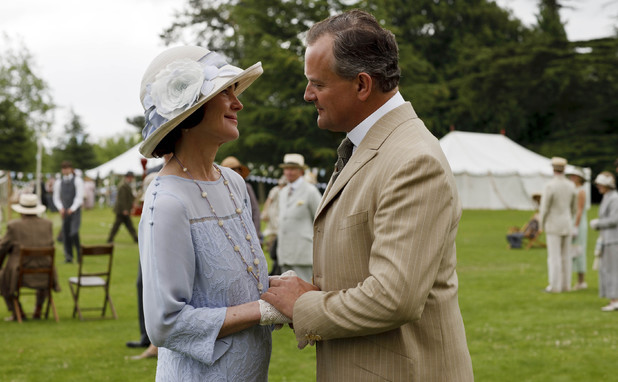
Darling, I’m so glad you survived your time in the land of Prohibition.
(UK / DVD episode 8. Also, spoilers below.)
Proving it has its priorities firmly in place, this episode starts with the VIPs: the Very Important Pigs. Look at ’em, up and drinking, fat and sassy! Oh, what a relief. I’m only sorry we never got to meet that dastardly fellow, the Negligent Pigman. After the great trough catastrophe, Tom and Mary have decided to offer sturdy Mr. Drew, whose devotion to Yew Tree Farm has proven his mettle, the job of Keeper of the Pigs.
Let’s just take a moment to savor this: Downton Abbey is full of grown men and women who require another adult’s help to change clothes three times a day, but Mr. Drew can be trusted to tend these somewhat delicate Pigs and FARM AN ENTIRE FARM. In fact, he’s so reliable that Edith is eyeing him as a potential foster father for her child. (She’ll be talked out of that by Aunt Rosamund, but that comes later.) For once I’m not making fun of the show; I think this is a pretty realistic depiction. I have no doubt that Mr. Drew is fully capable of running his farm and tending the Pigs. And while Mary has shown that she can do a hard night’s work in an extraordinary circumstance (and even elegantly scramble an egg afterward), it’s amusing how different the family’s definition of “farming” is from Mr. Drew’s. When Mary and Robert speak of “farming Downton themselves,” they mean making plans and hiring people to carry them out. When Mr. Drew speaks of farming, he means getting up at 4:30 in the morning to check on the Grantham Pigs before milking his own cow.
A recurring theme throughout the four seasons of this show has been how much happier the upstairs crowd is when they have some real work to do. During the War, we saw Edith blossom as an aide to the recovering soldiers (and, later, as a newspaper columnist), and Sybil grew from a restless cause-seeker to a woman who found real satisfaction in her nursing duties. We began this season with Mary and Isobel in zombie states, six months after Matthew’s death. The spark came back into Mary when she was nudged into taking an interest in the management of the estate, and Violet basically applied a bellows to Isobel, dumping the problem of Carson’s down-and-out former friend in Isobel’s lap, fanning the embers of her do-gooder zeal back into the fire she runs on.
We’ve seen it with Cora, too, this season: so many scenes in which she looks absently up from a book, smiles benignly, and does nothing of consequence—she has seemed more like an amiable ghost than a person whose actions have any effect on the world. This week, Cora was zooming around in a whirl of bazaar preparations, and although her somewhat vapid remarks seemed designed to elicit eye-rolls from her family as well as the audience, the truth is that organizing an event on the scale of that one is a mammoth undertaking. If you tried to assign me that job, I’d run away with the Pigman. I appreciated Tom’s insightful “beast of burden” remark near the end of the episode, his recognition of how hard Cora had toiled over the bazaar. I still found myself wanting to roll my eyes at everything Cora said—I’m serious when I say I think the script wanted me to—but Tom’s right. We very seldom see Cora at work, but she does work. There are parts of her job she could do a great deal better; she’s been only superficially aware of Edith’s misery and Rose’s mischief all season. But she organized a mighty impressive bazaar, and I’m glad Tom gave her her props.
(more…)
February 9, 2014 @ 9:03 pm | Filed under:
Television 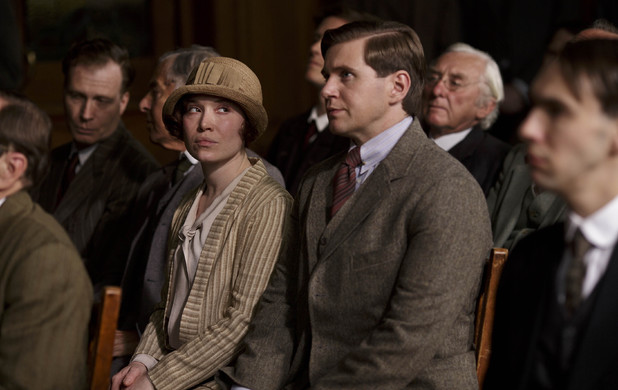
“You do realize even Alfred gets more screen time than you do?”
(UK / DVD episode 7. Also, spoilers below.)
Telegram! Robert has been summoned to America by Cora’s Horrible American Mother to assist Cora’s Impossible American Brother. There’s a scandal involving oil and a Senate committee who may or may not be favorably impressed by a titled brother-in-law, because nothing says respectable like an impoverished English earl who snaps up an American heiress to save his estate, and then loses her fortune on bad investments.
Bit of a flurry over the notion that Bates must accompany Lord Grantham to America. (I love how it’s always “America.” Last season, when Shirley Maclaine arrived to out-shout the Dowager, she referred to her home as “America” 100% of the time. You have to wonder if Julian Fellowes has ever chatted with any Americans long enough to discover that if you ask us where we’re from, we don’t name our country; we name our state. Unless you’re a New Yorker, in which case you name your borough.)
Anna puts on a brave face for Bates but sobs in the hall. Mrs. Hughes takes the case to Lady Mary, who puts on her best stone face and insists she would like to help, but she “must know the facts.” What is Mrs. Hughes to do? She reveals Anna’s secret, and Mary marches straight to her father and orders him to take Thomas to America instead of Bates, wearing that exact same stone face and saying, “I can’t explain it. If I could you’d agree with me.” I actually burst out laughing at this, despite the graveness of the subject matter. It’s so Mary. She expects her father to jump when she says jump and take her word that jumping is the gentlemanly thing to do in this circumstance. But by golly, nobody’d better expect her to take any request on faith.
All right, then, it’s settled, Bates stays, Thomas goes, Mary has a moment with Bates (“It wasn’t your fault, Bates. It wasn’t Anna’s, but it wasn’t yours, either”), and—HOLD ON EVERYONE, THE PIGS ARE COMING!
(more…)
February 2, 2014 @ 9:10 pm | Filed under:
Television 
“Look, I’m as unhappy about this storyline as you are.”
SPOILERS BELOW.
So here we are at episode 5—that’s episode 6 by UK reckoning, or if you’re watching via Amazon—more than halfway through the season. And if I have realized anything during these past few weeks, it’s that I would pay good money to watch a show featuring Isobel Crawley as a village sleuth—a sort of “indigation-fueled ” Miss Marple (to borrow Violet’s excellent phrase) minus the knitting—solving local crimes in between rounds of barbed exchanges with her crotchety relation. The whole Young Peg plot was a predictable throwaway, really—he’s a thief! no wait, I’ve been sitting on the paper-knife this whole time—but it allowed for some of the most amusing dialogue and face-making of the season. (And some champion bell-ringing on Violet’s part.) Game, set, match to the Dowager, indeed. Did you catch the stink-eye Isobel shot the good doctor at that remark? Coming to take his staunch loyalty for granted, are we?

(more…)
January 27, 2014 @ 6:49 pm | Filed under:
Television 
After the high drama of last week, this episode proceeds at a more subdued pace—right up until the final scene, which comes off like a promo instead of a scene: Previously on Melrose Abbey. But truly, there wasn’t a whole lot of Melrose in the house this time around. The most shocking development was that Mary voluntarily spent ten minutes in the nursery with baby George.
(more…)