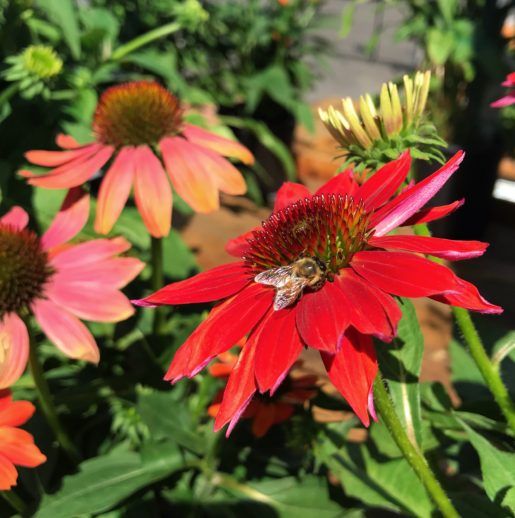
Rilla and I made a bug snug yesterday. I don’t have a photo of it yet (too cozy to get up right now, and anyway if I go downstairs I’ll be swept into The Rest of the Day and this post will float into the drafts pile with the hundreds of other unfinished musings I’ve amassed over the years), so I searched for bug and then bee in my photo library. So. Many. Bee pics. This one isn’t the crispest but the red coneflowers felt more apt for this November morning.
Anyway, the bug snug! You make a tripod of sticks or canes—we used this video to assemble it—and fill it with twigs, leaves, flower stems, grass cuttings, all the wealth summer left behind in your yard. This creates habitat for overwintering insects. Also it’s very cute.
2.
The bug snug is part of our big project: participating in Portland’s Backyard Habitat Certification program. The new house has a biggish corner lot, beautifully landscaped by the former owner (she’s my hero—oh the care and love she lavished on this house!), mercifully pesticide free, with roses and berries and perennials, but also a lot of grass. We’ve begun our project by sheet mulching over the grass along the retaining wall that runs along our corner sides (the front and west sides of the house). I’ve planted a few perennials there and some wildflower seeds, but the main goal for now is to knock back the grass and create beds for planting native shrubs and pollinator plants in the spring.
The kids were surprised when I told them it will likely be two or three years before we get to the Silver certification level, and longer than that to qualify for Gold. For me, the leisurely timeline is a comfort. It’s a puttering project, a little here, a little there, doing what we can do.
Huck has done most of the digging for the south-side border. We’re sheet-mulching over the grass (layers of cardboard, compost, and leaf mulch), but we needed to remove a narrow grass right along the retaining wall so we could tuck the cardboard down, and he’s making another narrow trench to edge the bed. He has discovered that he loves digging. This is excellent news for his mother.
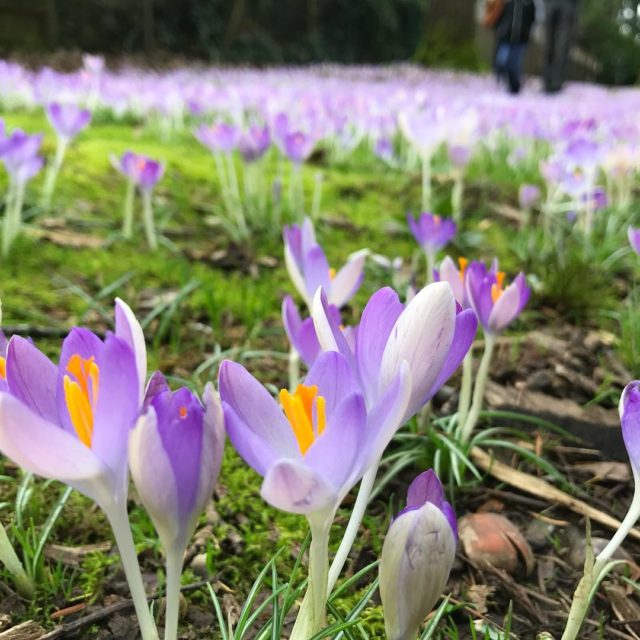
I saw the first snowdrops yesterday. Crocuses seem a bit late this year—usually there are many in the yards of our neighborhood by this point. The photo above was taken at a local park the last week of January, the year we moved to Oregon.
I took photos like mad that year—that first incredible Pacific Northwest spring. Funnily, I’ve hardly taken any pictures at all in the past few months. I think that without noticing it, I’ve hit a point where I’ll look at something beautiful and think: I’ve already got a photo of that somewhere. It’s nice, quite peaceful really, feeling like the seeing alone is enough.
I’m now wondering if this shift is related to my increasing immersion in needle-painting. The time-scale is so different: you can snap umpteen pics a minute, or you can spend months laying stitches with single strands of floss. Both art forms spark great joy. But I think right now I’m more nourished by the slower one. Now I only seem to take a photo if I think I might want to stitch it at some point.
Even now I’m staring at those petals and stamens and imagining what colors of thread I might choose. Those delicious lines of dark purple against the lighter shades. The deeper orange-yellow of the stamens that are farther from the lens. The way you could drop in just a stitch or two of the gold in the center of the more distant crocuses. The question of focus: would you try to recreate the mist of flowers at the top edge of the photo? Or zoom in close to the few up front?
In one of Eric Maisel’s wonderful books—I think this was A Writer’s Space, but it might have been Fearless Creating—he suggested an exercise to help give clarity about what you really truly want to do. He said to dream big, just imagine the grandest vision possible involving the art you wanted to create. Like, say, giving an acceptance speech for a major award for your novel. And since this was when I was becoming really obsessed with embroidery, I started to imagine a gallery wall with my original pieces—but the thing is, the vision immediately shifted to a small mountain cabin, quiet, a tumble of floss skeins, a chair with good light. I understood in a flash that my embroidery ‘dream’ was simply time and space in which to work.
That was a good little epiphany. Apart from the mountain cabin, there was nothing in the vision that isn’t within my reach nearly every day, if only for a few minutes.
This category is such a gimme—in Portland—in spring!
Scott and I take a walk every day after lunch—longer and longer, as the weather improves. And I often take an earlier walk with Huck or Rilla or both. Some days, after Scott and I return, I go back out, another ramble through the streets of Northeast PDX, by myself. With music or with silence. I love walking to a soundtrack, but a quiet walk provides the white space I’ve been seeking. I sometimes find it hard to choose.
In bloom this week: daffodils (the earliest risers now fading, but big lush clumps of them still nodding in full glory); cherry blossoms and tulip magnolias; a few flowers left on the flowering plums & Bartlett pears, but those are mostly leafing out; tulips beginning to open; a profusion of grape hyacinths (my favorite bulbs); wild violets in the lawns; camellias already dropping petals in a thick carpet on the sidewalk and grass; vinca and lantana; a few early rhododendrons.
Bees ecstatic in the cherry blossoms.
Last year’s green onions, neglected, fattening with bloom.
Ahhh…a fun, full, hard, harrowing week is behind me. Not only did I have the excitement of the book launch, I also took a (truly excellent) four-day Author Visits workshop by Kate Messner & Julie Hedlund, and I had a writing deadline for Brave Writer. The workshop was terrific, with lots of practical strategies for reimagining our in-person school visits to fit this year’s all-remote reality. (Even schools that are reopening classrooms aren’t going to be bringing in authors and illustrators to meet the kids face-to-face this year.)
This week things are settling back to routine—this still-new routine in which the bulk of my work time falls between 6am and noon, and we homeschool in the afternoons. With only two kids left to homeschool, three hours is plenty of time for any high-tide learning we have planned. Then I log into Zoom for my afternoon coworking session (3-5pm PDT; see my Patreon if you’re interested in joining) and I usually keep going afterward until I run out of steam—usually around 6. A full day, to be sure! But I like it that way.
Today’s Tuesday, which means Poetry Teatime! Maybe I’ll see if Rilla wants to make some oat bars for our treat. We’ll also do some conversing in German (we’re using Talkbox.mom this year and having a lot of fun with it—I can share a coupon code if you’re interested). Rilla and I are cooking up some kind of longterm study project on frogs, one of her special interests.
Something I haven’t had enough time for this past month is reading! Hoping to turn that around this week. My Kindle is going to explode if I don’t give it some attention. I want to ask what you’re reading right now but that’s a dangerous question, when you already have a TBR list that stretches to the moon.
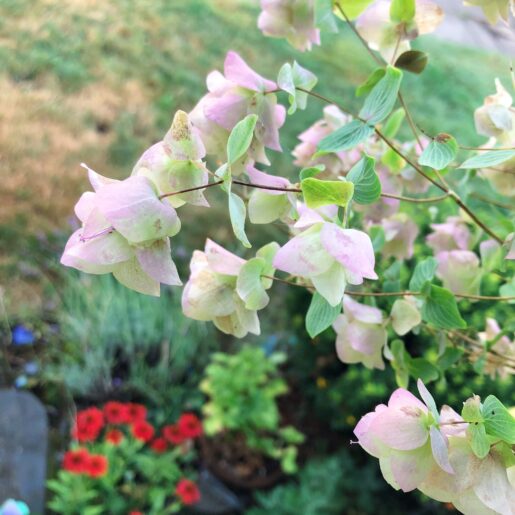
Small delights: flowering oregano and coneflower. Two ripe blueberries. Chickadees chatty in the bushes. The air still cool. Kimiko Hahn, Billy Collins, and Ross Gay in my head. Huck working out percentages in an absorbed murmur as he comes down the stairs. Bees in the lavender. Pens in the jar.
First: very important: in that last post, I forgot to caption the photo! This matters only because I meant to say it was my neighbor’s garden, not mine. That daisy-and-lupine combination is magical and I’d like to copy it as soon as I can…which may not be for a long while. The vicious pandemic grocery budget has absorbed several other categories of funds at present. Plus I’m still paying off my little skin cancer adventure.
Fortunately, living in my Northeast Portland neighborhood has expanded my take on gardening. My first spring here, I walked around in wonder, dazed, drunk on beauty. The yards all around me astonished me daily with wave after wave of bloom. If you followed me on Instagram in Spring 2018, you saw my enchantment in action—every day, photo after photo of some delightful combination of petal and leaf in a neighbor’s front yard. And, knowing Portland has many dazzling corners, I kept thinking: gotta get to the rhododendron garden, gotta get to the rose garden—but I was still recovering from radiation then (it takes a long while before you feel fully yourself after treatment), and “gotta gets” weren’t in the cards yet. Then one day it struck me: I live in a giant garden. This whole neighborhood. It’s all right here rolling out from my doorstep, free for the drinking-in, and not a morsel of work required on my part.
That realization hushed the gotta-gets right up, and ever since, I walk around this neighborhood (it’s called Roseway, for Pete’s sake) feeling like Mary Lennox. Everything’s wick and wonderful and surprising.
I met the neighbor who owns the lupine garden (oh I wish you could see her entire yard; there’s no lawn (my ideal); it’s all daisies and lupines and poppies, and one big peony in the middle) once last summer, during the hot months, when I was out for a nature walk with Huck and Rilla, and the neighbor (we didn’t exchange names, pity) was out front, weeding. I gushed over her lemon balm, which smelled heavenly, and she immediately grabbed a shovel and dug up a clump for me. Gardeners and sourdough bakers are the most generous folks around, always eager to shove some treasure into your hands. It helps, I suppose, when your treasures are things that multiply abundantly.
Sourdough: of course you know I had to restart my starter this spring, what with 80% of the internet obsessed with baking at the moment. I had a good one going two years ago but never seemed up to baking with it (see above re: low energy for a good long while post radiation) and eventually I let it go. Before that, I had years of sourdough starters on and off in San Diego and Virginia. Again: much more tending of the starter, not so much baking of bread. (Sourdough bread, that is. I baked honey wheat loaves almost daily at some points. Remember when I had a whole bread blog?)
This time around, I’m baking. Yesterday’s loaf wasn’t my best: the cooler weather? A wetter dough? I got a decent oven spring but the crumb was dense, not airy like I aim for. And I thought the loaf was just a tad undercooked. Which made for a hilarious moment when Rose told me this was my best sourdough bread yet: it’s the perfect texture, she said. Rilla emphatically agreed. They like a dense, moist loaf. Which means I can never go wrong! No matter how the bread turns out, someone in the house will think it’s perfect.
Which is how I feel about my neighbors’ gardens, all of them. What you’ve nurtured here: perfection. Any gaps or flaws you may perceive are invisible to me. All I see is your magic. Those purple irises against the lime-green euphorbia: inspired! Your lawn full of tiny blue forget-me-nots: a poem I’m learning by heart.
As I mentioned yesterday, I’m scooping things up from Facebook memories.
Feb 3, 2009 (A couple of weeks after Huck was born) Just said goodbye to my parents (sniffle) and now I’m alone, possibly for the first time, with my OH MY GOODNESS six children.
Feb 4, 2009
Off to a busy start. Speech therapy, piano, Journey North. Nothing like diving right in!
***
Feb 3, 2010
This moment caught: 9yo sketching amaryllis, the 2 boys playing w/ trains. 11yo reading about B. Franklin. Teen reading Gulliver. 3yo sings.
***
Jan 27, 2013 Kids tearing through the room, shrieking, swords aloft, while Scott softly strums the ukelele, singing sweetly: I Wanna Be Sedated
Feb 4, 2013
Aw, how cool is this? The Journey North Mystery Class coordinator wrote me to say thanks for sending so many new families their way. Thanks to YOU guys for joining the fun! You know who you are.
***
Feb 3, 2014
In my statcounter this morning: search hits for “done with downton abbey” and “downton abbey season 4 not believable.”
Feb 3, 2014
Dear new lady in yoga today who said to me, “You’ll understand once you hit 30”: I LOVE YOU.
Feb 4, 2014 Sticky short film preview: “Exiled from the tropical paradise where they evolved, a tiny population of remarkable stick insects dodged extinction by hiding under a single windswept bush on the world’s tallest sea stack for 80 years. Thanks to a dedicated team of scientists they’re now living safely in captivity, but when can they go home?” (2020 note: I never did see the whole film. Must remember to look it up.)
***
Feb 3, 2017 In the car on the way to piano lessons, there’s a heavy sigh from the backseat.
Rilla: Sometimes…sometimes I just wish I were a mantis shrimp.
Feb 4, 2017
Just read the 2009 NYT obit for Eleanor Perenyi. Have decided that being remembered as a “writer and deliciously opinionated amateur gardener” is a worthy life goal. I’m sure I have a book of horticulture essays in me somewhere.
Feb 4, 2017
This one’s too long to paste: a detailed note about books I was reading/half-reading after two frenzied months of reading Cybils YA Fiction nominees. “Books I have read 1-3 chapters of since January 1st, most of which I do mean to finish eventually.” (Note to self: would be fun to do an update of this post. Which ones did I actually finish?)
I’m in a weird place right now where reading is concerned. I do this sometimes–read the beginnings of too many things and find it hard to settle down to finish something. I could have read three books in the time I’ve been pinballing between a dozen.
I try to be patient with myself when this mood hits, once or twice a year. It’s very common for me to rebound from Cybils reading this way—that fierce two-month drive to read a staggering volume of books. It’s compounded this year by—oh, let’s just say by many factors unique to 2017.
***
Feb 4, 2018
This one reminds me it’s time to visit Wilshire Park to see if these beauties are back in bloom. I’m guessing yes: we’ve got crocuses popping up all over the neighborhood.
January 30, 2020 @ 4:42 pm | Filed under: Nature Study
The view out my studio window this morning. If you’re wondering whether I got any writing done, there’s your answer. I called Huck, my early bird, to see the spectacle and we stood at the kitchen door and just stared and stared. This undoctored iPhone photo doesn’t do it justice. All of Portland was agog—the Portland subred is one breathtaking pic after another today. Ditto the #portlandsunrise hashtag on Instagram.
Rilla’s a cloud spotter (The Cloud Collector’s Handbook is a favorite tome) but a late sleeper—oh the dilemma for a doting mom! I let her sleep. She said (considerably later in the morning) it was the right call. I’m counting on her to educate me about this type of cloud formation, though! We’d have jumped on it already, but I got wrapped up in an Instant Pot burn-error situation and morning ran away from me. (Aloo gobi, one of my favorite dishes. Three burn errors. But eventually an entirely scrumptious lunch, and plenty for later.)
We’re nearing the end of Moominland Midwinter and I’m going to miss it! We all laugh and laugh and laugh. At Little My, especially. Spring is coming back to Moominvalley, and it feels like that here, too, only we bypassed the months of snow and ice. So far. Ice could still happen. Hear that, all you trees bursting into premature bloom? You worry me! (As much as I love you.)
January 27, 2020 @ 9:16 pm | Filed under: Nature Study
It’s crocus time here, right on schedule. Other bursts of bloom are unnervingly early—branches with pink blossoms, camellias going full throttle. I’ll have to look back at my photos from last year, but I’m pretty sure we didn’t get camellias until March or April. Late January is moss time. Gray skies and green walls. I love it.
That chartreuse just kills me! It’s getting to be the time of year when you don’t want to take a walk with me because I have to stop every six paces for a photo. Scott is very patient.
Funny tidbit yesterday: on Saturday the kids and I had walked down Klickitat Street (still a thrill), and yesterday Scott and I happened to take the same path. A few blocks from home, we noticed a black glove on a low stone wall belonging to a corner house. I stopped to look at the glove, and Scott thought I was taking an arty photo—a lone glove on the mossy wall. But no, what caught my eye was that it looked like my glove. I reached into my pockets—and sure enough, I was missing one. Thanks, kind neighbor, for finding it and leaving it where it caught my eye!