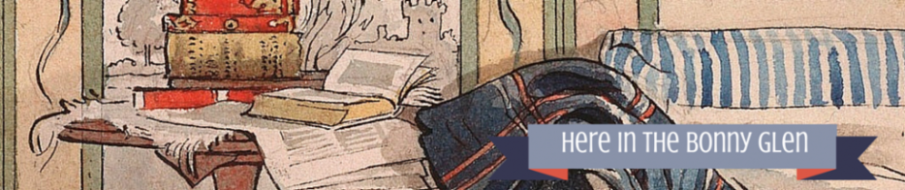
Arthur Rackham illustration from Some British Ballads, 1919.
Image source: Wikimedia Commons.
Our poetry selections for today, as we move out of Chaucer and into some medieval ballads: “The Twa Corbies” and its English cousin, “The Three Ravens.” Just a little something light and cheerful for a chilly November day. You know, light like sunbleached bones.
The Twa Corbies
As I was walking all alane,
I heard twa corbies makin a mane;
The tane unto the ither say,
“Whar sall we gang and dine the-day?”
“In ahint yon auld fail dyke,
I wot there lies a new slain knight;
And nane do ken that he lies there,
But his hawk, his hound an his lady fair.”
“His hound is tae the huntin gane,
His hawk tae fetch the wild-fowl hame,
His lady’s tain anither mate,
So we may mak oor dinner swate.”
“Ye’ll sit on his white hause-bane,
And I’ll pike oot his bonny blue een;
Wi ae lock o his gowden hair
We’ll theek oor nest whan it grows bare.”
“Mony a one for him makes mane,
But nane sall ken whar he is gane;
Oer his white banes, whan they are bare,
The wind sall blaw for evermair.”
(spoken)
(sung)
This week’s Poetry Friday roundup can be found at Teacher Dance.
I’ve posted this song before, I think, or mentioned it, at least. “The Broom of the Cowdenknowes”—one of those good old Scottish folk songs that makes something well up within me. This intense emotional response seldom has to do with lyrics; it’s something in the Celtic melodies, the yearning, the slurred notes melting into each other and reaching for something never quite graspable. That sea-swaying cadence at 22 seconds undoes me every time. I remember in dance classes when they told us (coaching better posture) to imagine a string pulling upward from the top of our head: the effect this music has on me is as if there’s a string attached to my heart and the notes are pulling.
A song that pulls me with both melody and lyrics is one I know I’ve shared here before, The Loch Tay Boat Song. Oh, it devastates me. In a good way.
“The crow when he sings is nothing short of a clown; he ruffles his feathers, stretches his neck, like a cat with a fish bone in her throat, and with a most tremendous effort delivers a series of hen-like squawks.”
This quote, attributed simply to a “Mr. Mathews” in the Anna Comstock Handbook of Nature Study, elicited a chorus of giggles from my flock this afternoon, when we encountered it during an hour spent informing ourselves about crows. Beanie, the nine-year-old, especially enjoyed it, and I heard her repeating it to herself shortly afterward.
This morning all our plans for the day went up in…not smoke, but mercury. Half the children have fevers and sniffles; some are worse than others. We canceled Shakespeare Club, much to the regret of the teenager and her mother (sob—we were to begin rehearsing scenes from The Scottish Play today), and although the older girls aren’t sick, we thought it best to forego their piano classes as well, lest we pass these unpleasant germs around.
Late in the morning, Rose and I spied a trio of crows quarreling on the phone wires out front. As we watched, it became evident they were fighting for a particularly choice perch on the fixture jutting out from the top of a pole. One bird claimed the spot, and the other two took turns wheeling and diving at him. He wouldn’t budge. They had us in stitches. Rose said it was like Saturday mornings on our sofa, when the children wrestle over the remote control.
We are often amused by the crows who haunt our yard, so we decided to find out more about them. Comstock was, as usual, more than helpful. (But if ever, ever, ever a book begged to be converted to a digital format, it is that unwieldy three-inch-thick behemoth!)
“The crow is probably the most intelligent of all our native birds,” she writes. “It is quick to learn and clever in action, as many a farmer will testify who has tried to keep it out of corn fields with various devices, the harmless character of which the crow soon understood perfectly….”
The kids enjoyed Comstock’s descriptions of tame crows, especially the story of one bird who “was fond of playing marbles with a little boy of the family. The boy would shoot a marble into a hole and then Billy, the crow, would take a marble in his beak and drop it into the hole. The bird seemed to understand the game and was highly indignant if the boy played out of turn and made shots twice in succession.”
Of course now we all want a crow for a pet.
After Anna Comstock, we had to see what the internet could tell us about crows. There was Robert Frost, of course, feeling cheered (as were we!) by the antics of a crow—
The way a crow
Shook down on me
The dust of snow
From a hemlock tree
Has given my heart
A change of mood
And saved some part
Of a day I had rued.
And Van Gogh’s Wheat Field with Crows.
Comstock had told us that when a flock of crows (excuse me, a murder of them), descend upon a field, one of them always stands sentinel. Rose thinks the crow in the left foreground is probably this bunch’s sentinel.
A tame crow seems to have caught Picasso’s interest, too—
Woman with a Crow, Pablo Picasso.
When you’re talking about crows, Aesop comes to mind. We recalled the fables of the Crow and the Pitcher, and the one about the Fox and the Crow with the bit of cheese.
Crow poetry makes me think of the Scottish ballad, “The Twa Corbies”—rather a grisly tale, but gripping! Here’s a YouTube clip of the poem being read (not sung) aloud in Scots. There’s an English translation below the “more info” link. We also listened to this version sung by The Corries—still grisly, but quite lovely.
We put some peanuts on our patio table and were almost immediately rewarded with a comedy routine performed by three curious crows—the same lads from this morning?—who were terribly intrigued by these Delicious-Smelling Objects left Unattended on the Flat Thing—intrigued but too suspicious to do more than cock their heads and eye them warily from the back of a chair. Then up they’d wheel and careen around the yard, swooping low over the table but never Getting Too Close.
Rose is keeping a count on the peanuts to see if the crows get brave when we aren’t looking.
Another old Scots ballad I’ve been humming almost incessantly lately.
The water is wide,
I canna cross o’er.
Neither have I wings to fly.
Give me a boat that can carry two,
And both shall row,
my love and I.
A ship there is,
And she sails the sea.
She’s loaded deep as deep can be.
But not so deep
As the love I’m in…
I know not if I sink or swim.
I love these old songs so very much. This one goes way, way back, and has many variations, some Scottish, some English. The most common version, the one I’ve quoted above, goes on to tell a very sad tale of love lost, betrayal, faithlessness. But I like the song best just like this: these two simple verses, which by themselves seem to me to speak to a true love, a real love, the kind between two people who, pulling together, can navigate stormy waters no matter how burdened the boat.
Of all the haunting, achingly beautiful Scottish ballads, this one may be the most aching and the most beautiful. The melody is gorgeously poignant in its own right, but add the words, the raw, profoundly moving outcry of a sailor spurned by his nighean ruadh—his red-haired girl—and your heart just might break along with his. Oh I cannot live without her…for my heart’s a boat in tow…This is one of the loveliest bits of poetry ever uttered.
Loch Tay Boat Song
When I’ve done my work of day,
And I row my boat away,
Doon the waters of Loch Tay,
As the evening light is fading
And I look upon Ben Lawers
Where the afterglory glows;
And I think on two bright eyes
And the melting mouth below.
She’s my beauteous nighean ruadh,
She’s my joy and sorrow too;
And although she is untrue,
Well I cannot live without her,
For my heart’s a boat in tow,
And I’d give the world to know
Why she means to let me go,
As I sing horee horo.
Nighean ruadh, your lovely hair
Has more glamour I declare
Than all the tresses rare
‘tween Killin and Aberfeldy.
Be they lint white, brown or gold,
Be they blacker than the sloe,
They are worth no more to me
Than the melting flake of snow.
Her eyes are like the gleam
O’ the sunlight on the stream;
And the songs the fairies sing
Seem like songs she sings at milking.
But my heart is full of woe,
For last night she bade me go
And the tears begin to flow,
As I sing horee, horo.
 Arthur Rackham illustration from Some British Ballads, 1919.


