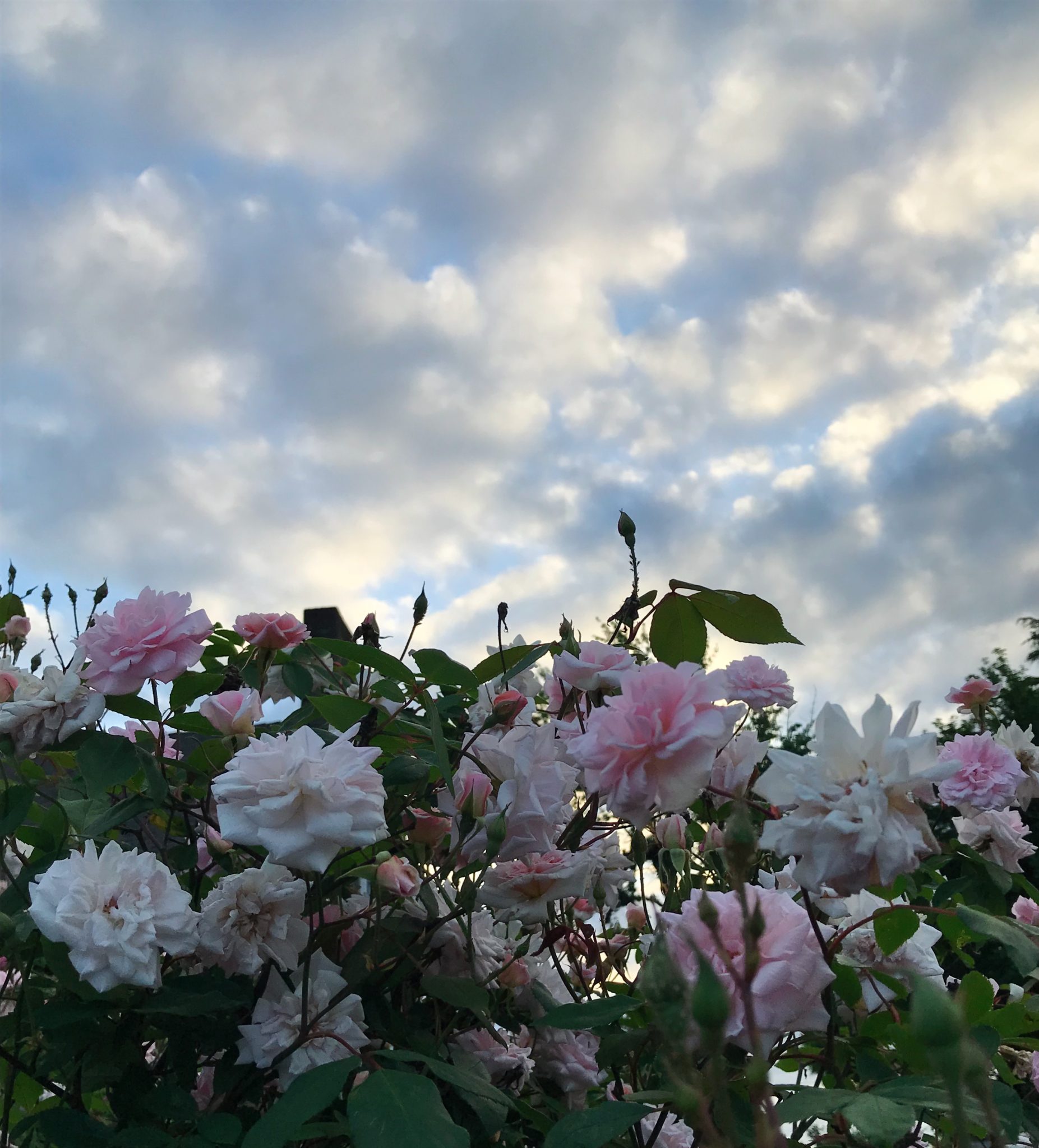
This is the dream we carry through the world
that something fantastic will happen
that it has to happen
that time will open by itself
that doors shall open by themselves
that the heart will find itself open
that mountain springs will jump up
that the dream will open by itself
that we one early morning
will slip into a harbor
that we have never known.
My copy of The Dream We Carry (named after a line from “This Is the Dream”) has the original Norwegian on the verso and the English translation on the recto. Rilla, curled up beside me, enjoyed comparing the two versions. She was struck by the lovely image of the mountain springs “jumping up” and reached for Google Translate’s snapshot feature to compare the literal (and much less poetic) translation. That led to a line-by-line unpacking of the language. The Hauge collection Luminous Spaces has an entirely different translation and we got really caught up in discussing the figurative and connotative differences between these variants:
…that we one early morning
will slip into a harbor
that we have never known
that I one early morning will glide
in on a wave I have never known
(Google Translate’s rendering of the original—interesting that it’s in first person singular, when both English translations use we)
Slip into a harbor, glide into a cove, glide in on a wave—such distinct and potent images, each in their own way.
There are buckets more I could say about our Hauge conversations, but the only one I’ll mention now is the Fillyjonk connection. We’re reading Tales From Moominvalley and today we finished the scene in which the anxious, constantly catastrophizing Fillyjonk tries to share her worries with her neighbor, Gaffsie, over tea in her gloomy seaside house:
“…This calm is unnatural. It means something terrible is going to happen. Dear Gaffsie, believe me, we are so very small and insignificant, and so are our tea cakes and carpets and all those things, you know, and still they’re so important, but always they’re threatened by mercilessness…By something one can’t ask anything of, or argue with, or understand, and that never tells one anything. Something that one can see drawing near, through a black windowpane, far away on the road, far away to sea, growing and growing but not really showing itself until too late. Mrs. Gaffsie, have you felt it? Tell me that you know what I’m talking about! Please!”
Gaffsie, a practical and restrained creature, doesn’t get it. She’s uncomfortable with the Fillyjonk’s demonstration of emotion, and she doesn’t have much use for a dramatic recitation of all the terrible things that could happen—because none of them have.
The poor Fillyjonk! Hauge’s dream is utterly closed to her—so far, at least.
Today this chapter sent me leaping (like a mountain spring) to read Hauge’s poem “We Don’t Sail the Same Sea”—
We don’t sail the same sea,
though it looks the same.
Rough timber and iron on deck,
sand and cement in the hold,
I ride low, plunge
headlong through breakers,
wail in fog.
You sail in a paper boat,
your dream fills its blue sail,
so soft is the wind, so gentle the wave.
Hauge struggled with depression and had to endure some very dark periods. Some of his poems acknowledge a sense of bleakness or of brooding menace—Fillyjonk feelings. I think the two of them do sail the same sea. But Hauge has the promise of that dream, the promise that some day the doors will open to a world where mountain springs jump up and and the wind fills a blue sail. I have hopes that the Fillyjonk, too, will encounter that dream—perhaps through an encounter with the Moomintroll family, or with Snufkin, later in the book. Right now she’s wailing in fog—with a kind of raw courage, the kind it takes to “plunge / headlong through the breakers.”
Well. At the end of lessons today I said we’d be moving on from Hauge next week, and such a clamor arose! Scott and the children think not. It seems I’ve been remiss in hoarding Hauge to myself all these years. I’m so happy they find him as compelling as I do.
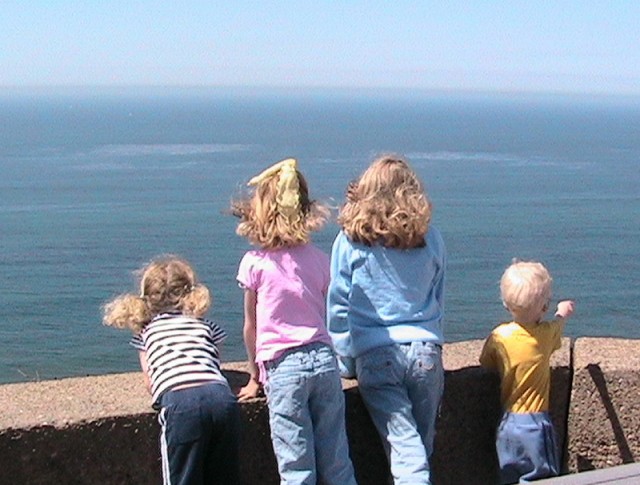
A somewhat grainy photo of my four oldest children taken at the Point Loma Lighthouse in 2007, not long after we moved to San Diego. The Pacific was still quite new to them. When I coined the term “tidal homeschooling,” we lived in Virginia and the image was entirely figurative—but when I think back to those early tidal-learning days, this pic is the one I see.
I remember writing here long ago about how my favorite category of post was connections. The serendipitous links of thought we encounter when something we’re reading or experiencing echoes or relates to some earlier conversation, book, film, experience.
Today, for example: we read another Hauge poem (“Winter Morning”) and had a really rich discussion of how much is going on in those four simple lines—a discussion that incorporated some of the conversation we had in the comments here about yesterday’s poem. We talked about the way Hauge uses simple, crisp, concrete images (frosted windowpanes, the glow of a good dream, a woodstove “pour[ing] out its warmth/ from a wood block it had enjoyed the whole night”) to describe a moment, and something much bigger than the moment. And from that rather animated discussion we jumped to Linda Gregg’s “Art of Finding” essay:
I am astonished in my teaching to find how many poets are nearly blind to the physical world. They have ideas, memories, and feelings, but when they write their poems they often see them as similes. To break this habit, I have my students keep a journal in which they must write, very briefly, six things they have seen each day—not beautiful or remarkable things, just things. This seemingly simple task usually is hard for them. At the beginning, they typically “see” things in one of three ways: artistically, deliberately, or not at all. Those who see artistically instantly decorate their descriptions, turning them into something poetic: the winter trees immediately become “old men with snow on their shoulders,” or the lake looks like a “giant eye.” The ones who see deliberately go on and on describing a brass lamp by the bed with painful exactness. And the ones who see only what is forced on their attention: the grandmother in a bikini riding on a skateboard, or a bloody car wreck.
But with practice, they begin to see carelessly and learn a kind of active passivity until after a month nearly all of them have learned to be available to seeing—and the physical world pours in. Their journals fill up with lovely things like, “the mirror with nothing reflected in it.” This way of seeing is important, even vital to the poet, since it is crucial that a poet see when she or he is not looking—just as she must write when she is not writing. To write just because the poet wants to write is natural, but to learn to see is a blessing. The art of finding in poetry is the art of marrying the sacred to the world, the invisible to the human.
Okay, here’s the thing. I had planned to read this excerpt of Gregg’s essay, and to introduce a new practice for the four of us—Huck, Rilla, Scott, and me. We have a spiral-bound sketchbook that, at intervals, we use as a shared family journal. In 2020 it was the whole family chiming in with quips, sketches, and interesting tidbits. It went dormant last year, and when the Linda Gregg passage resurfaced in my Readwise review over the holidays, I decided to appropriate the journal for this practice. Maybe not daily, but several times a week, we’ll jot down things we’ve seen or heard.
But weeks have passed since I reread the passage, and I’d forgotten that last line—the “marrying of the sacred to the world, the invisible to the human.” That’s exactly what we’d just been talking about with the Hauge poem, and what we talked about yesterday. The way he expresses a single image that speaks vividly both as a literal description (in a way that makes your breath catch) and as a reflection on some aspect of human experience. “Marrying the sacred to the world” is what Hauge does best.
So: part intention, part serendipity. The best kind of high-tide morning.
_____________________
A postscript added after I made today’s recording—listening to the Linda Gregg passage read aloud, I got to “the art of finding” and went Oh of course! And made a note to let tomorrow’s poem be Elizabeth Bishop’s “One Art.” Another connection.
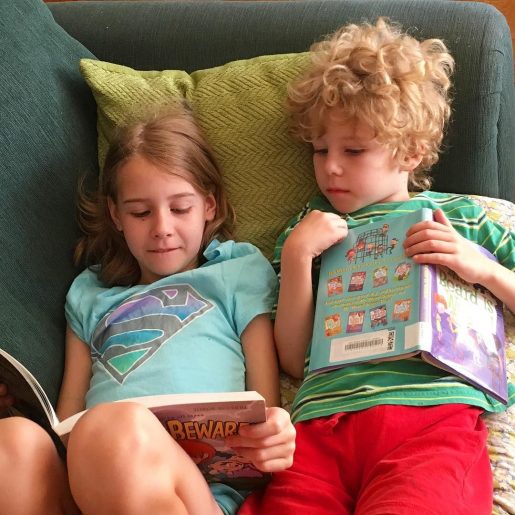
This photo is dated October 2016, which seems too recent? Huck would have been six and Rilla around ten. I think. My time-math is blurry. Huck will be fourteen this week. Can you even?
Well, here they are, my last two homeschoolers. We kicked off a new high-tide season this morning, lightly. It struck me recently that while poetry has been a staple of our lesson times since forever, I hadn’t introduced much contemporary poetry to these two. Which is odd, because I read so. much. of it myself. At least one poem a day, often many more than that.
This revelation made my 2023 Fresh Start plans easy: I have loads of lovely and arresting poems I want to share with Huck and Rilla. We’ll keep reading our old favorites, of course, but I plan to dip frequently into the two gorgeous collections edited by James Crews: How to Love the World and The Path to Kindness, as well as Poetry Unbound, Poetry 180, and all the slender, marked-up books on my shelves.
(I say slender, because ages ago I learned a big lesson about myself: I don’t like reading poems in big fat Collected Poems volumes. I want a slim, portable book. I seldom go for a Best Of.)
Today I knew exactly what I wanted to reach for: Olav H. Hauge’s beautiful The Dream We Carry. We read “One Poem a Day” and I was delighted by how much Rilla loved it and saw in it. Huck was reserved at first but warmed to the poem as we discussed it.
One Poem a Day
by Olav H. Hauge translated by Robert Hedin
I’ll write one poem a day,
every day.
That should be easy enough.
Browning did it for a while, though
he rhymed
and beat time
with his bushy eyebrows.
So, one poem a day.
Something strikes you,
something occurs,
something catches your eye
—I get up. It’s lighter.
Have good intentions.
And see the bullfinch rise from the cherry tree,
stealing buds.
That last image always goes straight to my core. The way he, after mapping out a simple, spare plan for himself, does just what he has resolved to do, capturing some small, striking observed moment in a few lines—lines that represent exactly what the poet does. Like the bullfinch, he rises up, carrying something small, simple, full of promise, the bud of an image that will unfurl into a poem.
Oh, I love him.
Something especially fun about the way our lessons have worked these past few years is that Scott is present for them. He’s got his coffee and his computer, but he listens to the readalouds (of which, despite the kids’ ages, there are many, because we all like learning that way) and he chimes into the discussions, and when I want to show the kids a picture of a bullfinch, he’s already got one pulled up on his screen.
We also began our next Moomins book (Tales from Moominvalley) and watched a couple of scenes from Taming of the Shrew, just for the fun of seeing John Cleese as Petruchio.
Okay. Whew. It’s March. I’m a few days away from finishing my last Brave Writer Dart of the year (this one on Nim’s Island, that utter delight of a book), and I’ve scaled back on other freelance work in order to—dare I say it?—give myself a little break. It is a long. long time since I’ve had a real break. I want to work on my new novel, finish some stitching projects, and read a lot of books.
I’ve been feeling pretty wrung out, I must admit. I just answered a lot of messages on FB and IG (and comments here) and was horrified to see some of them have been sitting for months. I didn’t mean to be rude. I was just buried.
And now, like the daffodils exploding all over my neighborhood, I’m ready to emerge. I mean, sort of. Emerge and be sociable online again, and write posts and answer comments. But in another sense, I’m thinking the nice, quiet, soaking-up-the-good-nutrients life of a flower bulb sounds like heaven. I guess I’d better scrap the metaphors and, while I’m at it, the plans. The planning!
LOL LOL LOL I just realized that what I’m saying is I’m ready for low tide!
Which is funny, because the kids and I are definitely in high tide right now. We’re reading Beowulf, Wilding, and Moominpappa’s Memoirs. Lots of good rabbit trails. Lots of geometry.
How’s this for a quote? From Seamus Heaney’s brilliant translation of Beowulf:
“He is hasped and hooped and hirpling with pain, limping and looped with it.”
Oh we lingered long over those delicious verbs. Hirpling!
And they’re the right verbs for this moment in time: the whole world, it seems, is hasped and hooped and hirpling with pain. And no epic warrior coming to set things right—it’s going to take small actions from all of us, small ripples building up into great waves.
I wish you could see the sky outside my window right now. The light—it’s like it’s shining behind and through things, a luminous wash of gold, like something from an Elizabeth Goudge novel. Oh, I know what I’m thinking of: the “tide of gold” in The Scent of Water, the light moving across rooms in Mary Lindsay’s house, rooms that had once been part of a monastery infirmary. I reread that book (again) last month and have been on a Goudge kick ever since: the light, the woods, the skylark, the shipwrecked grain coming up near the water’s edge every year. And the small thoughtful or loving actions of individuals rippling out to change others’ lives. That’s what I love most about her work: the way one nearly invisible choice, one kind word, one hand held out to another human, can set in motion a cascade of events that makes life better for a community.
This Youtube video walks through a few more problems, including some with three-digit numbers and carrying over. The method works with larger numbers but gets a bit unwieldy beyond three or four digits.
Ahhh…a fun, full, hard, harrowing week is behind me. Not only did I have the excitement of the book launch, I also took a (truly excellent) four-day Author Visits workshop by Kate Messner & Julie Hedlund, and I had a writing deadline for Brave Writer. The workshop was terrific, with lots of practical strategies for reimagining our in-person school visits to fit this year’s all-remote reality. (Even schools that are reopening classrooms aren’t going to be bringing in authors and illustrators to meet the kids face-to-face this year.)
This week things are settling back to routine—this still-new routine in which the bulk of my work time falls between 6am and noon, and we homeschool in the afternoons. With only two kids left to homeschool, three hours is plenty of time for any high-tide learning we have planned. Then I log into Zoom for my afternoon coworking session (3-5pm PDT; see my Patreon if you’re interested in joining) and I usually keep going afterward until I run out of steam—usually around 6. A full day, to be sure! But I like it that way.
Today’s Tuesday, which means Poetry Teatime! Maybe I’ll see if Rilla wants to make some oat bars for our treat. We’ll also do some conversing in German (we’re using Talkbox.mom this year and having a lot of fun with it—I can share a coupon code if you’re interested). Rilla and I are cooking up some kind of longterm study project on frogs, one of her special interests.
Something I haven’t had enough time for this past month is reading! Hoping to turn that around this week. My Kindle is going to explode if I don’t give it some attention. I want to ask what you’re reading right now but that’s a dangerous question, when you already have a TBR list that stretches to the moon.
For YEARS I’ve wanted to comb through my blog archives and collect the best writing, the most enduring resource recommendations, the laugh-out-loud kid moments. But that’s a lot of posts to revisit! And time is so short. It struck me that if I aim for three months a week, I could complete the project in 60 weeks—a little over a year. Of course, by then there will be, presumably, 60 more weeks’ worth of posts. But that’s getting way ahead of myself. I’m much better at hatching plans like this than sticking with them over the long haul. (Hello, Gretchen Rubin Tendencies obliger here. I need deadlines and outside accountability to finish things.)
But well begun is half done, as Mary Poppins likes to say (hahaha, it’s clear Mary Poppins never wrote a novel), so here’s one quarter: January-March 2005. Jiminy crickets! There’s some good stuff here!
The comments are closed on some of these older posts, but feel free to hit me with any questions or remarks here on this post.
Here’s a post I wrote on Instagram, the day before my cover reveal last week:
Real talk: here’s what my fancy author life looks like. Snuggled up in my writing chair with my boy (“We’re going to need a bigger chair soon, Mom”), breakfast half eaten, hair unbrushed, trying to overcome my profound self-promo embarrassment in order to give my book a proper sendoff. Huck helped me create my cover-reveal announcement on Canva and picked the color for the countdown clock in my Stories. It’s the time of day when we usually do math and Spanish and read poems, but the reality of work-at-home homeschooling life is: lots of days go in different directions! Right now Huck and Rilla are watching a really good video on space (How the Universe Works on Prime Video—so good!) and I’m sitting here writhing over hashtags. Hashtags! I have “Tom’s of Maine” written on the back of my hand to remind me we’re almost out of toothpaste. I’m wondering if it’s too early in the day for gummy bears. I’m thinking I should wrap up this post and go on a nature walk with the kids. I’m remembering I haven’t sent out an issue of my author newsletter in YEARS and I should really revive that thing for the cover reveal tomorrow! Eep! Forget the gummy bears: this calls for chocolate.
I should hashtag THIS post too but y’all, I’m hashtagged out. My bird clock just chirped the 1pm bird at 11am, so I guess that’s something I should go address. Okay! A plan! Chocolate and bird clock—no one can say I don’t have my priorities in order!
Six days later:
• Bird clock: fixed.
• Nature walk: didn’t happen that day but we made time for it on Friday, and on the way home we stopped for pumpkin snickerdoodles at the German bakery. Oh how I love living in a city neighborhood again! Today’s another pretty morning, a gray sky shot through with light, so I think we’ll make time for another walk this morning, after our Moominland Midwinter readaloud.
• Newsletter: still a work in progress. 😉 If you’d like to sign up to make sure you don’t miss its return issue, here’s a link. If you were signed up before, you’ll get it automatically (unless you unsubscribed at some point).
A collection in progress. I intend to keep adding photos as others share them. What a deep joy to spend time in the company of these smart, creative, funny, wholehearted homeschool moms/Brave Writer coaches. Every conversation was full of new discoveries, meaningful connections, and belly laughs.
Who could have imagined that the Yahoogroups we joined in the ’90s would bring us lifelong friends and nourishing work? So happy to get some IRL time with my brilliant, inspiring, visionary friend Julie Bogart. Not that you can tell from these pics because I always play it cool.
Jeanne Faulconer
Jeanne Faulconer is another fortuitous connection made on homeschooling lists in the mid-90s. I loved her voice in the Home Ed Magazine discussion groups and was thrilled when our paths crossed in person at Virginia Homeschoolers events in Charlottesville and Richmond. Here we are all these years later, still talking shop and bonding over writing & relaxed education.
Farzana Minty
I met Farzana Minty at the 2016 Brave Writer conference, at which I was a guest speaker. She came up to me after one of my talks and spoke movingly of some of the parallels between our motherhood experiences. She radiates warmth and kindness in all she does. Getting to spend time in conversation and laughter with Farzana was one of the highlights of a truly magical weekend.
Rebecca Pickens
We were supposed to sit with different people at every session during the retreat, to give us all a chance to get to know one another if we didn’t already. But somehow the lovely Rebecca Pickens and I kept ending at the same table, and I enjoyed her company immensely. What a gem my new friend is!
Jai Tracy, Jen Holman, Farzana Minty, and me
Many of us who were supposed to fly out of Cincinnati on Sunday evening encountered cancelled flights. I had just gotten through security and was retrieving my phone from the TSA bin when it pinged in my hand: my flight was delayed and I would miss my connection in Minneapolis. Delta put me up at the Marriott, where I found three more Brave Writer coaches in the same position. (A whole other crew wound up at different hotels.) Our dismay at not getting home on schedule was quickly overtaken by delight at getting to spend some extra time together. Somehow I hadn’t managed much conversation time with Jai Tracy and Jen Holman at any point during the retreat, so I was happy we got to linger over dinner in lively discussion. And I’ll take all the Farzana time I can get!
All my other retreat selfies were taken with other people’s cameras. I plan to scoop them all up to add to this album (starting with my beloved pal Karen Edmisten—a long overdue reunion for us! One worth every minute of lost sleep as we sat up late gabbing). Too delicious an event not to capture.