Monday morning. Long line at the post office. I had a stack of packages to mail—same as everyone else there. I also needed to pick up more of the flat-rate priority mail boxes, but the racks were empty. A man ahead of me in line needed some too, and one of the clerks had to go hunt up a new batch of them in the back room. Listening to the impatient sighs all around, I was glad he’d beat me to that request.
Except it turned out—after the guy left, which is a bummer—that the new stack of boxes was the wrong kind, just plain priority mail, not the flat-rate boxes. So that poor customer went home with a pile of the wrong thing. I was the one who discovered the error, while the clerk was taking care of my packages.
“Are these the same as the flat-rate boxes?” I asked, not seeing the words “flat rate” anywhere on the white slabs of ready-to-fold cardboard.
“Oh, shoot,” said the clerk. “No. Shoot. We gave him the wrong kind.”
I had already told him I was going to need a dozen of the medium flat-rate boxes, so he said he’d have to go look for them after he finished ringing up my packages. More restless sighs from the long line of people behind me. Now I was going to get to be that person, the delayer.
The clerk handed me my receipt and disappeared to the back room. Shuffle, sigh, murmur goes the line. Seconds tick painfully by. This is the kind of situation that makes me squirm; I have a tendency to blurt out inanities in a vain effort to break the tension.
“This is the awful part,” I said to the line in general. “When you’re the one holding everybody up.”
Every single person in that line stared back at me blankly. Not one single commiserating smile, not even a quirked corner of the mouth. Just—blank. Except for the one woman who muttered to the man in front of her, “She picked an interesting time for this.”
Which, I couldn’t help it, made me chuckle—an interesting time for what? For picking up shipping boxes? In the post office during the holidays? That’s an interesting time? I think it’s kind of a pedestrian time, an obvious time, don’t you? Or maybe it’s just that I “picked” a time when the line was very long. Which is to say, I went to the post office in December. Hee. I’ve stood in no less than four very long lines at three different branches of the post office in the past week, at various times of day. (Y’all are keeping me busy with these book orders!) I feel fairly confident in saying categorically that there is no time the line isn’t long, this time of year.
It was funny, the contrast between that P.O. trip (mortifying) and the one I made last Saturday morning, with Stevie along for the ride (amusing). We had three packages to mail and I was hoping to pick up the flat-rate boxes then, but then, too, the display rack was empty. And—ironically—I didn’t ask the clerk (different clerk, different P.O.) to fetch me some that day, because the line was moving so very slowly. When Stevie and I got in line, there was a woman finishing up at the counter who had mailed six or seven packages, and I gathered her order had been complicated and had taken a while. The man at the front of the line was clearly at the limits of his patience; he was puffing air out his nose quite angrily, like an irritated bull.
The clerk, a cheerful, portly fellow, seemed to be trying—with much more success than I had a few days later—to lighten the mood with humor. As the six-package lady was packing up her wallet to leave, the clerk announced, “All right, and FIVE..FOUR…THREE…TWO…ONE! We’re closed, people!”
Gasps all round—but immediately he was laughing, waving his hand to show he was teasing us. Everyone giggled except the puffing bull-man, who barked, “You’re lucky we don’t all have pistols!”—which I think was meant to be funny, actually, but came off rather alarming.
Then it was that man’s turn at the counter. As he strode forward, he watched the six-package lady exiting and said, loudly, “Doesn’t she know they teach remedial math in night school?”
I looked anxiously at the door to see if the woman had heard the insult. I think (hope) she was out of earshot by then.
“Harsh,” I murmured, and the woman in line ahead of me, a lovely twinkly-eyed grandmother with fluffy Miss Marple hair, shook her head in agreement.
The bull-man pointed at the angel stamps on the poster and said, “I want 25 of those.” But they only come, the clerk explained, in books of 20. Bull-man snorted, exasperated. “Fine. Then give me 25 of those blueberry ones,” he grumped, pointing at the juniper-berry stamp in the Evergreens collection.
“I’m sorry, sir,” said the clerk. “Those come as a set—the four evergreen designs.”
“But I only want the berries.”
“I’m sorry, sir, they don’t come separately.”
“But I don’t want the pine cones!”
“I’m sorry, sir…”
By now Miss Marple and I were both giggling, hidden from the bull-man’s view by the big empty rack that was supposed to hold my flat-rate boxes. The young guy in front of Miss Marple shot me a grin. There was this ripple of camaraderie all down the line—the bull-man had been so disgusted with the six-package lady for taking so long. He would have hated to be behind his own self in line. It was kind of delicious, this moment.
Now, threaded through the seven or eight minutes it took the man to agree to suffer the pine cones along with the berries, Stevie was chattering to me in his hybrid of English and ASL, and I was speaking-signing back to him, and he was melting the hearts of the other women in line, as he is wont to do. He’s just such a cute little guy, you know? Miss Marple loved him. Ms. Marple, I should say, because she told me all about her granddaughter who is deaf, and she, grandma, signs a little, “but not enough.” And we talked about Signing Time and ways to learn ASL.
And it turned out the young guy in front of her was mildly hard of hearing and had worn hearing aids as a child, but didn’t wear them any longer. He cracked Stevie up, making eyes at him around the empty box rack. It felt like we were all passengers together on a cruise or something, fellow travelers bonding on a long journey.
At last the bull-man stomped out with his despised pine cones, and the next few transactions moved rapidly. Stevie and I were beckoned forward by the same affable clerk who’d been so patient with bull-man and six-package lady. He greeted me heartily and signed hello to Steve. And proceeded to explain, as he weighed my packages, that he too was hard of hearing. (What are the odds? It was kind of incredible, this convergence of hard-of-hearing men young and old.) I learned to sign when I was little, he signed, and Stevie grinned and got shy, and I was kind of relieved the bull-man wasn’t in line anymore because our conversation undeniably added a few extra moments to the transaction.
Good moments. Moments of connection. Everyone in that line was smiling—the bull-man’s ironic surliness had put us all in merry spirits, somehow. That and a cute little deaf kid with blue hearing aids.
I guess that sense of connection, that we’re-all-in-this-together feeling, is what I was looking for on Monday, three days later, when I babbled my remark to the impatient queue in the other post office. I was a six-package lady myself that time and already self-conscious about that when the whole wrong-kind-of-box thing happened.
I should have brought Stevie with me that day. Or a loud and bitter hater of pine cones.
(And yes, we can communicate in sign language as well, but during this conversation I was holding a plate in one hand and a giant slice of pizza in the other. Priorities.)
During yesterday’s evening tidy, Jane asked Wonderboy to put a pair of shoes away in the cubby.
Wonderboy, as many of you know, is hard of hearing. Even with his hearing aids in, he cannot pick up soft unvoiced consonant sounds such as those made by the letters C and T.
Which may explain why, this morning, we discovered that pair of shoes in the kids’ bathroom—in the tubby.
What Rilla’s saying at the end there is “With Alex, Leah, and Hopkins.” Totally unprompted, I swear.
When I watched our Christmas 2005 video the other day, the bit that gave me the biggest pang of nostalgia was watching Wonderboy signing away. He hardly signs at all anymore, now that he talks so much. I’m thrilled with his verbal speech, but I really miss the signing. It’s funny to think back on how much ASL dominated our lives (in a rich and satisfying way) for a couple of years there, and now our use and pursuit of sign language has slipped to the back burner, becoming something of a hobby rather than a daily necessity. Jane still wants to certify as an ASL interpreter someday, and every few months we pull out our materials and learn another chunk of vocabulary and grammar. There are community college courses we might take next year. It’s a beautiful and important language, and I don’t want to let it go, even if our boy doesn’t need rely on it for communication the way he once did.
And of course the Signing Time DVDs remain in great demand with my little people, as the video above attests. With Rilla, we’re seeing all the benefits of sign language we saw with the first three girls—because rudimentary ASL was a part of our baby & toddler life from the get-go, long before we had a Wonderboy or knew he had hearing loss.
Here are some old posts singing the praises of our favorite kiddie DVDs:
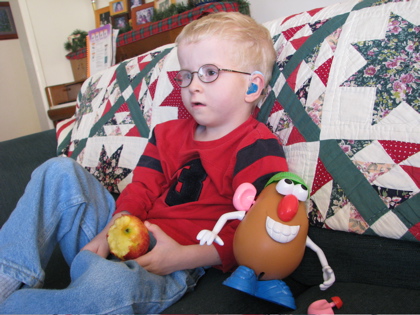
Here’s my boy, hanging out having a snack with his good buddy, Mr. Potato Head.
I wondered why one of Potato Head’s ears was lying on the couch with a spare screw-cover (left over from the construction of a toy shopping cart) stuck on the end. Wonderboy informed me that it isn’t an ear—it’s a hearing aid. And it needed a new battery, of course. Evidently he went rummaging around in the drawer where we keep his own hearing aid batteries and found the little orange screw-cover.
Oh, I could just eat him up every minute of the day.
I am reposting this piece from March, 2007, now that I have finally gotten around to fixing the broken image links. When I imported it here from Lilting House, all the images fell out. Now they’re back!
Did you know that ears are one of the few body parts that never stop growing? I think noses might be the other. Besides hair and fingernails, obviously.
When you wear behind-the-ear hearing aids, the hearing aids last for years, but the ear molds—the little custom-made silicone or acrylic doohickeys that fits into your ear—need replacing every so often. As your ear grows, the ear mold ceases to fit, and first you get a feedback problem, and then eventually the mold just won’t stay in the ear at all.
So you go to the audiologist’s office, and she makes new impressions of your ears with a quick-hardening goo. You ship the impressions off to a lab, and in a couple of weeks you’ll have your brand new ear molds.
If you are three years old, you may find this process somewhat entertaining, if mildly uncomfortable. If you are six years old and the uncomfortable part is happening to your brother, not to you, you will consider it a ripping good time. Beanie pronounced it “huge fun.”
I get a large number of hits every day from hearing-aid-related searches, including variations of “toddler ear molds,” so I thought it might be helpful if I posted a walk-through of the process. Besides, pictures are always fun.
First the audiologist checks your ears, making sure there isn’t too much wax in there—that might mess up the shape of the impression. Then she carefully inserts a little foam stopper to make sure none of the impression goo goes too far up the ear canal.
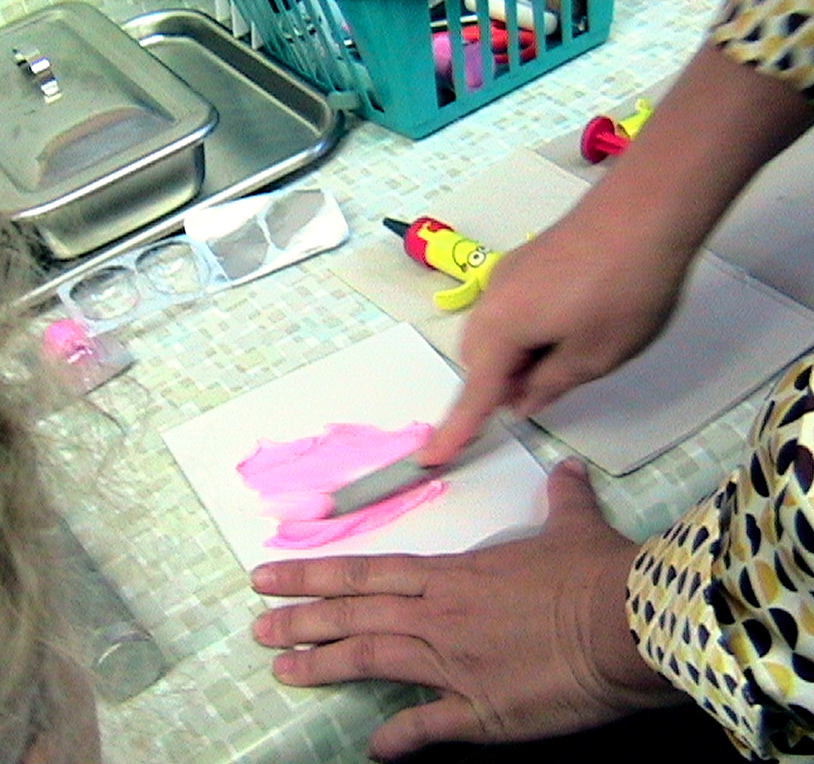
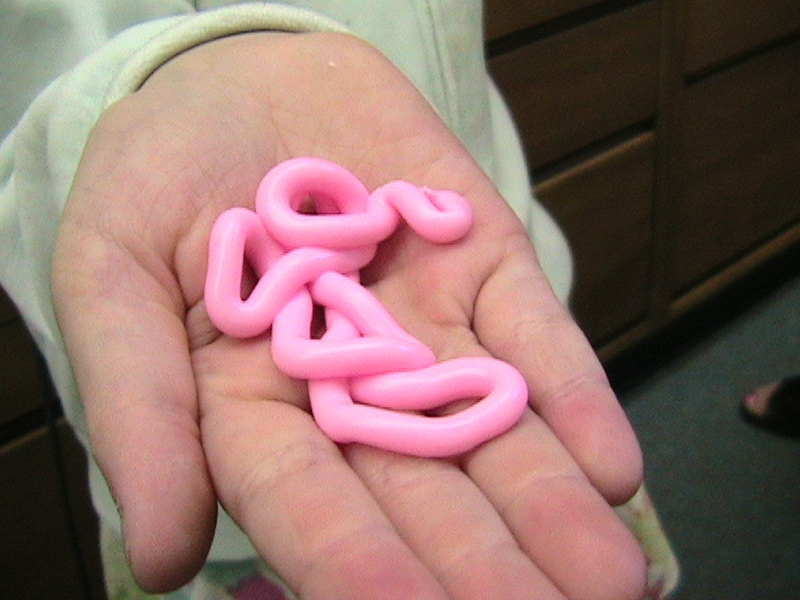
Then she pops the two kinds of goo out of their little bubble wrappers, and she mixes them together into a pliable substance that can be squeezed out of a syringe but will harden within a few minutes. Beanie, supervising, thought this mixing process looked pretty nifty and is now wondering how to work “become an audiologist” into her plan to be a scuba-diver with ten children.
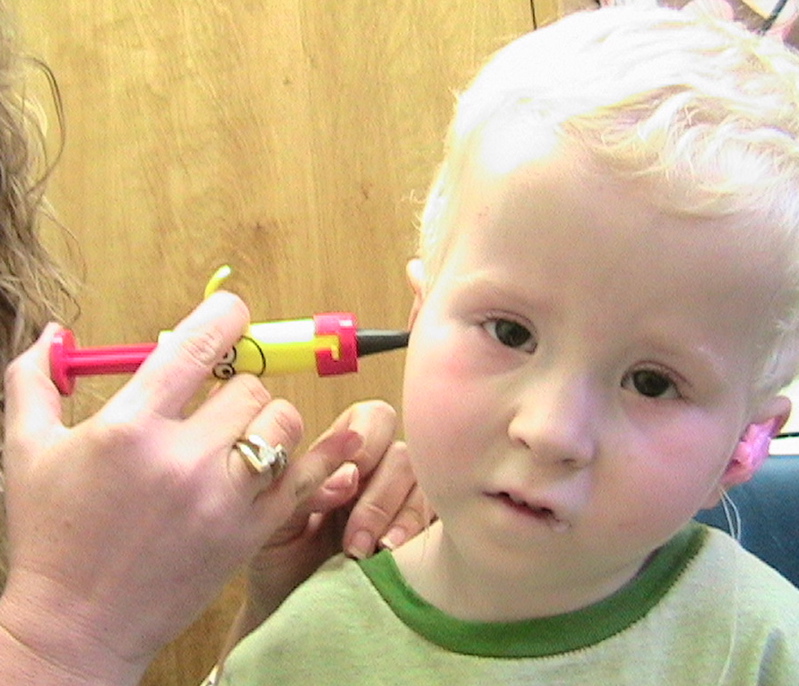
The audiologist scoops the goo into the syringe and carefully squeezes it into the ear, sort of like making an icing rose on a birthday cake. Now you have to sit and wait. You can’t poke at the goo, much as you might wish to. Nor can you pull on the string that is connected to the little foam stopper inside your ear canal. Patience, grasshopper.
Meanwhile, the audiologist squirts the leftover goo out of the syringe. This, I am told, is THE BEST PART.
Let’s do the other ear while we’re waiting. It’s okay to drool.
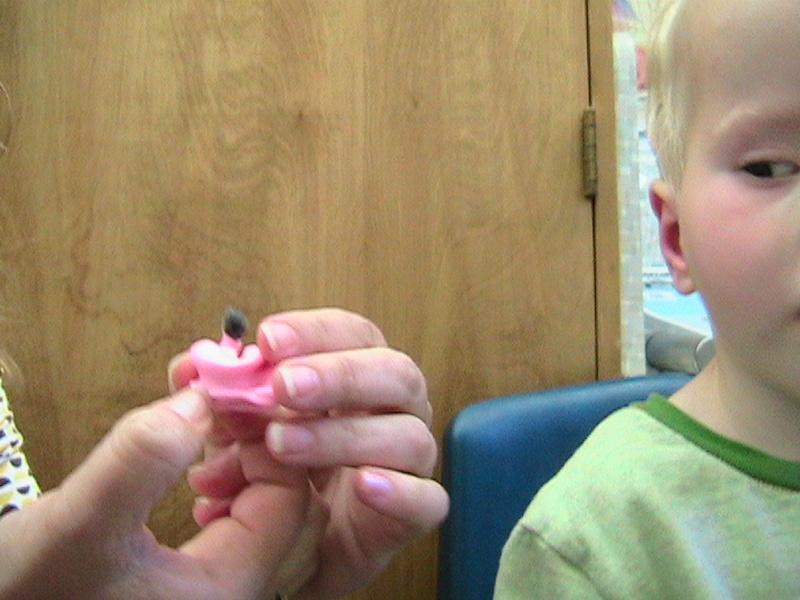
Finished! Time to pull out the impression. No need to be suspicious; it won’t bite.
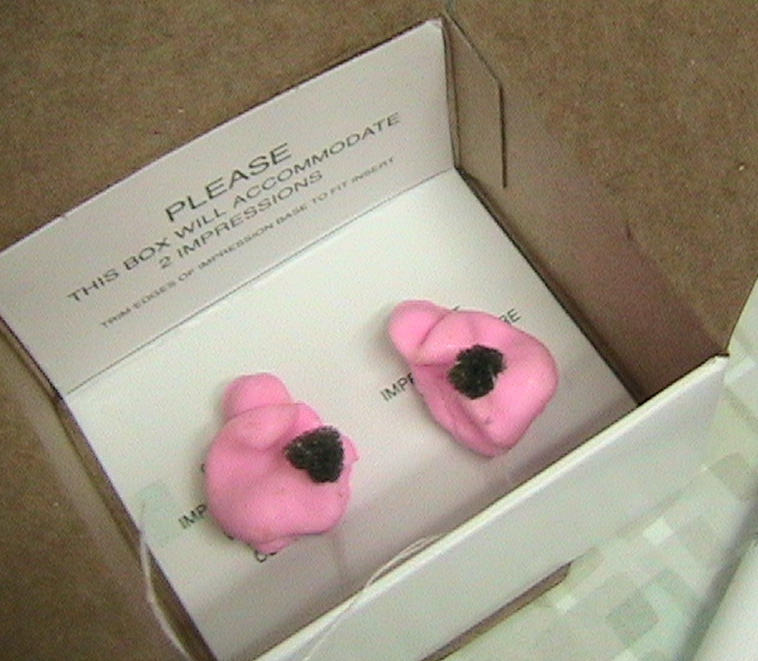
The impressions go into a box and are dispatched to the Lab, that mysterious place where ear molds are born.
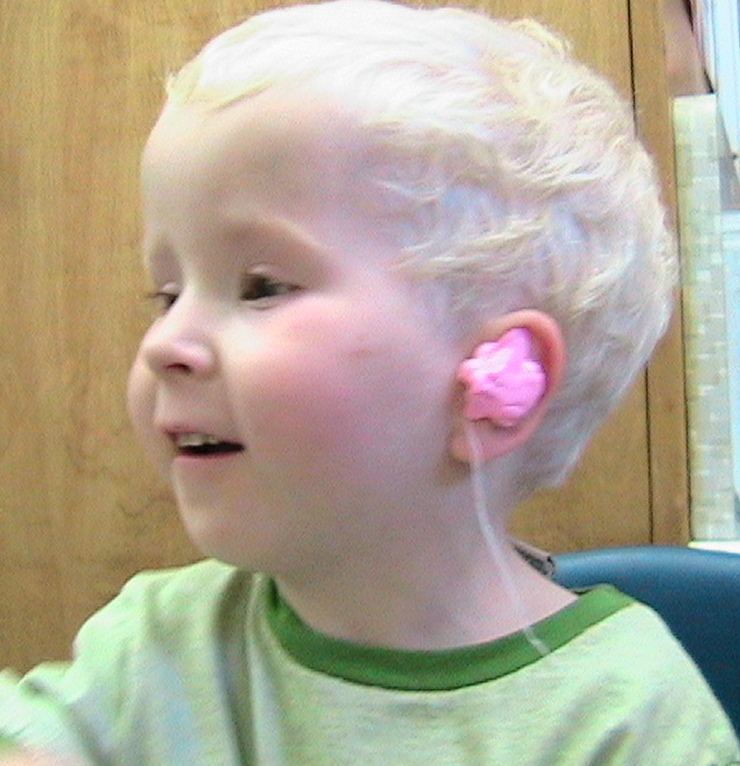
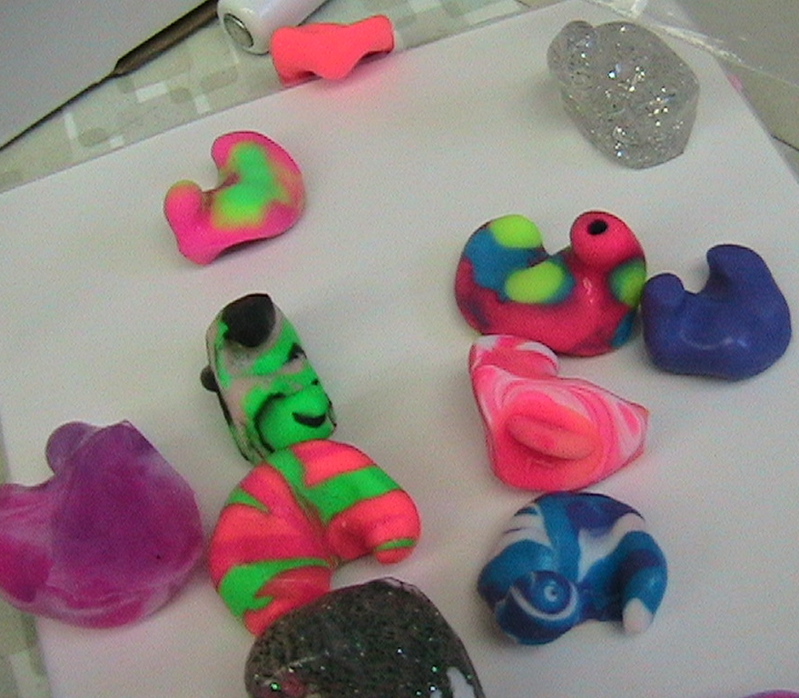
Now comes the fun part! (The other fun part, says Beanie.) What color ear molds do you want? The sky’s the limit. No, Bean, you can’t have a pair of sparkly ones for yourself.
What color did he get? You’ll have to wait two weeks to find out.
Today was the Solemnity of the Assumption, a holy day for us. We went to the 9 a.m. Mass at the chapel of a local nursing home run by Carmelite sisters. The kids and I sat in the last row, but the boy grew too noisy, and I had to take the two little ones out to the lobby. By “too noisy” I mean he’s in this phase where his favorite favorite thing is to ruff-ruff like a puppy. There we were in this tiny little chapel full of nuns and elderly people, and my son was barking. During the homily. Embarrassing much? You could say that.
So I spent the rest of Mass in the lobby, my cheeks burning, trying to keep the barking to a whisper. Trouble is, Wonderboy can’t HEAR a whisper. This has a somewhat limiting effect upon his desire to vocalize sotto voce. I was kicking myself for not getting the crew up and out early enough to make the 8 a.m. Mass at our own parish, which has a soundproofed cry room.
When Mass was over, the priest, an elderly fellow himself, walked straight through the chapel doors to the lobby where I was standing. He smiled at us, shook my hand, admired the beautiful children. I apologized for Wonderboy’s noise.
The priest held a hand to his ear.
“Eh? What’s that?” he shouted, in the unmistakable tones of the hard-of-hearing.
It is impossible for me to convey the deliciousness of that moment. In an instant, my mortification was gone. Of course I still wished that Wonderboy had kept quiet (he’s been so good during Sunday Mass the last couple of months—and we sit right near the front of the church, not in the cry room, which is a rowdy, unpleasant place on a Sunday), but I realized once again what experience has taught me so many times. We’re never as great a nuisance as I think we are in situations like this. Hardly ever is anyone judging us as sternly as I am, behind my flaming cheeks.
“What’s that you said?” the priest repeated.
I raised my voice, as if I were talking to my semi-deaf son. “I’M SORRY MY LITTLE BOY WAS SO NOISY DURING MASS!”
The priest gave a hearty laugh. “It’s not like I would notice!”
He laid a hand on Wonderboy’s head, gnarled fingers patting the white-blond hair above the blue hearing aids.
“My brother had fourteen children,” he said. “Fourteen nieces and nephews, I had. Now those children could make some noise!”
The congregation began to file out: white-haired ladies with walkers, old men leaning on canes, beaming Carmelite sisters in their brown habits—every one of them stopping to smile at the children, ruffle a head of hair, shake a hand. There was no hint of reproof or censure in anyone’s manner: only warm smiles, friendly greetings, huge peals of laughter when Wonderboy, God bless him, ruff-ruffed at them. These good souls seemed universally delighted to see—and yes, even hear—youngsters in the aisles of their nursing home which, perhaps, come to think of it, is sometimes all too quiet.
Wonderboy’s hearing loss came as a shock to us. Sure, we knew he’d failed the newborn hearing test. Three times. But those rounds of testing were administered in the NICU where there is always a humming and beeping of background noise, and the tech had told us that ambient noise could skew the test results. We had more pressing things to worry about: his (minor) heart defect; his recovery from omphalocele repair surgery; the genetic testing necessary to determine whether he had a potentially serious chromosomal syndrome; the fact that he was going home on oxygen. At least he was going home, and we tucked the hearing-test business to the back of our minds and focused on the immediate business of keeping him alive.
Every month the health department sent us a letter reminding us to have the hearing screen repeated. Sure thing, we said, just as soon as things slow down a bit. We were constantly having to take him to some specialist or another. The chromosome study came back negative: his medical issues were not due to a genetic syndrome. He was just one of those babies for whom something goes slightly awry early on in utero, resulting in a number of physical abnormalities down the line. An MRI had shown brain abnormality, but what its effects would be, no one could say: time will tell, they said. (They are still saying that.) He had extremely high muscle tone (hypertonia) and could not stretch out his arms and legs very far. His fists were tightly clenched. He started physical therapy at four months of age. He required emergency surgery to repair a double hernia with incarcerated bowel. The cardiologist was still keeping a close eye on his heart. The hearing test would just have to wait.
Besides, we told ourselves, we know he isn’t deaf. He startled to loud noises. Of all the things there were to worry about, we really didn’t think hearing loss was one of them.
But by six months, we had suspicions. He wasn’t babbling. He didn’t turn his head at the sound of my voice, lighting up with recognition before even seeing me, as our other children had. We took him back for another hearing screen.
He failed.
The audiologist said something about a “mild” hearing loss, and I thought that didn’t sound too bad. “Oh, no,” she told me, hastening to set me straight. “It isn’t like a ‘mild’ fever. ANY hearing loss is serious. Most speech sounds fall at the bottom of the scale, so if you have any hearing loss at all, you’re going to have trouble with speech.”
As it turned out, Wonderboy’s loss was a bit more serious than the audiologist first thought. Further testing placed him at the “moderate” level on the scale of mild—moderate—severe—profound. Unaided, Wonderboy’s ears can’t detect sounds softer than 50 decibels. Most speech sounds fall in the 20-decibel-or-lower range. Our little guy can hear vowel sounds, the louder middles of words, but few of the consonants that shape sound into speech. For Wonderboy, people probably sound a lot like Charlie Brown’s teacher. Wah-WAH-wah-wah-waahh-wah. We learned about the speech banana: the area on a graph that shows where speech sounds fall in the decibel and frequency ranges. Wonderboy can’t hear sounds above the horizontal 50 line on that chart.
(More or less. He has a sloping loss which is slightly better at the lower frequencies.)
By his first birthday he was wearing hearing aids, and what a huge difference we could see! Aided, he tests around the 20-decibel range. He hears and understands a great deal of what we say. He is two and a half years old now, and he is finally beginning to add some consonant sounds to his verbal speech. Daddy used to be “Ah-ee” and now he is “Gaggy.” (This cracks me up. You can get a lot of mileage out of calling your husband Gag.) Grandpa is Amp-Ha. Wonderboy’s baby sister is “Gay-gee.” As you can see, he doesn’t have a B sound yet. His M is perfect, though; I have been Mommy, clear as a bell, for over a year.
But Wonderboy’s verbal speech is only part of the picture. His actual vocabulary is enormous, thanks to sign language. We are huge fans of the Signing Time DVDs. He uses a combination of sign and speech; we all do. Although it appears he will be primarily a verbal person as he gets older, sign language will always be an important second language for him. Hearing aids, incredible as the technology is nowadays, don’t do you any good at the swimming pool. Just for instance.
Hard of hearing. It used to be a phrase that conjured up in my mind the image of a grizzled old man with an ear trumpet. What? What’d ye say? Speak up, lad! (Apparently he is a grizzled old Scotsman.) Now it applies to my son. Words pop up on a TV screen, “closed captioned for the deaf and hard of hearing,” and I’ll give a little mental jump: Oh! That means Wonderboy!
Watching our children learn to speak is one of the great delights of parenthood. We mothers tend to collect their funny pronunciations, their experimentation with the meanings of words. This time around, my joy has been doubled, for I get to see communication unfold in two languages. His funny little toddler signs are just as endearing as any “helidopter” or “oapymeal” ever uttered by a two-year-old. (“Oapymeal” was one of Jane’s. It meant oatmeal. I served it often just to hear her say it.)
There are some links to American Sign Language resourcesin the sidebar of my old site. (I’ll set up a page here soon as I get a chance.) I can’t say enough about the wonders and benefits of ASL, not just for deaf and hard of hearing children, but for all babies and toddlers, especially those with any type of speech delay. ASL is a beautiful, nuanced language, a visual poetry. I count myself privileged to have been put in the way of learning it. Jane is determined to certify as an interpreter someday, and I have to admit I’m a little jealous. I wish I’d learned at her age.
Wonderboy makes a fist and touches a knuckle to his cheek, wiggling the hand. “Ah-hul!” he shouts. Apple, in two languages. The speech banana? We’ll get there, one way or another.