Reading Notes: Words and Whuffie
Thursday 3/12
—Not much reading time today. Shakespeare Club in the afternoon and somehow the morning just went to different activities. Did squeeze in time for about half a chapter of Lucky Girl. Love how she’s retelling the history of her birth parents, her adoptive parents, even the nun who facilitated the adoption.
—Beanie was glued to Usborne’s Living Long Ago all morning long. Wants to make fish pasties (the name made me LOL) and meat pie. Explained to me how to make a fake beauty mark. Showed me pictures of hoopskirts and farthingales, right before the Shakespeare kids arrived & “farthingale” was a word in one of our scenes.
Friday 3/13
—Baby had his two-month appointment today. Weighed in at 14 lbs! This has nothing to do with reading, of course, but it’s the reason I didn’t read much to speak of today. Schedule upturned. Guess I did read the med journal article refuting Sears’s recommendation to space out vaccinations.
Saturday 3/14
—A gardening day. Sorry, books. I’m a foul-weather friend. (Not that there’s any foul weather here.)
Sunday 3/15
—Finished Down & Out in the Magic Kingdom. Doctorow spins an entertaining yarn. And makes me want to run and hide in the nearest neo-Luddite cave. And also, simultaneously and contradictorily, kind of makes me want to go to Disneyland. He paints a future in which scarcity is a thing of the past: scarcity of food, energy, shelter, access to transport, almost everything. The only kind of scarcity left is esteem-based: a good table in a restaurant, primo seats at a Disney attraction. What serves as currency in this kind of society is: esteem. The respect and good opinions of others. Fascinating concept. Doctorow calls it “Whuffie.” When others think well of you, your Whuffie goes up. Poverty amounts to ostracism, worse than ostracism actually, because it isn’t that people are choosing to look past you; they simply don’t notice you at all. Their mental internet uplinks tell them you have no Whuffie and their gazes just slide past you as if you aren’t there, which in a way you aren’t.


Doctorow explores some of the complications and disadvantages of his Whuffie system: a kind of saccharineness overtakes public discourse, because in order for people to think well of you (increasing your Whuffie), they usually need to like you, which means people are careful to speak very pleasantly to each other all the time. Which sounds like a good thing, but if it’s not sincere it would be cloying. And even in a Whuffie economy, the rich tend to get richer and the poor poorer, because the more liked and respected you are, the better positioned you are to influence people and do things that make them admire you all the more. As I said, a really fascinating concept.
(Fair warning to my gentle readers—quite a bit of rough language and promiscuity in the book.)
UPDATED with link to interesting interview with Cory Doctorow about Down & Out in the Magic Kingdom.
Wednesday 3/18
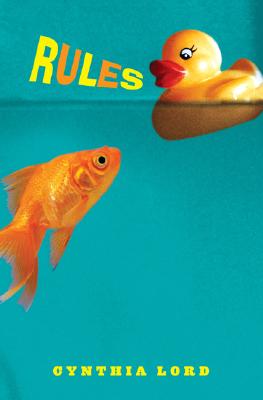
Finished Rules by Cynthia Lord, a recent Newbery Honor book. 12-year-old Catherine has a brother, David, age 8, with autism. Catherine has great affection for her little brother and is quite protective of him, sensitive to the reactions of others around him, but she is frustrated, too, tired of the embarrassing situations David is constantly, unwittingly creating. At her friends’ houses, he’ll run through the house counting doors and slamming the cellar door if it’s open; a drop of water on his pants will cause him to undress right then and there. Catherine has created a whole set of rules to help David (who loves rules) learn accepted social behaviors; she is constantly adding to the list and reminding David of his rules.
My heart went out to Catherine. My Wonderboy is not on the autism spectrum, but he has some specific behaviors that are quite common in spectrum kids, and I could envision exactly the kind of situation Catherine kept encountering. That wet-clothes thing, Wonderboy totally does that. One drop of water is all it takes. And the fixating on an expected event, the difficulty in dealing with a wrinkle in the plans: oh yes, we’ve been there. But I’m the mom and helping ease my son through these challenges is part of my vocation. Watching Catherine battle frustration at David’s rigidity, seeing how helpless she sometimes feels, I felt some pangs over my older children, who, like Catherine, are extremely patient and loving with their brother, and who, like Catherine, probably feel in over their heads sometimes. Catherine’s parents are wincingly oblivious to her frustration. She longs for time alone with them, and seldom gets it. She longs for time alone with friends, without the complications that David’s presence can entail (as when, during the new girl next door’s first visit to Catherine’s house, David is bothered by the squeaking of Catherine’s guinea pigs and tries to drown them out by shouting), and seldom gets it. And even then, David seems to occupy most of her thoughts.
Catherine’s plight is handled with great sensitivity. Always, her deep love for David is apparent—and is, indeed, the cause of some of her hardest moments. It bothers her when people stare at him, but it bothers her even more when a stranger’s gaze slides past him, deliberately not seeing him. (Hmm, Whuffie again.) But Catherine’s unhappiness runs deep as well, and this is portrayed in an honest and utterly realistic manner.
The best parts of the book are the scenes in which an awkward friendship develops between Catherine and an older boy, wheelchair-bound, unable to speak, whom she sees every week in the waiting room of David’s OT clinic. Jason communicates by pointing at words written on index cards in a binder that is always with him. He’s rather a cantankerous person, clearly depressed, possibly suicidal. Catherine is shy and fumbling around him, not wanting to offend him but often doing so. And yet they become friends. Jason likes her a great deal. Unimpressed by the limited vocabulary his communication book affords him, she offers to make more word cards for him—and this is the heart of the book, because as Catherine searches for words that are important, vivid, useful, meaningful, to include in Jason’s book, she is also searching for words that communicate her own feelings. Her additions to the book range from the comical (“Whatever”—good for annoying your mother with, she tells Jason) to the poignant (“complicated,” “hidden,” “murky”). She’s groping for an understanding of who she is besides “David’s sister,” and she’s searching—though she doesn’t know it—for the courage to not care what people think, because what makes her unhappiest is her anxiety over the opinions of strangers, neighbors, the kids at school, the girl next door. Her friendship with Jason stretches her (and him too, it seems) in ways that are uncomfortable and good.
Meg says:
The concept of Whuffie has me intrigued, so I’ve just put that book on my library list. There’s a similar idea in EXTRAS by Scott Westerfeld. It’s the extra 4th book after the trilogy of UGLIES, PRETTIES and SPECIALS. While reading EXTRAS, I kept thinking about the growing role in our lives of things like Facebook and Twitter. Imagine a future where popularity is the only currency . . .
On March 19, 2009 at 3:18 am
Karen Edmisten says:
Coincidence — I was just talking about Cory Doctorow to Atticus this morning, about a piece he wrote re. copyright infringement and internet sharing. Now I’m interested in this book but just checked and — sigh — our library doesn’t have it.
Rules sounds lovely and sad, but hopeful, and like something that my girls would like. Thanks.
On March 19, 2009 at 4:33 am
Melissa Wiley says:
Karen, if you can stand to read Down & Out on your computer, you can download the entire book for free at the link above. (Speaking of Doctorow’s interesting stance on information sharing—he is a major proponent of such free sharing & makes all his books available for free download.)
Re Rules–just an fyi that there’s some conversation about “are you allowed to date yet?” from one 12yo to another. Nothing beyond that, but I imagine my 13yo will be surprised by the idea of kids that young dating.
Meg, I may have to check out those Westerfeld books–thanks.
On March 19, 2009 at 6:26 am
Meredith says:
I am loving these reading notes posts Lissa, and Rules sounds very interesting. Happy week!
On March 19, 2009 at 6:53 am
Beth says:
I am going to put Rules and Down & Out on hold straight away. Thank you so much (again!) for writing about the books you read: I love hearing your thoughts, but also just hearing of the books themselves.
On March 19, 2009 at 7:41 am
MelanieB says:
re: Whuffie, Facebook and Twitter…
Evidently on the Twitter alternative, Plurk, there is something like that in play called karma that has something to do with how many people are following you. I don’t really understand. My husband– who’s always one of the first on these new technologies– explained it to me.
On March 19, 2009 at 10:21 am
KC says:
Rules sounds very good. Reading your notes brought tears to my eyes. My three girls have had to alter their lives because of my oldest who has autism. You can see sometimes how much they give up for him. I’m going to get this one. Thanks for your notes.
On March 19, 2009 at 10:32 am
Cathy says:
I really liked Rules. Like you I was saddened by the parents obliviousness to their daughter’s feelings. What a great lesson it teaches to kids that doing the right thing isn’t always the easy thing.
Thanks so much for your booknotes. I enjoy reading what you review and am off to see if my library system has the Doctorow book.
On March 19, 2009 at 8:57 pm