Archive for the ‘Unschooling’ Category
Hello, poor little neglected blog. The weekend was much too full of living to leave time for chronicling. And now I could sleep for a week!
The Good Vibrations Unschooling Conference was a blast. Such a fun crowd! Here are a few of the things we got to do this weekend:
*knights and chivalry (Beanie and Jane)
* board-breaking (ditto)
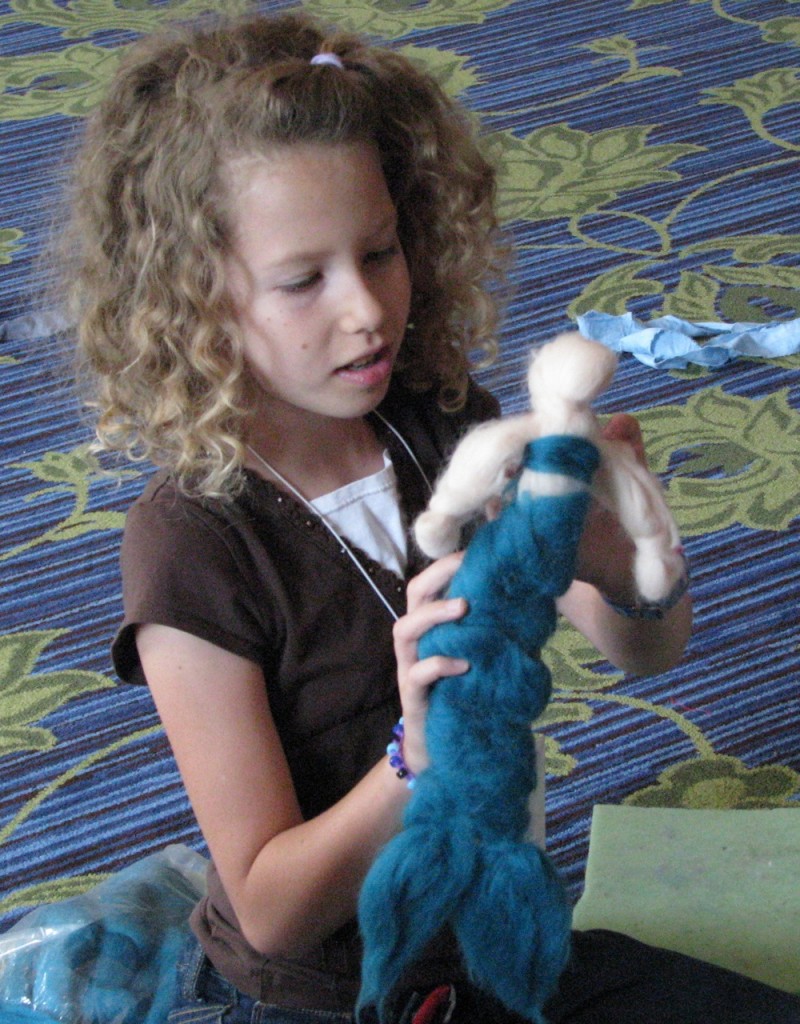
* needlefelting (Beanie learned how and made a lovely new friend)
* drop-spindle spinning (Jane learned how, so AT LONG LAST the spindle I bought for research when I was writing the first Martha book is seeing some use)
* painting and drawing (nearly everyone—there was a wonderful art room set up and you could go create to your heart’s content any time of day)
* “Rock Star Drama Camp” (Beanie attended this most excellent funshop led by the ebullient Amy Steinberg. Later, Amy flagged me down in the hall to tell me Bean’s a natural actress. No surprise to this proud mama who directed her as Feste in scenes from Twelfth Night last spring!)
That’s just a small sample. Flo Gascon, the conference organizer, did an amazing job of putting together a seamless, merry, stimulating weekend—and gracefully weathering the big excitement of the San Diego Blackout.
Some of the talks I attended:
“Zero Tuition College” by Blake Boles, about which I shall have MUCH TO SAY either here or at GeekMom. Fantastic talk. (Rose and Jane also went to a college pros and cons session moderated by Blake. Much food for discussion later.)
Updated: Here’s a link to Blake’s Zero Tuition College website.
“Artodidact” by Brenna McBroom, an inspiring young woman who described her decision to leave college and focus on her pottery with apprenticeships and mentorships. I loved this talk. So did Jane and Rose, especially Rose, who was captivated by Brenna’s pottery (we’d been oohing and ahhing over it in the conference lounge all day, and right before Brenna’s talk, Rose talked me into buying the lovely little pot I kept returning to over and over—I’m so glad I did) and is now burning to take a ceramics class herself. We’ve spent this morning looking at possibilities around town.
“Good Ideas and Bad Ideas” by Holly Dodd, daughter of Sandra Dodd. Holly shared some of her insights gleaned from visiting and/or nannying for many different families around the world.
“Unschooling Lifestyle Q & A”—four veteran unschooling parents answered audience questions. Most of the questions were parenting-focused, and to be honest I always feel a little outside that discussion when it’s from the radical unschooling end of the unschooling/alternative education continuum. I live at a different spot on that continuum and am happy with the way things work in our family. But this talk was lively and enjoyable, even if I didn’t agree with every point made. Heck, the panelists didn’t always agree with one another—that was part of the point, the reason organizer Flo Gascon had structured the panel the way she did: to give a range of viewpoints to common concerns.
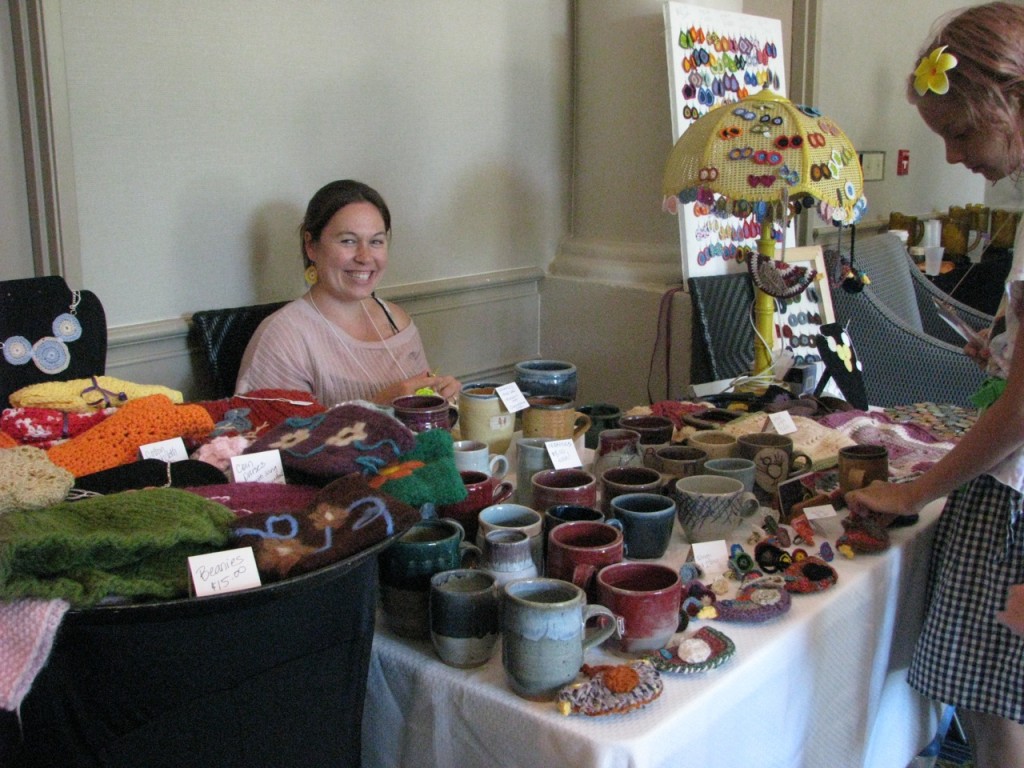
Of course the best part of any conference is meeting new people and reconnecting with friends. The hotel had provided a nice big sunny room as a lounge area, and there was always a lot bubbling there. People crafting and chatting, toddlers playing with the toys volunteers had pooled, artisans young and not-so-old selling their wares, and a great deal of laughter. Wonderful, wonderful.
Originally published in Februrary 2005.
 It’s been a rough morning. Our wagon tipped over while fording a river, and we lost fifty pounds of salt pork and our only shotgun. Then Rose took sick—cholera, we think—and died before we could do anything about it.
My girls are undaunted by this stunning double tragedy. They push on across the prairie, estimating the number of miles to the next fort. Maybe we can trade our mule for a new gun.
“At least we still have the fishing pole,” says Rose. She seems to have accepted her own death gracefully.
“I don’t like wattlesnakes,” announces Beanie.
Jane cracks up. “Who does? Remember when I got bit, back before we crossed the Platte?”
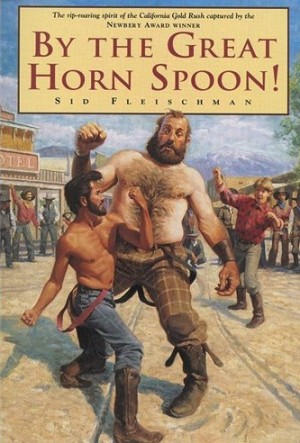
We found ourselves on the Oregon Trail by way of a great read-aloud, one that vaulted unexpectedly to the top of our Family Favorites list: By the Great Horn Spoon by Sid Fleischman. I began reading this hilarious novel to the girls on a cold winter afternoon, but after Scott got caught up in the story during a coffee break, it became a family dinnertime read-aloud. At times, the kids laughed so hard I feared they would choke. We sailed with young Jack and his unflappable butler, Praiseworthy, from Boston Harbor all the way around Cape Horn and up to San Francisco. Along the way we visited Rio de Janeiro and a village in Peru. We panned for gold in California and made friends with half a dozen scruffy, optimistic miners. We found ourselves caring deeply about such oddities as rotting potatoes, dusty hair clippings, and the lining of a coat.
Our westward journey has occurred at a fairly brisk speed. After Great Horn Spoon deposited us in the thick of the California Gold Rush, there was much conversation about the many reasons and ways in which people migrated west. Our trail led to other books: Moccasin Trail , Seven Alone
 , By the Great Horn Spoon!, and now Old Yeller
 . We discovered the absorbing Oregon Trail
 computer game and have outfitted a dozen or more separate wagons for various westward journeys. Rose got hooked on the food-gathering part of the game. I can’t tell you how many baskets of dandelions and wild onion she collected. Jane seems most interested in the game’s diary function. She clicked her way through the journal of the young pioneer girl who appears in the animated sequences at certain points along the trail, and then she began to write a trail journal of her own. The sad death of our sweet Rose, the disastrous river-crossing, and Beanie’s encounter with the rattlesnake are now chronicled for posterity.
I don’t know what lies around the next bend in the trail. I’ve stopped trying to pave the road ahead of time. The best adventures, it seems, are to be found in the bumps and detours. We’re well outfitted for the journey with books and maps and eyes and ears and that burning appetite for knowledge that can make a hearty meal out of buffalo grass and brambles.
—Excerpted from an article appearing in the Virginia Homeschoolers newsletter.
Particularly Cool Stuff My Kids and I Have Learned a Ton From or Just Plain Had a Good Time With:
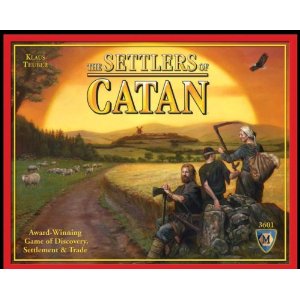
Settlers of Catan , the board game. Jane got this for Christmas last year. We’ve been obsessed ever since. Except when our friends hijack it and keep it for weeks because it is that great a game.
Signing Time DVDs. Catchy songs, immensely useful vocabulary in American Sign Language. I trumpet these wherever I go. We talk about Rachel like she’s one of the family.
Prismacolor colored pencils. Indispensable. I was amused to see that Jane mentioned them in the first line of her “I Am From” poem. She’s right; they have helped color the picture of her life.
Uncle Josh’s Outline Map CD-Rom. Because maps are cool, and maps you can color (with Prismacolor pencils, hey!) are even cooler. The kids are constantly asking me to print out a map of somewhere or other. You can find other outline maps available online (for free), but I like Josh’s for clarity. And once when I had a problem opening a particular map (it’s a PDF file), I called the help number and it was Uncle Josh himself, a most amiable gentleman, who quickly solved my problem.
The Global Puzzle. Big! Very big! Will take over your dinner table! (So clear off that laundry.)
Set. It may annoy you that your eight-year-old will be quicker at spotting the patterns in this card game than you will. There’s a free daily online version as well.
Quiddler. Like Scrabble, only with cards. This, too, can be played online.
Babble. Like Boggle, only online and free.
Chronology, the game. Like Trivial Pursuit, only with history.
Speaking of online games: the BBC History Game site is awfully fun.
And Jane was fairly addicted to Absurd Math for a while there. Need more free math puzzles? Nick’s got a bunch.
A Case of Red Herrings and Mind Benders. Logic and problem-solving puzzles: a fun way to pass the time on long car trips or in waiting rooms.
Zoombinis Logical Journey computer game and sequels. Stretch your brain trying to get the little Zoombinis to a village where they can bounce in peace.
Oregon Trail. The game that launched a massive wagon trail rabbit trail for my kids a couple of years ago—and they still aren’t tired of the game. (Now there’s a Wii version, too!)
Roots, Shoots, Buckets & Boots : Gardening Together with Children. Plant a sunflower house! Up-end a Giant Bucket of Potatoes and dig through the dirt for your rewards! Grow lettuce in rainboots! Boots! With lettuce growing in them!
Wild Goose Science Kits. Fun experiments with a low mess factor. Note to self: remember the Wild Goose Crime Kit come Christmastime. (Sadly, these are no longer available. Wild Science offers similar kits.)
A microscope. Sonlight sells a nifty set of prepared slides with paramecium and other fun stuff for the kids to peer at.
If the scope sparks an interest in dissection, there’s a way to do it online with no actual innards involved: Froguts! The site has a couple of free demos to occupy you while you save up for the full version. (Which I haven’t seen yet, but it does look cool.) HT: Karen Edmisten.
Klutz Books. Over the years, we’ve explored: knitting, embroidery, origami, magic, Sculpey, paper collage, paper dolls, beadlings, and foam shapes. Look under any piece of furniture in my house and you will find remnants of all of the above.
Which reminds me: Sculpey polymer clay. Is it possible to get through a day without some? My children think not.
Usborne’s calligraphy book and a set of markers.
But while I’m on Usborne, my kids also love and use at least weekly: Usborne Science Experiments Volumes 1, 2, and 3.
Muse magazine. The highlight of Jane’s month. From the publishers of Cricket. We also like Odyssey, Click, and Ask.
Classical Kids CDs. Beanie’s favorite is Vivaldi’s Ring of Mystery.
Refrigerator poetry magnets. I gave Scott the Shakespearean set a couple of Christmases ago. Note to self: You are not as brilliant as you think! You were an English major, for Pete’s sake, with a minor in drama. Thou knowest full well old William was a bawdy fellow. If you don’t want your little ones writing poems about codpieces, stick to the basic version. But oh how I enjoy the messages Scott leaves for me to find and then pretends he doesn’t know who wrote them:
I am
so
in love
with my
delicate
wench.
And of course of course of course, Jim Weiss story CDs. I rave about these every chance I get because they have added such riches to my children’s imaginations. For years, they have listened to Jim’s stories after lights-out. Greek myths, Sherlock Holmes, Shakespeare, folk and fairy tales, the Arabian Nights, the Jungle Book: of such stuff are dreams woven.
Check out my Giant List of Book Recommendations too!
Originally posted March 28, 2005
 Yesterday my kids pulled out a CD we used to listen to all the time: the soundtrack to Snoopy: The Musical
 . This was a play I loved as a teenager, when it was performed by some friends at a different high school. I had a crackly tape recording of a dress rehearsal which my sisters and I listened to ad nauseum. We had, after all, outgrown the soundtrack to Annie by then, and I had yet to discover the melodramatic satisfaction that is Les Miz.
So when Jane was five or six and I, for no particular reason, found myself humming one of the dear old Snoopy songs, I hunted around online and found a recording. Ah, the bliss of Google! My tiny girls loved the album, as I knew they would. A singing dog! A boy named Linus! A squeaky-voiced Sally belting out tongue-twisters!
Later, as the girls grew, they connected to Snoopy on different terms. One of our favorite songs on the album, “Clouds,” is like a theme song for homeschoolers. Charlie Brown and the gang are lying around looking at the sky, and someone asks Charlie Brown what he sees in the clouds.
“I see a—” he begins, but Sally cuts him off to sing that she sees: “A mermaid riding on a unicorn.” Peppermint Patty sees “an angel blowing on a big long horn.” Linus, ever my favorite, is a visionary. “I see Goliath, half a mile tall, waving at me….what do you see?”
Poor Charlie Brown. How can he get an answer in edgewise? Lucy sees a team of fifty milk-white horses; Patty sees a dinosaur; Linus sees Prometheus, waving; Snoopy, grandiose as always, sees the Civil War. The entire Civil War.
You could spend a year rabbit-trailing your way through this song. The Peanuts kids know their history, I’ll give ’em that. (Although they seem to hit a bit of a roadblock when it comes to a certain American poet/storyteller, as evinced by their poor classroom performance in the hilarous song “Edgar Allen Poe,” elsewhere on the album.) When these kids gaze at the clouds, they see Caesar crossing the Rubicon, the Fall of Rome, and even all twelve apostles, waving at Linus.
Linus: “The Pyramid of Khufu!”
Sally: “You too?”
All but Charlie Brown: “Seven Wonders of the World…”
For our family, this is a song of reciprocal delights. Some of these cloud-tableaux are historical events the girls already knew about, and the idea of Snoopy beholding an entire war sculpted in cumulus is irresistibly funny. Some events are things my kids first encountered in the song. When, years later, we read about the Rubicon in A Child’s History of the World , there were gasps of delighted recognition from everyone including the then-two-year-old. Click, another connection is made.
So I was happy to hear the Peanuts gang belting away once more yesterday afternoon. It has been a couple of years since last they regaled us with their splendid visions. The girls have encountered more of the world, more of the past, and so they have more to connect with in the lyrics of Charlie Brown’s imaginative friends.
As for Charles, alas. The gang, having at long last exhausted the gamut of grand happenings to see in the heavens, demand of Charlie, “Well, what do you see?”
Says Charlie, glumly (and you probably remember the punchline from the Sunday funnies when you were a kid): “I was going to say a horsie and a ducky, but I changed my mind.”
(Cue hysterical laughter from little girls. Every. Single. Time.)
Shaun wrote:
Just don’t take this the wrong way: you make it sound so easy. Lay the right books around the house, throw in a little yarn and cool background music, and away you go! I know it can’t be so simple all the time.
I thought about this all day, and I realized that this really is the easiest thing I do. If I am alert and open for conversation, present and mindful in the way Leonie has been describing, the connections happen like fireworks, pop pop pop pop pop all around us.
That post wasn’t meant to be a blow-by-blow account of our day. I had just finished jotting down notes about the cool things we talked about that day, as I try to do most days, for my own enjoyment really, and I thought it might be fun to flesh out the notes a little over here. But there were lots of things that happened yesterday that didn’t make it into my little connections list, and not all of them were easy. One of the kids had a particularly rough afternoon. By the end of the day I was a shriveled husk of a person, and Scott probably read desperation in my eyes when he walked through the door. His jovial hustling of the kids outside to run races is undoubtedly what saved me from blowing my calm-and-patient streak. (Owe you one, honey.)
So my goodness, please don’t read that post as an account of a perfect day. It’s the account of some awesome moments in a pretty typical day. I am suddenly reminded of a conversation I had with Alice not long after I made the cross-country drive to San Diego alone with my kids. Alice was in the planning stages for her upcoming Golden Gate adventure, and she was trying to decide whether to drive or fly to San Francisco. “Seriously,” she asked me, “how bad was it?”
I replied, “No worse than any regular day at home.”
I still remember her peal of laughter: she saw at once what I meant. Any day at home in the company of many small children is full of challenges. There are great moments, and there are moments when the sound and fury threatens to swallow your sanity. I love this life, this stay-at-home mom stuff. I’m grateful to be able to do it. But there’s no denying it’s a bumpy ride at times. My toddler has decided she is morally opposed to sitting in her carseat. She has no choice, but every journey begins with an outraged protest. My four-year-old falls apart if I put my keys on the counter instead of in my purse. My introverted nine-year-old would love nothing more than to be at home all the time, but she is sandwiched between sisters who bubble over with eagerness to Go and Do. We compromise, we bend, we go up, we go down. Every day has its moments. Gorgeous moments, and moments of the sort that make a 2500 mile road trip seem like a walk in the park.
But the connections moments? Apart from the difficulty of climbing out of my own head and being alert and present for those around me, this really is the easiest part of my life.
In our CM days, I used to keep rough daily lists of the books we read, lessons we did, games we played, “big ideas” we discussed, connections we made. The latter two categories were my favorite things to record, and I still keep notes about those. Sometimes here, sometimes in my notebook, sometimes at the old daily notes blog. I love to look back and marvel at all the places my children have taken me, figuratively speaking.
Today Wonderboy had speech therapy, and as the rest of us waited in the car we got into a lively discussion about perseverance and self-motivation. I’d mentioned a blog post I’d read that said kids don’t possess innate fortitude and need their parents to provide external motivation for pushing through challenging tasks, the parents providing backbone the kids themselves don’t have yet. Jane said, “But Mom! Remember in Eight Cousins when Aunt Clara wants Rose to wear a corset? And Uncle Alec gets mad and says that the custom of putting even babies in stiffened waists makes them grow up with weak backs?” Her mind had made a leap because of the backbone metaphor, and it was great to see how she analyzed the comparison and expanded upon it. “If someone is being your backbone for you, I don’t see where perseverance comes in.” Which is interesting, because that’s the same thing I’d thought when I read the post, but I hadn’t told her that. Sticking at a task because someone is making you would seem to require more obedience than perseverance.
We talked about external motivation vs. internal motivation, and people who succeeded at difficult endeavors through their own determination and persistence. She gave me a short history of Andrew Johnson, about whose pre-presidential life I knew nothing until today. It seems he was well past ten before he learned to read, and not until age 18 did he learn to write and cipher.
Me: How do you know all this?
Jane: From So You Want to Be President, of course.
That was one of Scott’s daddy-book picks a few years ago. He gives each kid a picture book for Christmas and birthdays. I should do a series of posts about those, one of these days. He finds the most interesting books.
In the parking lot outside speech, we saw what looked remarkably like a pair of Eastern bluebirds. They can’t have been, not in San Diego. We looked up blue birds (not bluebirds) in our Western Birds field guide back at home, but nothing we found looked right. So there’s a mystery we need to solve.
Rose wanted me to read the origin story of comic-book hero Adam Strange. Seems he was an archaeologist who discovered a hidden city of the Incas, including a vast treasure which had been intended for the ransom of the Inca emporer, Atahualpa, who was captured (and eventually killed) by Pizarro. Just as Adam Strange is about to be clobbered by the secret city’s protectors, he happens into a stray space-ray that teleports him to a planet in the Alpha Centauri system. Much sci-fi superhero action ensues. The girls had some wry commentary on certain gaping plot-holes, but they are great fans of Adam Strange nonetheless.
Jane asked me to do some of the puzzles in her Mensa Mind Puzzle book with her. This is a big fat book of brainteasers my father gave her. She adores it with the intensity of an Alpha Centauri space-ray. We sat on the couch together and worked on a couple of pages’ worth of puzzles. We’re both good at the number/logic ones and the word puzzles, but when it comes to the visual pattern solving games, I’m sunk. She’s very quick at those. My brain goes all fuzzy. We talked about Howard Gardner’s multiple intelligences theory and visual/spatial intelligence vs. logic/mathematics intelligence vs. linguistic intelligence, and others.
Scott sent us this link, and we watched, and gasped, and realized, and laughed.
Toward the end of the afternoon, things fell apart a little. Squabbles broke out; I got tired. Beanie thought it would be nice to lie down together while she read me riddles from The Book of Think. She was right.
When Scott came home from work, he had all the kids out in the backyard running wind sprints. They were writing down their times and when they came in, the girls made a chart. Scott put on some David Bowie and I heard him quizzing the baby: “Who’s this?”
“Bow Ee!” She’s at that age where every syllable is its own word.
“That’s my girl.”
Now the little ones are asleep and Scott is reading Harry Potter to Rose. When last I saw Jane, she was crocheting while listening to something on her Walkman. Beanie is reading Adam Strange. I need to go sweep the kitchen floor.
I just spent all my posting time writing another really long comment in the patience/unschooling thread. Is it cheating if I post it here as well? (Cheating what, Lissa?)
Maybe not cheating, but nepotism perhaps. (Can nepotism apply to one’s own self?) There have been so many good, wise comments on that post, and I keep pulling excerpts to paste into a post—two posts, one on parenting and one on learning/unschooling—but the posts would be almost as long as that comments thread. Besides, excerpts are not as good as whole comments, in context.
This comment was a reply to one of many questions asked in that thread.
Wendy asked,
“Does unschooling mean we give equal weight to everything our children are interested in? For example, is reading a Star Wars novel (which my 10yods is now doing, aloud, for his 8yo brother) just as valuable as reading, say, Scotland’s Story? I know I must be missing something, but it seems like relativism to me to say that it is.”
That depends on what you mean by valuable, and by relativism. Relativism in this context sounds bad, like moral relativism. (You can tell I’m not a moral relativist because I think moral relativism is bad.) But I don’t see how it could be moral relativism to say “this bit of knowledge is just as valuable as that bit of knowledge.” Valuable for what purpose? In what context? Here are some things of value I see in a boy reading Star Wars aloud to his brother:
learning to read with inflection (useful in many professions)
gaining deeper understanding of dialogue including how to punctuate it, how conversations unfold
deeper understanding of pacing, rising action/falling action, conflict, character development, description, subplots, metaphor and imagery (all very valuable in my particular profession!)
deepening of bond between brothers; warm happy memory for them, shared knowledge for games and in-jokes
experiencing the good feeling of doing something nice for someone, discovering the joy of charitable acts
science stuff about space, planets, gravity, engines, weapons, etc
Star Wars usually conveys a message that is decidedly NOT moral relativism: good is good, evil is evil; good fights evil (and prevails: hopeful message); it’s not ok for a good guy to do something bad even if he has a good reason (ends do not justify means); even the worst of bad guys can repent and try to make amends
other Star Warsy themes are the importance of working as a team, playing off each other’s strengths; perseverance; sacrifice
And probably a lot of other things I’m not thinking of.
Of course, it doesn’t have to be either/or with Star Wars and the Story of Scotland (not that Wendy was saying it did; I’m just developing a thought)—both books might capture a kid’s interest at different times, or at the same time. Jane had a three-year Boxcar Children passion; she read that series so many times she could identify all 100+ titles by number. At the same time she was reading lots of books from the classics lists. If there wasn’t something valuable about formula fiction, there wouldn’t BE formula fiction. No one would buy it; it wouldn’t get published (by the millions). There is something deeply satisfying about reading a story that unfolds in a reliable way. It’s comforting, but it can be exciting, too, knowing that the next twist is due and making guesses about the plot, puzzling out the mystery or solution to the conflict.
And in a way it’s impossible to put a value on knowledge because you don’t KNOW what you’re going to need to know in the future. (If you don’t know it already, and a pressing need arises, you’re going to learn in a hurry. I knew next to nothing about the War of 1812 when I was offered the Charlotte books. The first book was set in the middle of the war, and I had four months to write it. And historical accuracy was imperative both to the publisher and to my sense of integrity. So you can bet I took in an enormous amount of knowledge at a rapid pace!)
I think it is so, so hard for all of us who were schooled to break down the boxes that school put knowledge into. School has to decide what information to present when, and to whom. It says “this is important for all people of X age to know.” (But though it can present the information, it can’t guarantee that all the students will wind up “knowing” it.) School says that certain knowledge is more valuable than other knowledge. But you know what? Knowing how to fix a toilet would have saved me a lot of money, but school never presented *that* potentially valuable knowledge. I can draw really pretty circles with a compass, though. I’ve had more plumbing problems in my life than occasions requiring perfectly round circles.
In typing class I learned to put two spaces after every period. That was a valuable piece of information when I took timed typing tests for temp agencies during college. Later, when employers needed word processors instead of typists, I had to “unlearn” that habit. Only one space after a period, in computer typing. Knowledge that formerly had value became disadvantageous. Circumstances change.
The value of knowledge *is* relative, isn’t it? “Is this important” depends on “for what?”
That isn’t the bad kind of relativism, moral relativism. It’s practicality.
I place a very high value on beautiful prose and well-crafted fiction. I value some types of poetry (Elizabeth Bishop) over others (Hallmark greeting card). Hallmark sells millions more greeting cards than Elizabeth Bishop sold books. And yet, I say her work is “better” (a relative judgment) than a Hallmark card. I say it, and I believe it, and I can tell you why, syllable by syllable. But it’s possible that my grandma (if I still had one living, that is) would be far more moved by the sentimental lines on her birthday card than Elizabeth Bishop’s rapturous meditation upon a very ugly fish.
Another way to think about it is: who is learning more—the kid who is passionately interested in Boxcar Children, or the one who is patiently enduring Great Expectations?
(That same child might, however, find herself captivated by Great Expectations a few years later—her appreciation of suspense fiction having been honed by dozens of Boxcar Children books.)
Charles Dickens knew the “value” of words—he got paid by the word. When he read his own work aloud, he stripped out most of the adjectives; he’d just put them in to pay the bills.
We (having been well schooled) might say that classical music and opera are “more important” or “better than” cartoons. But most of the kids in my generation first (and maybe only) encountered opera in the cartoons. Ohh Bwunhiwda, you’re so wuv-wy…Yes I know it, I can’t he-e-elp it… 🙂
My kids discovered Strauss through Tom & Jerry. I discovered Strauss through That’s Entertainment!
To come back to the question: do we give equal weight to everything our children are interested in? I think yes, we do. School has to decide what to present how, and in what way, but at home, we don’t. We aren’t bound by a calendar year or test date. We don’t have to squeeze knowledge into someone else’s boxes. Way leads on to way!
I’ve been thinking through some things in emails (and offline) lately, and I wanted to bring some of those thoughts here. It has to do with patience, a good kind and a bad kind, and their relationship to happiness and learning, especially unschooling.
My children think I’m a pretty swell mom, but they know all too well that I have my faults. If you asked them, they would say (if they weren’t too loyal to rat on me) that my greatest fault is impatience. They’d be right, at least as far as my relationship with the kids is concerned. Impatience comes from frustration, (or does it lead to frustration?), and I think we all know that what spills over from an impatient person’s frustration is scolding, or nagging, or sharp words. Impatience is what you feel when people aren’t doing what you want them to do: it’s a frustrated desire for control.
When Jane was two years old, in the hospital fighting leukemia, people used to constantly compliment me for my patience. Other parents, nurses, doctors—I heard it from many people and it always puzzled me. I didn’t feel ‘patient,’ not in any virtuous sense. What I felt was a keen awareness that my days with this child might possibly be numbered, and I didn’t want to lose a single one of them to a bad mood. I wanted to savor every moment with my baby girl, in case I didn’t have many moments left to savor. So I gladly, gratefully, spent hours playing playdough with her, or giving her i.v. pole rides in the hallways, or holding her while she slept. You don’t need ‘patience’ to live through moments like that.
And through the years, I’ve held on to that sense of ‘savor this moment because it is precious’ with my kids. But I cannot deny that as the years passed, and as more children joined the party, impatience elbowed its way into my heart, my words, my actions. I can almost pinpoint the moment I changed, or at least the moment impatience boiled over into sharpness. Rose was three years old, and Beanie was a baby; we were at a lake beach near our home in Virginia, and I got stuck. Stuck trying to leave the beach, with an unhappy, sandy Bean crying on my hip and a bag slipping off my shoulder, and an intractible Rose straining to pull away from me, her heels digging into the wet sand, wavelets lapping at our ankles. We needed to leave. Jane was already halfway to the parking lot (and too young to be there alone). I couldn’t put the baby down without getting her wet (again), and I was out of diapers. Rose refused to budge. I felt helpless, completely held hostage by a stubborn toddler. I had to scoop her up under one arm like a football and carry her, screaming and squirming, back to the car.
I say “had to,” but I’m sure I had other options. It didn’t seem like it at the time. We were there with friends—the dad friend would, in later years, recall that episode with glee, the day he “saw Lissa lose it.” Why I didn’t holler to him to stop grinning and pick up Rose, I don’t remember. I am quite certain that either of the mom friends who were present would have been happy to help. They probably offered to, but what I remember about the moment is that sense of helplessness and frustration.
Moms of small children can run into that feeling often. What it is, really, is a feeling of being out of control. Loss of control is scary. I dealt with it well when the loss of control was due to illness, something out of any human being’s power to alter. But ah, it’s when a person, or people, especially small people who are “supposed” to obey their mama, are flouting my attempts to control—that‘s when impatience comes in.
People who try to control other people often find themselves feeling impatient, or worse. The reason mothers (to single out one kind of person) scold or fuss or nag or criticize their children is because they are trying to bring a situation back under control—that is, to make things go the way the mom wants them to go.
When I had three or four children each wanting to go a different direction, that’s when I got impatient. That’s when I became a mom who scolds. That’s when I stopped savoring every moment, only selected moments.
That’s when I started to wonder what had happened to the patient mommy I used to be. I used to be so patient—I would think that all the time, forgetting that in the days when people remarked upon my patience, I hadn’t felt like patience came into the equation at all.
I think when we talk about patience in terms of a quality we don’t feel like we possess (“I used to be so patient”), we are talking about a kind of patience that isn’t really a virtue at all. That kind of patience is about enduring the present moment until a better one comes along. It’s a gritting-one’s-teeth-and-getting-through-it state of mind.
It’s how many of us endured countless hours of our lives in school. The kids who didn’t patiently endure were the ones labeled troublemakers. Patient endurance is how most people get through hours in line at the DMV, or (to poke my own self here) the interminable waits in doctor’s offices. There is no moment-savoring going on in that kind of patience. In fact, often ‘being patient’ really just means ‘being quiet and not making a fuss’ while resentment or irritation is churning underneath.
I think the reason people tend to be less patient with their children is because they can in fact exert some external control over the children—as opposed to the doctors who keep us waiting, or the complicated beaucratic systems directing the flow of traffic at the DMV.
But “exerting control” by nagging, scolding, lecturing, ordering in a drill-sergeant’s bark—these are actions that, sooner or later, will do harm to a relationship. Nobody likes being nagged, scolded, or lectured ‘for their own good.’ I sure don’t like it, I know that much. It’s a complete violation of the Golden Rule, isn’t it? Treating children the way we’d like to be treated if we were in their shoes means finding other ways of dealing with those out-of-control moments.
I think for me, the shift back toward a better way began when I drove the kids from Virginia to California by myself. Rilla was six months old, Wonderboy three. Scott had already started his job out here, and he would have flown back to drive with us but I talked him out of it. If he came along, we’d be on the clock; he could only take so much time off work. If I drove alone, we could amble, stopping as often and as long as the kids needed to—which turned out to be very, very often. I had to abandon myself to the flow of the trip: letting go of the desire to control every move we made. We wound up having a wonderful time, the six of us, and I think a big part of the reason is because that 2700-mile journey was about taking each moment as it came. They were moments worth savoring, and savor them I did.
Not that there weren’t some bumps in the road. There were (are) still five children, not all of them always wanting the same thing. But I found that being mindful of the difference between ‘taking care of’ and ‘controlling’ (or trying to control), and being determined to appreciate the present moment, not just try to to ‘get through’ it—those attitudes eliminate impatience. Really. And then the bumps in the road become part of the grand adventure, challenges to be tackled, puzzles to be solved. It’s so much more satisfying to be creative and fun than to be frustrated and stern.
There is another kind of patience, a good kind. It’s the quality that allows a mother with ten places to put every minute to sit in the driveway drawing chalk figures for her toddler, or blow bubbles until the whole bottle is gone, or take half an hour to walk down the block, admiring every dandelion and ant that catches her little one’s eye. It’s the patience that plays a game of Monopoly with an eight-year-old until every last dollar is in someone’s pile, the kind that listens with interest to a detailed recounting of the latest phone-book-sized Teen Titans collection. That kind of patience isn’t about enduring the present moment until a better one comes along. It’s about enjoying the present moment for exactly what it is, with gusto and gratitude.
There’s “patience in suffering,” too, of course, and while perhaps that kind isn’t about enjoying the present (painful or sorrowful) moment, it too involves a willingness to accept the present moment for what it is. People who are patient in suffering tend to be people overflowing with gratitude for all the other things in their lives besides suffering. This is a very great virtue, and I think it grows out of the peaceful sense of appreciation for what is, now, as opposed to a longing for something different, something better: it’s the good kind of patience all grown up.
Anyway, I’ve been thinking about all this in conjunction with unschooling, which is a whole way of living that embraces the present moment, rejoices in what is good about it. Unschooling says: this day, this encounter, this connection of ideas, this moment between us—this is very, very good. Unschooling begins with a dismissal of the kind of experiences that a child must “patiently endure” in order to be “educated,” but it is more than that, more than a rejection of one way of being. Unschoolers see everything in the whole wide world as interesting, connected, something they can learn about. (Scroll halfway down at the link and you’ll see why I linked that page in particular, though the whole site speaks to the point.) Instead of patiently (or impatiently) enduring the long wait at the DMV, an unschooler might look around, notice things, think about them, wonder how and why. Why are all the people sitting in the back two rows in this waiting area, but are scattered among all the rows in that bank of seats over there? What kinds of jobs do the people waiting in line have, and was it hard for them to get time off to spend a weekday morning here? When did the old cameras get dumped in favor of digital cameras? Why are the walls a glaring white instead of something soft and soothing like in doctors’ offices? What is the ratio of DMV employees to customers? Is customer the right word for a person in line at the DMV?
Of course I’m not saying that unschoolers are the only people who approach life this way. Harvard professor John Stilgoe, the author of that book I’m still reading: he gets it. He sees what’s interesting in power lines and telephone poles and manhole covers. He has made these things interesting to me. Reading that book is making visible—even beautiful—all sorts of things that were ugly or invisible to me before. The other day I looked out my windshield sideways down a street and saw, for the first time in my life, how the rows of of drooping wires made a spiderweb against the sky: lacy, delicate, lovely.
It reminded me of Philip Isaacson’s book Round Buildings, Square Buildings, Buildings that Wiggle like a Fish, which showed me ways of looking at buildings that made every building interesting to me, made me see the artistry and story of the Brooklyn Bridge, the white clapboard church, the green glass skyscraper.
I’ll never forget reading, in college, Betty Edwards’s Drawing on the Right Side of the Brain, and how one of her students said that after taking Betty’s drawing class and working on portraits, every face she looked at seemed beautiful to her. The drawing lessons taught her to really look at people, and when she did, she saw beauty everywhere.
I know I’m going all over the place here, but in my mind these things are all connected: this way of really looking, really seeing, noticing what is interesting and important and even beautiful about things many people whisk by without noticing. And what I can do for my children is refuse to fill up their lives with things they must patiently endure until a better moment comes. I can savor the moments as they happen, and give them the time and space to find what’s interesting and beautiful in every face the world shows them.
As I was writing that last sentence, Beanie appeared in front of me with a big smile and a present: a bracelet made of safety pins linked together, each pin shining with green and blue beads. “It’s for you, Mommy,” she breathed, so proud and excited. “Jane showed me how.” How patiently (the good kind of patience) she must have worked to slide all those beads in place.
I never noticed before what a work of art a safety pin is!
The other day I posted a link to this article about Harvard professor John R. Stilgoe. The article made me want to read his book, Outside Lies Magic: Regaining History and Awareness in Everyday Places . I’m only a chapter in, and already I can tell this is going to be one of those books I have to post a lot about as I’m reading it. It’s transformative.
Some quotes:
[Regarding his courses at Harvard]
“…I refuse to provide a schedule of topics. Undergraduate and graduate students alike love schedules, love knowing the order of subjects and the satisfaction of ticking off one line after another, class after class, week after week. Confronted by a professor who explains that schedules produce a desire, sometimes an obsession, to “get through the material,” they grow uneasy. They like to get through the material.
“I explain that the lack of a topic schedule encourages all of us to explore a bit, to answer questions that arise in class or office hours, to follow leads we discover while studying something else. Each of the courses, I explain patiently, really concerns exploration, and exploration happens best by accident, by letting way lead on to way, not by following a schedule down a track.
“My students resist the lack of topic structure because they are the children of structured learning and structured entertainment. Over and over I explain that if they are afraid of a course on exploring, they may never have the confidence to go exploring on their own.”
(snip)
“Learning to look around sparks curiosity, encourages serendipity. Amazing connections get made that way; questions are raised—and sometimes answered—that never would be otherwise. Any explorer sees things that reward not just a bit of scrutiny but a bit of thought, sometimes a lot of thought over years. Put the things in spatial context or arrange them in time, and they acquire value immediately.”
This is exactly what I’ve enthused about when I write about the connections my kids have made—I get so excited about it; it amazes me to see what they put together in their minds, and where the subsequent discussion takes us. It’s how I learn best, and live best, too.
In a post a while back I quoted Sandra Dodd on connections:
“Learning comes from connecting something new to what you’ve already thought or known.”
She has a connections page on her website (well worth your time to explore). At the top is a quote from Heraclitus, circa 500 B.C.:
A wonderful harmony arises from joining together the seemingly unconnected.
Yesterday, perched in that tree outside the library, Beanie looked at a sign on a church across the street and said, “Mom! The Black Douglas!”
The sign said “E. Douglas.” It reminded her of the story of The Black Douglas (a Scottish hero) that we read in James Baldwin’s book Fifty Famous Stories Retold. She giggled and said the sign should say “B. Douglas.”
The Baldwin book is a great one for connections. When we see rocks poking up from beneath the waves out at sea, Bean calls out, “The Inchcape Rock!” We have a whole long-running family joke spinning off King Alfred and the cakes he burned while daydreaming military strategy. The joke kind of blurs into my kids’ very, very favorite Gunther children quote, uttered by a young Margaret at dinner one night: “Mommy, my burnt corn is cold!”
(One of the many reasons I adore Alice. She’s my kind of cook.)
Last weekend the girls were watching a Tom and Jerry cartoon. Tom was conducting an orchestra in the Hollywood Bowl (and beating down an eager Jerry who wanted to help). Jane wanted to know what the music was. I thought it sounded like Strauss, but I wasn’t sure, so I (what else) Googled it. Sure enough: it’s the overture from Die Fledermaus. We looked it up on Wikipedia and read about the opera, and we watched the overture on YouTube. Which led to viewing other songs, mostly sung by the famous coloratura Edita Gruberova, who is famous for her Adele in Fledermaus and who also played the Queen of the Night in Mozart’s Magic Flute, which (if you want another Alice connection) is the song my cell phone plays when she calls me because it always reminds me of her daughter Theresa singing the aria around the house. And from there way led on to many other ways, and these connections will keep popping up in years to come, linking to something else.
Oh, I just remembered writing about this years ago, how I love that we call it “linking” when a topic on one web page connects to a page somewhere else.
“Way leads on to way,” of course, is a quote from “The Road Less Traveled.” But unlike Frost’s traveller, who, “knowing how way leads on to way,” doubts life will ever bring him back to this crossroads in the wood where he has chosen to take the less traveled path, the paths unfolding before our connections can and will be revisited and explored endlessly, in different ways, all through our lives. And like the paths in the wood, where wind and light and leaves and wildlife are always altering the landscape so that the path changes from hour to hour, our mental landmarks are changed and built upon and nuanced every time we revisit them.
Another funny connection: I had read much of the first chapter of Outside Lies Magic to Jane yesterday—it’s one of those books you just can’t keep to yourself—including the parts quoted above about Stilgoe’s students being uncomfortable working without a clearly defined linear schedule. This morning I asked Beanie to do a job for me, and I was explaining it step by step— overexplaining, evidently, because Jane laughed and said, “Gosh, Mom, it’s like you think she’s a Harvard student.” Heh.
“Exploration,” says John Stilgoe,
“is a liberal art, because it is an art that liberates, that frees, that opens away from narrowness. And it is fun.”
Yes: it is so, so much fun, and that is why I write these posts all chattery with excitement over this or that connection the kids made today. (Or that I made myself!) I know I get carried away, but that’s the point, isn’t it, that way leading on to way has carried me away? And yet—and yet—I think we are at once ‘carried away’ and made more fully present in the now, more rooted, by these relationships between ideas about things past and future. The joy of connection makes me want to celebrate this moment, this brief encounter with wild-haired child and broad-trunked tree, bus going by, sign on church wall, Scottish warlord creeping over the tower wall and startling the English soldier’s wife who has just put her babe in arms to sleep by crooning that the Black Douglas won’t get him. Child, laughing, shouting “Dinna ye be sae sure aboot that!” across the courtyard outside the library. How can I not celebrate this freedom?